Upbit's trading volume rose 273 percent in the wake of the recent Bitcoin rally. Within 24 hours, the South Korean crypto exchange handled USD 1.84 billion, its highest daily volume since mid-March 2026.
Upbit is South Korea's largest crypto exchange and belongs to operator Dunamu. On the platform, investors swap the local currency, the won, for cryptocurrencies. Most recently, Upbit handled almost twice the volume of Bithumb. Before that, a bear market had pushed Bitcoin from around USD 90,000 down to USD 60,000. That decline had run since early 2026. At the same time, the benchmark KOSPI index nearly doubled in the first half. The semiconductor boom at Samsung Electronics and SK Hynix drove that rise. Korean capital therefore flowed into equities instead of tokens. Now part of it is coming back. On Upbit, XRP led the ranking with USD 418.9 million. Bithumb, the country's number two, also reported a gain of 132.9 percent.
XRP leads the trading volume rally at Upbit and Bithumb
At USD 1.84 billion in 24 hours, Upbit reached its highest daily turnover since mid-March 2026. The figure comes close to four times the previous day. XRP led the activity and accounted for USD 418.9 million on its own. Bitcoin, the stablecoin USDT and Ether followed. The ranking stands out, because an altcoin rather than Bitcoin delivered the largest single share of turnover.
Bithumb, the country's number two by volume, posted a gain of 132.9 percent to USD 934.9 million. XRP also topped the list of most traded assets there. However, the increase reached only half the strength of Upbit's. Together, the two exchanges thus handled almost USD 2.8 billion in a single day.
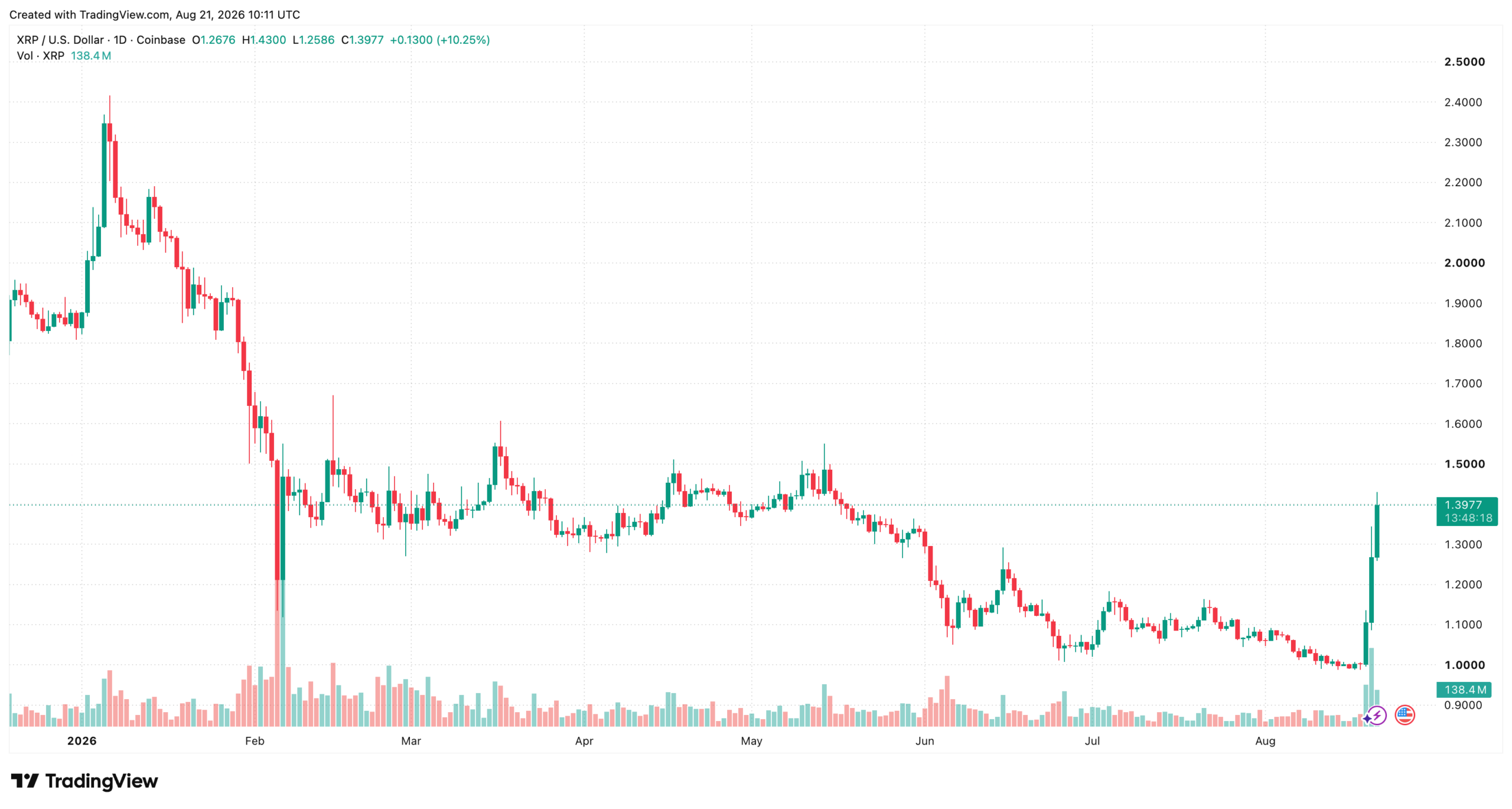
The price moves match this ranking. Bitcoin traded at around USD 77,700 and thus 13.2 percent higher than 24 hours earlier. Ether added a comparatively moderate 8.4 percent, to about USD 2,387. XRP, in contrast, jumped 25.2 percent to USD 1.37. Korean volume therefore concentrated on the asset with the strongest daily gain. A single altcoin accounted for a good fifth of Upbit's turnover.
The impulse for the Bitcoin rally came from Washington
The recovery did not start in Seoul. The expanded announcement by the US Treasury on buybacks of its own bonds counts as the trigger. In such a buyback, the Treasury takes outstanding paper off the market and replaces it with new issuance. Markets read these operations as a signal for additional liquidity, and risky assets usually benefit first. Bitcoin then gained sharply within two trading days.
Only afterwards did the Korean exchanges react. For investors in South Korea, the impulse also met a changed environment. Since late June, the domestic equity market has swung more widely. Many still kept their focus on the semiconductor rally.
The volume jump at Upbit is therefore the result of a global move, not its origin. A Korean volume jump without a preceding global impulse would instead signal demand of its own. The current increase shows investors following a rally that is already running. Consequently, markets outside South Korea will decide how far the effect carries.



South Korea's crypto exchanges lost ground during the KOSPI boom
The return meets exchanges that have just reported a weak half-year. Upbit operator Dunamu booked operating revenue of KRW 408.1 billion (USD 289 million) in the first half of 2026. That amounts to a decline of 49.1 percent. Operating profit also slumped by 79.7 percent to KRW 111.5 billion (USD 79 million). Finally, KRW 108.4 billion (USD 77 million) remained on the bottom line, 74.1 percent less than a year earlier.
Bithumb fared worse. Revenue fell 48.7 percent to KRW 168.8 billion (USD 120 million). The decline at Dunamu turned out almost identical. Operating profit shrank by 83.4 percent to KRW 14.9 billion (USD 11 million). A net profit of KRW 55 billion eventually turned into a net loss. That loss reached KRW 108.7 billion (USD 77 million). Revenue at both exchanges comes mainly from trading fees. Therefore the profit collapse ran much deeper than the revenue decline.
Across all five licensed exchanges, trading volume fell to USD 146.4 billion in the second quarter. Compared to the same period a year earlier, that marks a drop of 49.5 percent. Both houses attributed this to a contraction of liquidity in the global crypto market, which had weakened investor sentiment. The contrast with the domestic equity market is equally clear. On the one hand, Bitcoin lost more than 30 percent in the first half. Ethereum fell from USD 3,000 to around USD 1,600. On the other hand, the KOSPI rose almost 100 percent over the same period. Capital and attention consequently moved to Samsung Electronics, SK Hynix and the AI memory boom. A trading day worth USD 1.84 billion changes little about that record for now.