Strategy sells Bitcoin to fund its preferred dividends. In late June and early July 2026, the company sold a total of 3,588 Bitcoin for roughly USD 216 million. The proceeds finance dividends on its STRC preferred shares. It is the company's largest Bitcoin sale since it abandoned the "Never Sell" strategy.
Strategy, formerly MicroStrategy, is a US software company that has systematically shifted its balance sheet into Bitcoin since 2020. Through equity and bond issuance, the firm eventually became the world's largest publicly traded Bitcoin holder. In addition, the company issued several preferred share lines with fixed dividends, among them STRF, STRE, STRK, STRD and STRC. Under co-founder and Executive Chairman Michael Saylor, the "Never Sell" maxim held until May 2026. Later, the firm broke that line for the first time since 2022 with a small sale of 32 Bitcoin. In late June 2026, Strategy announced the "BTC Monetization Program," a structured framework for larger, repeated sales. After the most recent sale, the company still holds 843,775 Bitcoin, acquired for roughly USD 63.69 billion. Its dollar reserve stands at USD 2.55 billion.
Strategy sells Bitcoin to fund preferred dividends
The sale was not a spontaneous distress sale but part of a program announced in advance. Strategy disclosed it on 6 July 2026 through an SEC filing. The filing put the sale at 3,588 Bitcoin across several trading days. On 29 June 2026, the company had presented the "BTC Monetization Program" within a "Digital Credit Capital Framework." This permits conditional Bitcoin sales of up to USD 1.25 billion to service dividends on the preferred shares. Furthermore, the framework includes buyback authorizations of USD 1 billion each. One applies to the digital credit preferred shares and one to the common stock. Together, that amounts to USD 2 billion.
At the same time, the company raised the STRC preferred dividend by 50 basis points to 12 percent. The new rate takes effect from July 2026. At 12 percent, the STRC dividend sits well above common bond yields. As a result, the increased distribution noticeably raises the ongoing capital requirement. The proceeds from the sale serve two purposes. They fund the ongoing distributions on the STRF, STRE, STRK, STRD and STRC lines. Moreover, they replenish the dollar reserve set aside for that purpose. The framework is meant to make dividend payments predictable, without the firm depending on short-term distress sales. Thus, it ties its Bitcoin holdings directly to its payment obligations toward preferred shareholders. Michael Saylor confirmed the transaction via the platform X and cited the key figures.
These were the Q2 quarterly dividends on $STRF, $STRE, $STRK, and $STRD, and the full monthly dividend for June on $STRC.
— Michael Saylor (@saylor) July 6, 2026
Strategy breaks with the "Never Sell" doctrine
Until recently, Strategy stood for an uncompromising stance: once bought, Bitcoin counted as off-limits for sale. This "Never Sell" doctrine shaped the company's communication for years. For a firm whose market value is closely tied to its Bitcoin holdings, this was a notable step. In late May 2026, however, the firm broke it for the first time since 2022. It then sold 32 Bitcoin for roughly USD 2.5 million.
Purchases initially resumed after that. In early June, the company acquired 1,550 Bitcoin, and in late June another 520. These purchases temporarily lifted its holdings to 847,363 Bitcoin. The most recent sale later reduced them to 843,775 Bitcoin. The scale stands out. With 3,588 Bitcoin sold, the current transaction exceeds the first May sale by more than a hundredfold.
Behind the shift lies a formal requirement from the board of directors. It demands minimum coverage of twelve months for dividend and interest obligations. Consequently, the company sells Bitcoin as soon as the reserve falls below the twelve-month threshold. At annual obligations of roughly USD 1.76 billion, the reserve of USD 2.55 billion currently covers about 17.4 months.




JPMorgan warns of "two-way risk" in the Bitcoin market
The shift in strategy did not go unnoticed on Wall Street. Analysts at JPMorgan under Nikolaos Panigirtzoglou warned of the consequences in early July 2026. The new selling policy creates an avoidable "two-way risk" for the entire crypto market. The reason lies in the company's market position. According to JPMorgan, Strategy invested roughly USD 13.7 billion in Bitcoin since the start of 2026. That corresponds to about 70 percent of estimated net inflows into digital assets. In total, the firm holds around 4 percent of the Bitcoin supply.
When such a dominant buyer becomes a recurring seller, it changes the supply dynamics. On rising prices, demand from Strategy amplifies the upward pull, while on falling prices, its sales increase the downward pressure. JPMorgan therefore recommends higher reserve coverage of 24 to 36 months. Higher coverage would make Strategy more independent of short-term price swings. To achieve it, however, the company would have to issue common shares below net asset value.
The preferred shares themselves react with particular sensitivity. The STRC line fell roughly 25 percent below its par value in late June 2026. Retail investors hold an estimated USD 8.8 billion of this instrument, marketed as "stable income." The price decline suggests that they are reassessing the supposedly safe dividend. Critics also point to a reflexive mechanism. The mNAV sets the market value in relation to the value of the Bitcoin held. If the share price falls below that value, the mNAV drops below 1.0x. In that case, issuing new shares becomes dilutive rather than value-accretive. Thus, it complicates the usual capital-raising routes and could increase selling pressure on the reserves.
Unrealized billion-dollar loss weighs on MSTR stock
The sale falls in a phase of considerable balance sheet losses. For the second quarter of 2026, Strategy booked a largely unrealized loss of USD 8.32 billion on its Bitcoin holdings. The carrying value of these holdings stood at USD 49.67 billion as of 30 June 2026. However, the book loss mainly reflects the lower Bitcoin price rather than actual outflows.
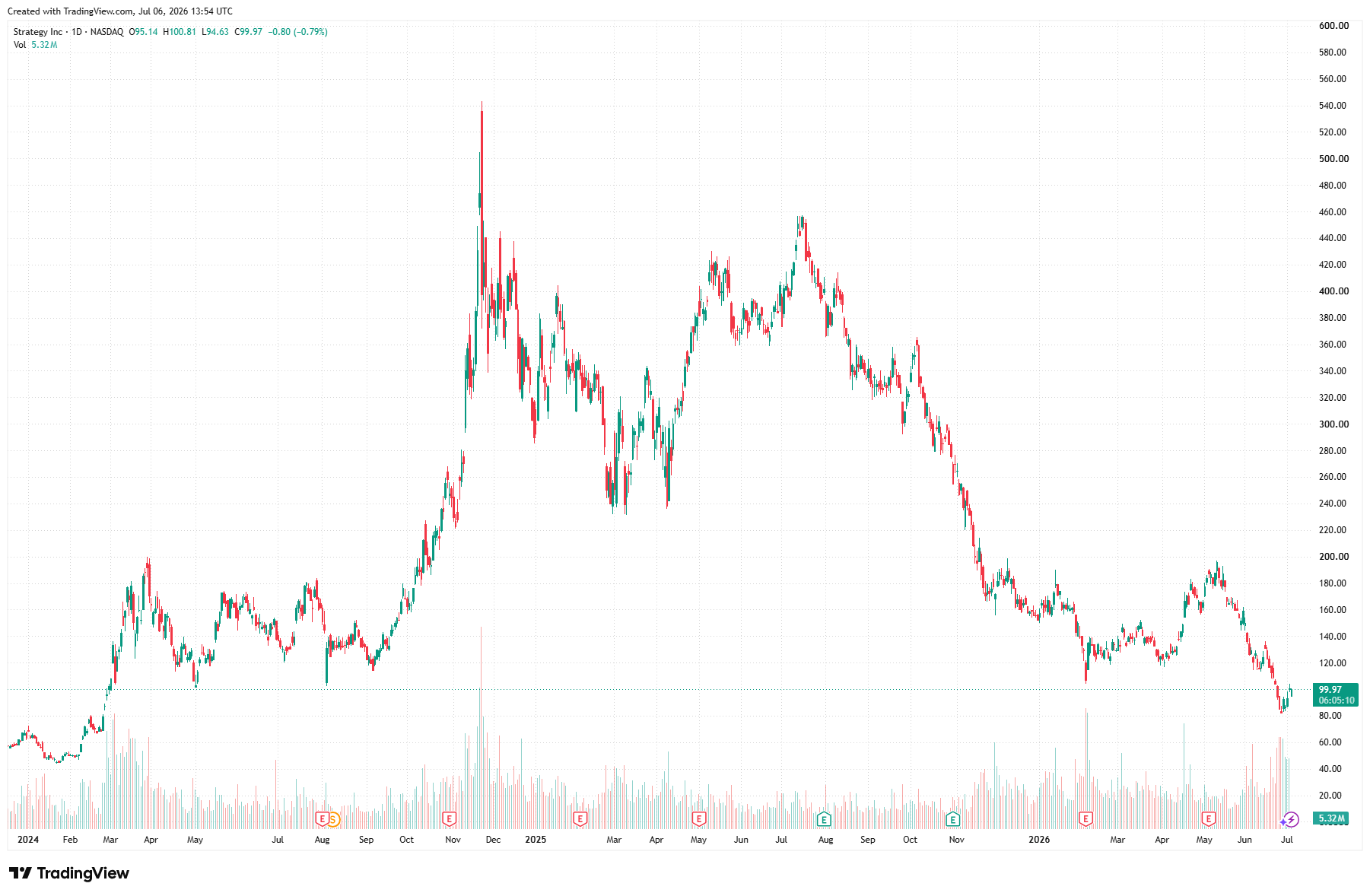
The stock market reacted as well. MSTR stock fell 2 percent in pre-market trading to USD 98.88. Over the past month, it lost roughly 26 percent. The average cost basis of the Bitcoin holdings stands at USD 75,476 per unit. The firm sold, however, at an average of roughly USD 60,000. Meanwhile, the market price recently traded at about USD 61,653. On a weekly basis, Bitcoin traded roughly 3 percent higher, at a market capitalization of about USD 1.24 trillion. Ultimately, the company parted with its Bitcoin below its own cost basis.