A summarizing review of what has been happening at the crypto markets. A look at trending sectors, liquidity, volatility, spreads and more. The weekly report in cooperation with market data provider Kaiko.
BTC prices rebounded over the weekend, stabilizing around $42k after dropping to their lowest levels since early December. In other news, the U.S. SEC delayed its decision on BlackRock's ETH ETF until March, Solana launched token extensions, and U.S. GDP surprised on the upside. This week we explore:
- Bitcoin's post-ETF performance and impact on liquidity.
- Binance market share two months post-settlement.
- The OKB flash crash on OKX.
Bitcoin rebounds as GBTC outflows slow
Since its conversion, Grayscale's GBTC has experienced significant outflows totaling around $5bn, with an average daily pace of nearly $500 million. Despite the outflows, GBTC still manages $20bn in assets.
The good news is that trade volumes and outflows have showed signs of slowing, providing much-needed support for BTC. The recent selloff is likely due to specific short term factors including forced selling (FTX) and profit-taking by investors who took advantage of GBTC's discount over the past two years.
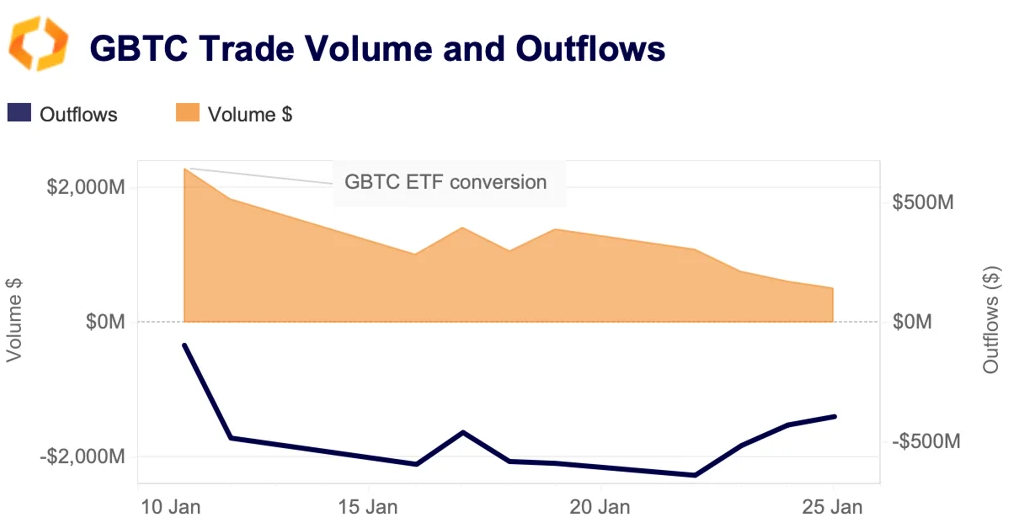
While GBTC outflows have been expected and are partly compensated by inflows into the other newly launched spot ETFs, the impact on sentiment has been significant. It is unclear how much of these inflows is new money entering the market and how much is rotation between products.
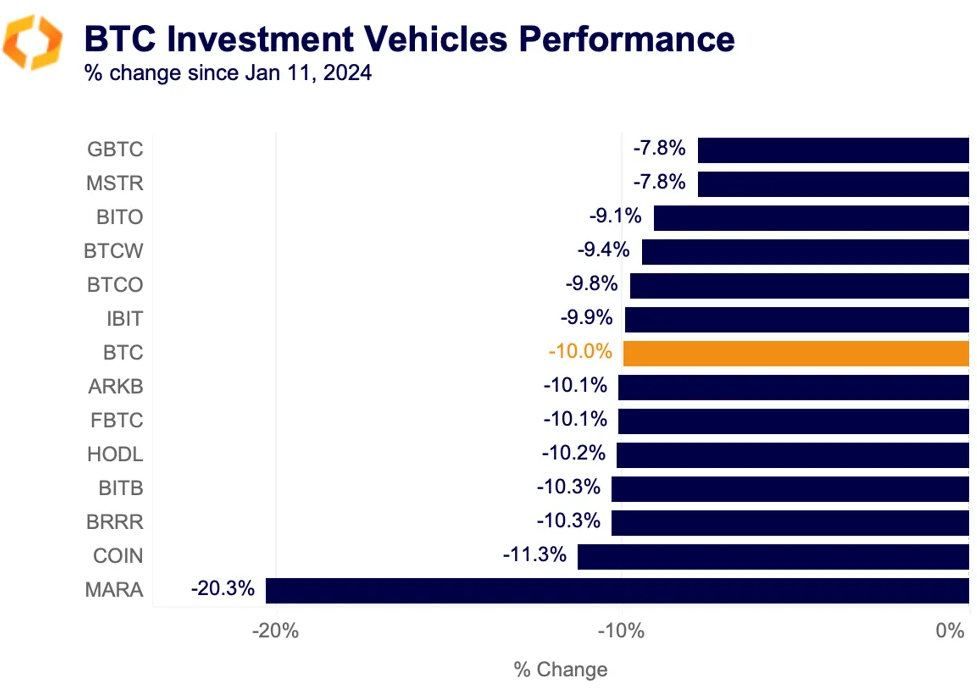
The market performance of BTC-linked stocks and investment vehicles since January 11 paints a mixed picture. Bitcoin miners significantly underperformed spot BTC while BITO, the first bitcoin ETF, and GBTC declined slightly less.
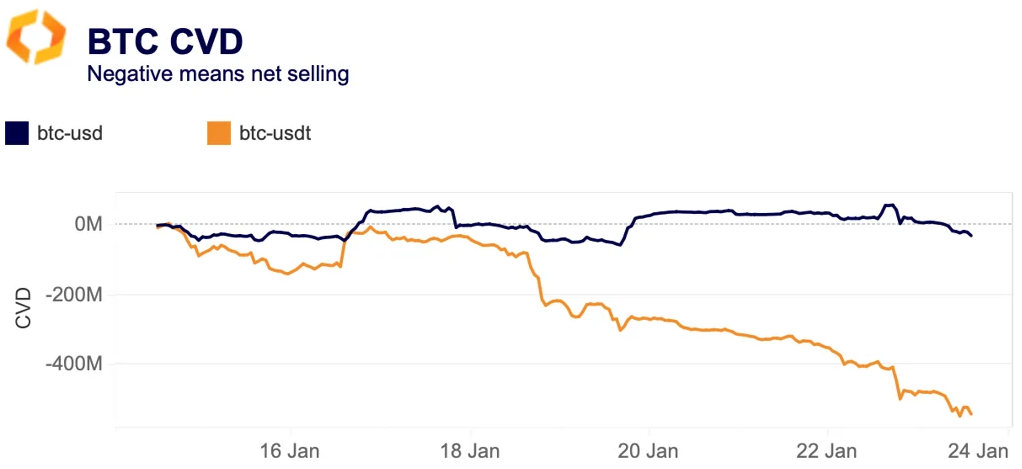
The cumulative volume delta (CVD) shows that BTC selling was broad-based and mostly concentrated on USDT markets while USD markets saw little to no selling pressures. Most of the GBTC-related transactions have been executed through Coinbase Prime, a prime brokerage using various liquidity sources, including OTC, for trade execution. Meanwhile, there has been significant selling of BTC through its USDT pairs on Coinbase, Bybit, Binance, Kraken, and OKX.
Low liquidity could also explain the strong price move. BTC's 2% market depth for BTC-USD and BTC-USDT trading pairs aggregated on 14 exchanges has not yet recovered to its pre-FTX levels of more than 10k BTC, suggesting that market makers have not returned in full force.
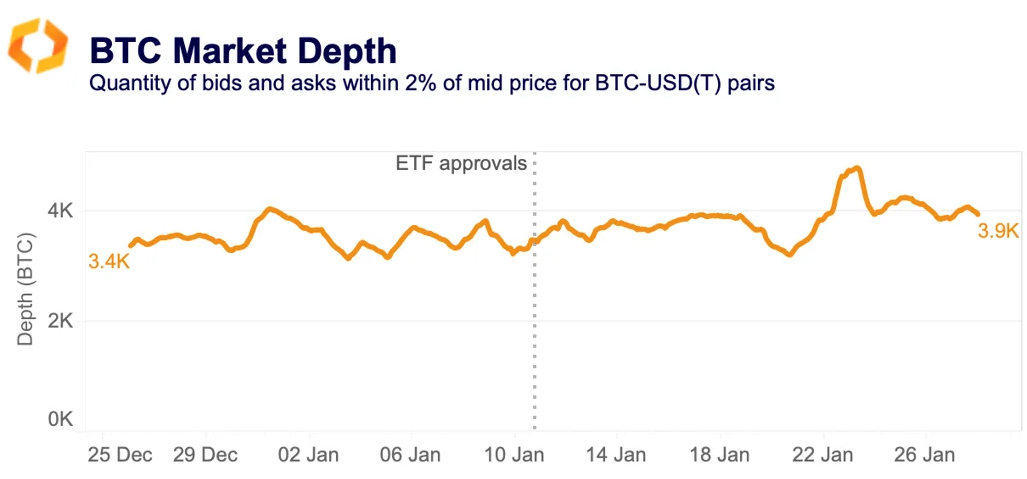
However, depth has increased slightly since the end of December, nearing 4k BTC for the first time in more than a month. Interestingly, the increase has been mostly driven by Binance.
Will ETF hype fuel ETH's comeback?
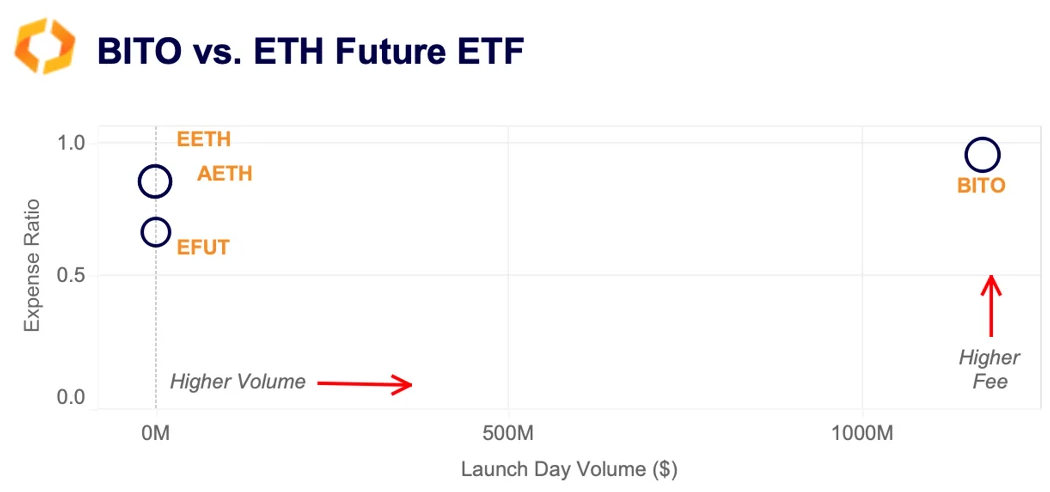
In 2021, BITO was the first BTC futures-based ETF listed in the U.S., registering one of the highest ever launch days by volume for an ETF. One year after BITO listed, a wave of ETH futures products began trading. Although the ETH futures ETFs launched in a different market environment, there is no denying that their volume was disappointing. EETH, AETH, and EFUT only had a few million in trade volume on opening day of trading, about 1,000x times less than BITO’s $1.2bn opening. Does this mean ETH spot ETFs will have a similarly lackluster first day if they're approved?
Binance's market share recovers post-settlement
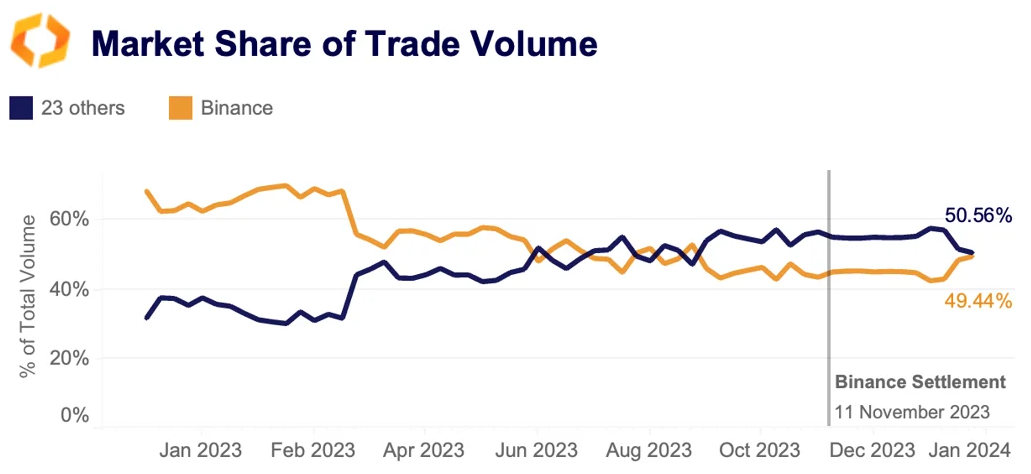
It's now been a little more than two months since Binance's settlement with the Justice Department. How has trade volume held up? Binance's market share relative to 23 other centralized exchanges barely saw a dent in the immediate aftermath. Over the years, Binance has expertly leveraged zero-fee trading pairs to boost volumes, so it is important to take this into account when analyzing the exchange's market share.
In early December, Binance rolled out another round of zero-fee promotions for BTC, ETH, and 4 other crypto assets. Then, in early January, ETF hype caused a surge in global trade volumes, which helped Binance's market share recover to nearly 50%. Its share still remains lower than last year's highs, but the exchange has proven to be mostly resilient in the aftermath of the settlement.
Flashcrash: What happened with OKB?
On January 23, the price of OKB, OKX’s exchange token, experienced a flash crash, dropping from $51 to less than $24. After an investigation, the exchange stated that the crash was due to the automatic liquidations of several margin positions after an initial price drop of 4.6% from $50.69 to $48.36.
The chart below shows that traders bought the dip after a series of sell orders led to the price crash, with buying significantly exceeding selling. At the time of writing, OKB price is yet to recover and continues to hover below its pre-crash levels.
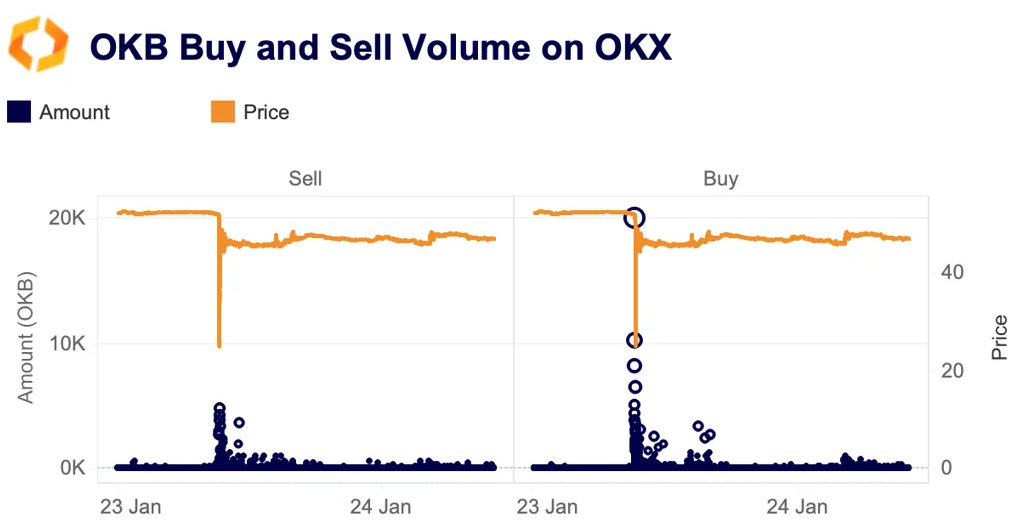
Interestingly, market depth on the bid side spiked hours before the price crashed at around 2AM UTC time, which could suggest market makers were preparing for volatility ahead, which does not fully match the narrative of events.
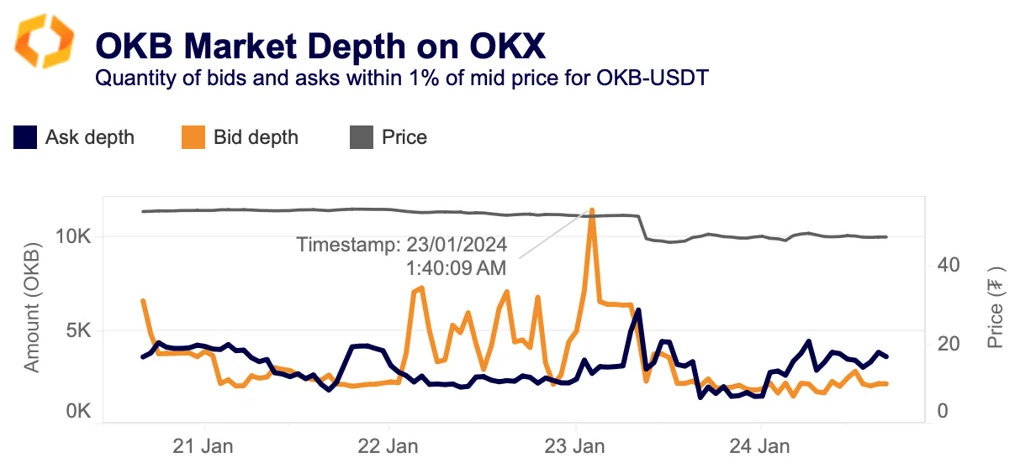
Exchange tokens enable holders to benefit from lower transaction fees, vote on new coin listings, and earn passive staking rewards. They are typically almost entirely traded on their affiliated exchanges. This is one of the reasons why these tokens remain relatively illiquid compared to others despite sometimes boasting large market caps.
EUR Tether has traded at a discount since November
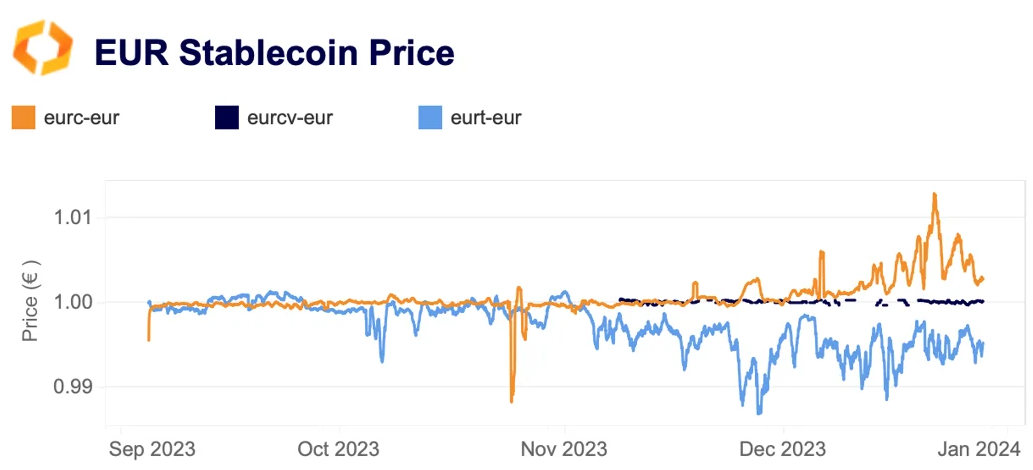
The EUR stablecoin market has come to life with the launch of several new offerings over the past few months. However, volatility has also risen; one of the largest euro stablecoins by market cap — EUR Tether (EURT) — has traded at a persistent discount to the euro since November. In contrast, Circle’s EUR Coin (EURC) has been trading at a premium, suggesting increased demand. The first stablecoin issued by a bank, Société Générale’s EURCV, has mostly kept its peg since launch in early December.
The EUR stablecoin market remains very fragmented, with EURT mostly traded on off-shore platforms such as HTX and Bitfinex while EURC dominates trading on DEXs. This could partly explain their volatility.


The ETF fee war spills into Europe
The simultaneous launch of 11 spot BTC ETFs on the world's largest stock market has boosted international competition, with issuers in other jurisdictions either preparing to launch their own spot vehicles or lowering fees on their already existing products.
Last week, CoinShares, Wisdom Tree and Invesco announced fee cuts for their physically backed exchange-traded products traded in Europe, bringing their fees more in line with the U.S. average. Canadian ETFs are also under price pressure, with several smaller issuers lowering fees.
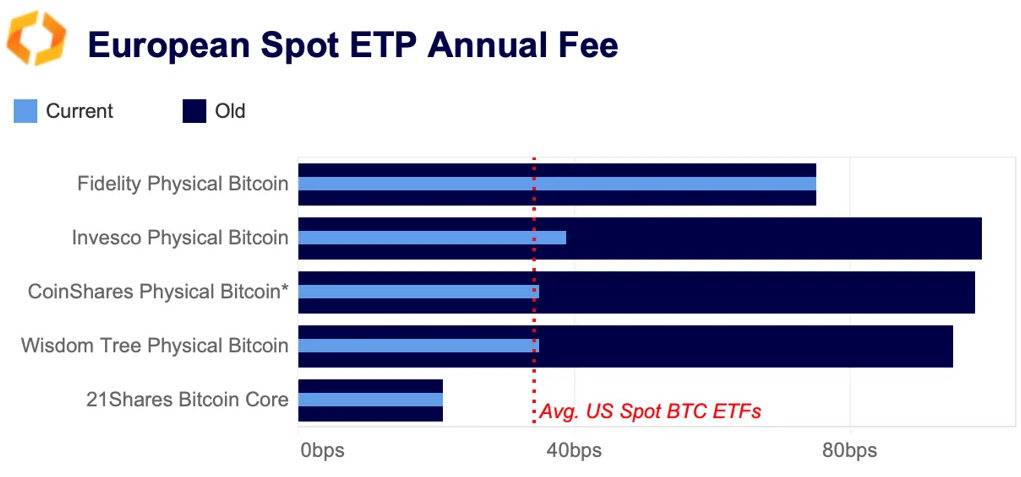
Centralized crypto exchanges are also likely to face price pressure, with spot ETFs often more cost effective. Most exchanges charge between 8bps and 50bps per transaction for retail users (the lowest volume tier), as well as withdrawal fees, which can vary depending on the token, chain, or transfer method.