OKX, BlackRock and Standard Chartered are launching a joint framework. As a result, tokenized real-world assets (RWAs) become usable as collateral in institutional crypto trading. Going forward, investors can post shares of the BlackRock USD Institutional Digital Liquidity Fund (BUIDL) on OKX as yield-bearing margin.
Standard Chartered handles custody in a regulated off-exchange setup. For the first time, a Global Systemically Important Bank (G-SIB) acts as custodian in such an arrangement. Initially, the framework applies to OKX Middle East. Moreover, it targets VIP and institutional clients, according to a press release.
How the collateral model works
BUIDL is a tokenized money market fund that invests in cash, short-dated US Treasuries and repurchase agreements. Securitize tokenizes the fund and makes it available across eight blockchains. These include Ethereum, Solana, BNB Chain, Avalanche, Polygon, Arbitrum, Optimism and Aptos. As of late April 2026, BUIDL manages around 2.58 billion USD spread across 101 holder addresses. Furthermore, the average yield stands at 3.47%, while the net asset value remains stable at 1.00 USD.
Under the new framework, clients deposit their BUIDL tokens with Standard Chartered. Therefore, they avoid having to transfer the assets between platforms. As a result, OKX accepts the custodied tokens as collateral for margin trading, while the underlying Treasuries continue to generate yield. In addition, distributions flow on-chain directly to holders, even when the tokens are locked as collateral.
A structurally decisive feature is the segregation of assets. For example, client funds remain explicitly separated from OKX proprietary holdings, which reduces counterparty risk versus the exchange itself. Therefore, this addresses the precise point that institutional allocators have made a precondition since the insolvencies of 2022.
Strategic logic of the three participants
For BlackRock, the framework expands BUIDL beyond pure cash management functions. Since its launch in March 2024, the fund has paid out more than 100 million USD in dividends. Moreover, BUIDL is today the largest tokenized money market fund in the market.
"BUIDL was designed to bring the benefits of tokenization to short-term Treasury positions. This framework with OKX and Standard Chartered enables qualified investors to unlock new possibilities in collateral management." - Samara Cohen, Global Head of Market Development, BlackRock
With this move, OKX positions itself further away from a retail image. Instead, the exchange moves toward a regulated prime broker function. According to its own data, OKX counts more than 100 million users and publishes monthly proof-of-reserves reports. Haider Rafique, Global Managing Partner at OKX, describes the cooperation as an attempt to "make existing markets faster, more transparent and more accessible". Furthermore, the framework combines "the strengths of three global institutions".
Standard Chartered has been systematically expanding its digital assets business since 2025. In January 2025, the bank launched custody services in Luxembourg. From mid-2025, institutional spot BTC and ETH trading followed. Then in January 2026 the crypto prime brokerage launched within the SC Ventures unit. In addition, in early April 2026 it became known that the bank intends to fully acquire its crypto custody subsidiary Zodia and integrate it into the Corporate & Investment Bank. As a result, the current framework fits seamlessly into this build-out strategy. Margaret Harwood-Jones, Global Head of Financing and Securities Services at Standard Chartered, emphasizes the custodian role as the core function of the initiative. Moreover, she points to the bank's protection and compliance standards for clients in the digital asset space.




RWA market and competitive environment
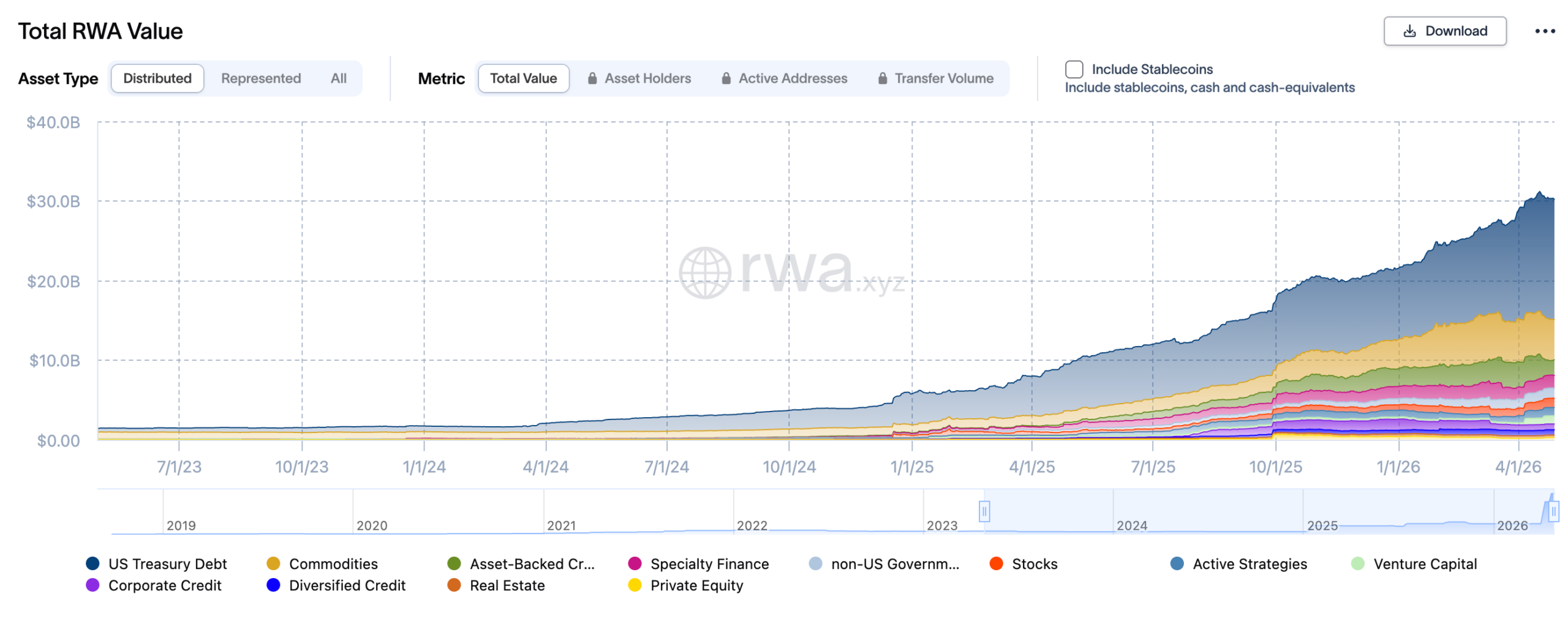
The market for on-chain tokenized real-world assets reached around 26.4 billion USD in March 2026. Furthermore, it grew roughly 300% year over year. Tokenized US Treasuries account for about 12.88 billion USD of that total and form by far the largest segment. For example, forecasts from various investment banks range from 16 to 30 trillion USD by 2030. However, these estimates differ significantly in their methodologies.
CME Group, Clearstream and Franklin Templeton also pursue similar collateral initiatives with the FOBXX fund. Notably, the OKX framework is the first to involve a G-SIB as custodian. Standard Chartered operates in 54 countries. Moreover, it falls under direct supervision of the Bank of England as well as Basel III capital requirements. As a result, institutional clients move within a familiar regulatory framework. Therefore, this fills a gap that purely crypto-native custodians have so far left open.
At the same time, the market for digital asset custody itself is growing rapidly. According to industry estimates, custodied volume could rise from around 1 trillion USD in 2026 to more than 7 trillion USD by 2035. Therefore, this corresponds to an annual growth rate of 23.7%. So far, the participants have not communicated a geographic expansion of the OKX framework beyond the Middle East.