Close Menu
Crypto Valley Journal
    Facebook X (Twitter) Instagram
    Crypto Valley Journal
    • Hot Topics
      • News
      • Minds
    • Focus
      • Background
      • Blockchain
      • Legal & Compliance
      • Non-Fungible Token (NFTs)
    • Investing
      • Markets
      • Financial Products
      • Decentralized Finance (DeFi)
      • Exchange overview
    • Education
      • Basics
      • Glossary
      • Politicians on crypto
    • Statistics
      • Bitcoin-ETF-Flows
      • Ethereum-ETF-Flows
      • Crypto market data
      • On-chain data
    • Academy
      • Overview
      • Part 1: Blockchain
      • Part 2: Money
      • Part 3: Bitcoin
      • Part 4: Cryptocurrencies
      • Part 5: Decentralized Finance
      • Part 6: Investing
    • English
      • Deutsch
    Crypto Valley Journal
    You are at:Home»Hot Topics»News»The Deutsche Bank expects Tether stablecoin collapse
    Deutsche Bank erwartet weitere Stablecoin-Zusammenbrüche wie Tether

    The Deutsche Bank expects Tether stablecoin collapse

    By Editorial Office CVJ.CH on 13. May 2024 News

    Stablecoins are cryptocurrencies that are pegged to fiat currencies such as the US dollar. Issuers maintain this peg through various mechanisms. However, Deutsche Bank suggests that many of today's dominant stablecoins, such as Tether (USDT), could collapse in the future.

    In a report, Deutsche Bank analysts examined 334 currency pegs in the fiat world since 1800, with only 14% of these attempts surviving. This insight also applies to stablecoins. Most of these cryptocurrencies pegged to the US dollar have no future. Deutsche Bank therefore expects "significant turbulence" for established stablecoins such as Tether (USDT).

    Subscribe to our newsletter

    The best articles of the week, directly delivered into your mailbox.

    Tether: The Next Terra/Luna Collapse?

    Deutsche Bank begins its stablecoin report by reflecting on the devastating collapse of the algorithmic stablecoin Terra/Luna. According to analysts, a "bank run" led to the demise of the LUNA cryptocurrency, causing the tethered TerraUSD (UST) stablecoin to collapse. In March 2023, the market was further destabilized by the collapse of Silicon Valley Bank (SVB), causing the USDC stablecoin to lose its peg for two days. And in January 2024, TrueUSD (TUSD) deviated from its 1:1 peg. According to Deutsche Bank analysts, these incidents illustrate the volatility and risks associated with stablecoins.
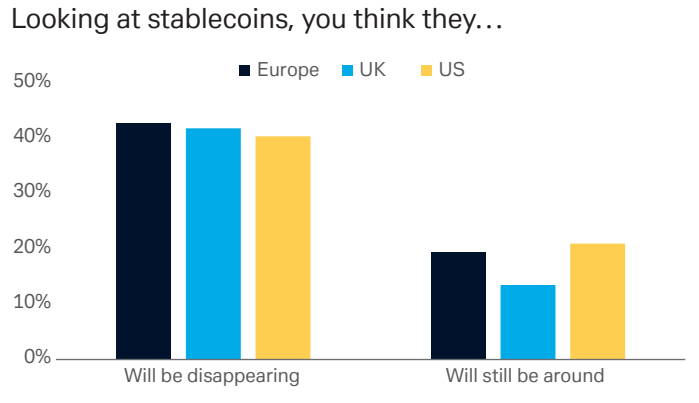
    Survey respondents do not expect a rosy future for stablecoins / Source: Deutsche Bank survey of 3,350 respondents

    The bank also looks at the similarities between non-algorithmic stablecoins and fiat currencies with fixed exchange rates. Both require substantial reserves and credibility from issuers, are subject to speculative forces, and most stablecoins and historical currency pegs are tied to the USD. The fact that nearly 50% of all exchange rate pegs have failed, with an average lifespan of eight to ten years, is also indicative of the future of stablecoins, according to Deutsche Bank analysts.


    Ray Dalio’s Bridgewater Associates Minds

    Star investor Ray Dalio considers Bitcoin inferior to gold

    CLARITY Act DeFi Background

    CLARITY Act: The year’s most important crypto deal heads for a decision

    JPMorgan warns: Recurring DeFi exploits and stagnant ETH-denominated TVL curb institutional engagement in the DeFi sector. DeFi

    JPMorgan: DeFi hacks and TVL losses weigh on institutional investors

    Basics

    Unit bias in crypto: Why cheap coins mislead investors

    Ray Dalio’s Bridgewater Associates Minds

    Star investor Ray Dalio considers Bitcoin inferior to gold

    CLARITY Act DeFi Background

    CLARITY Act: The year’s most important crypto deal heads for a decision

    Deutsche Bank compares apples and oranges

    History suggests further turbulence and loss of support for leading stablecoins. While some may survive, Deutsche Bank believes most stablecoins will fail. The main reasons cited are a lack of transparency in stablecoin operations and vulnerability to speculative tendencies. The stability of the market leader Tether is particularly questionable. The solvency of the issuer is doubtful, as USDT is the industry standard for crypto derivatives. A "Tether peso moment", a reference to the collapse of the peso's peg to the dollar in the 1990s, could have serious implications for the crypto ecosystem.

    While some questions about Tether's reserve reports remain unanswered, as previously discussed by the CVJ.CH editorial team after the SVB crisis, Deutsche Bank's stablecoin report compares apples to oranges, and even oranges to apples. First, a clear distinction must be made between algorithmic and collateralized stablecoins. Algorithmic stablecoins use various, often volatile market mechanisms to maintain a quasi-peg. Since the Terra/Luna debacle, this type of dollar token has largely disappeared.

    Collateralized stablecoins, on the other hand, are issued by centralized issuers. For each token, the issuer holds one dollar in reserves, consisting of a mix of securities such as U.S. Treasury bonds and cash equivalents. Each stablecoin can then be exchanged with the issuer for fiat currency. No central bank has maintained this standard of full reserves since the demise of the gold standard. Thus, the collapse of fixed exchange rates is much more applicable to algorithmic stablecoins, which also do not use dollar reserves.


    Share. Facebook Twitter LinkedIn Email Telegram WhatsApp

    About the author

    Editorial Office CVJ.CH

      The CVJ editorial staff consists of a team of Blockchain experts and informs daily and independently about the most exciting news.

      Related Articles

      CVJ.CH Weekly review calendar week

      Weekly review calendar week 19 – 2026

      JPMorgan sees Bitcoin ahead of gold in the debasement trade: GLD loses 2.7% AUM, IBIT gains 1.5% AUM since Iran war outbreak.

      JPMorgan: Bitcoin overtakes gold in the debasement trade

      Bitcoin regime shift in question as April rally pushes BTC above $80k, with $2.4 billion in ETF inflows and patient capital building support.

      Spring cleaning: Bitcoin tests the regime shift above $80k

      CVJ.CH Weekly review calendar week
      9. May 2026

      Weekly review calendar week 19 – 2026

      JPMorgan sees Bitcoin ahead of gold in the debasement trade: GLD loses 2.7% AUM, IBIT gains 1.5% AUM since Iran war outbreak.
      8. May 2026

      JPMorgan: Bitcoin overtakes gold in the debasement trade

      Bitcoin regime shift in question as April rally pushes BTC above $80k, with $2.4 billion in ETF inflows and patient capital building support.
      8. May 2026

      Spring cleaning: Bitcoin tests the regime shift above $80k

      twitter image button instagram image button linkedin image button youtube image button

      About Crypto Valley Journal
      About Crypto Valley Journal

      On the pulse of the movement

      • Academy
      • Contact
      • Advertising
      • About us
      • Partner
      • Imprint
      • Privacy
      • Disclaimer
      Search

      Type above and press Enter to search. Press Esc to cancel.