What has been happening this week in the world of blockchain and cryptocurrencies? Current events and background reports in our weekly review.
Selected articles of the week:
SpaceX disclosed a long-standing Bitcoin position for the first time in its SEC S-1 filing. The 18’712 BTC, with a market value of 1.45 Bn. USD, stand against a cost basis of 661 Mn. USD, representing an unrealised gain of 789 Mn. USD. The average entry price is around 35’324 USD per Bitcoin and dates back to purchases made in 2021. At that time, SpaceX accumulated 25’724 BTC in parallel with Tesla’s 1.5 Bn. USD purchase and has since divested only around 7’012 of those. Tesla, by contrast, sold around 75% of its holdings in 2022. With this disclosure, SpaceX joins the ranks of the largest corporate Bitcoin holders and simultaneously enters the public capital markets. According to the filing, the planned Nasdaq listing under the ticker SPCX is scheduled to begin on 12 June 2026. The targeted issuance volume of around 75 Bn. USD at a valuation of 1.5 Tn. USD would be the largest IPO in history.
SpaceX discloses 18,712 BTC worth $1.45 billion in its IPO filing. Cost basis $661 million, unrealised gain around $789 million.
Tether secures full control over Twenty One Capital
While SpaceX discloses its holdings for the first time, the ownership structure is changing at another prominent Bitcoin treasury player. Tether International has acquired SoftBank’s entire stake in Twenty One Capital (NYSE: XXI), giving it full control of the listed treasury company. SoftBank had taken a roughly 25% stake in April 2025 and contributed around 10’500 BTC, while Tether and Bitfinex jointly provided around 31’500 BTC. Twenty One Capital today holds 43’514 BTC worth around 3.35 Bn. USD, with a market capitalisation of 2.64 Bn. USD. The stock responded with a pre-market gain of 5.6% to 8.05 USD but has lost around 84% since its NYSE debut in December 2025. With the acquisition, Tether CEO Paolo Ardoino is preparing a planned three-way merger with Jack Mallers’ Strike payment platform and Bitcoin miner Elektron Energy. The goal is a Bitcoin-native company that combines treasury strategy with mining, lending and financial services.

Tether acquires SoftBank’s stake in Twenty One Capital, taking sole control of the Bitcoin treasury company holding 43,514 BTC.
Goldman Sachs rotates from altcoin ETFs into crypto equity
Crypto allocations are also shifting at the major banks, though away from altcoin ETFs. Goldman Sachs fully liquidated all XRP and Solana ETF positions in the first quarter, as its 13F filing shows. Affected are four XRP products from 21Shares, Bitwise, Franklin Templeton and Grayscale with a combined volume of around 152 Mn. USD, as well as six Solana products totalling 108 Mn. USD. At the end of 2025, the bank still held around 73% of the XRP ETF assets among the 30 largest US institutions. The Ethereum position in the iShares ETHA fund shrank by 70% to 7.2 million shares, while the Bitcoin holding at 715 Mn. USD was only marginally reduced. In return, Goldman raised its stake in Circle Internet Group by 249% and in Galaxy Digital by 205%, in addition to a new position in Hyperliquid Strategies. The reallocation shows a clear preference for Bitcoin spot, infrastructure equities and treasury vehicles over altcoin ETFs.
Goldman Sachs liquidates all XRP and SOL ETF positions in Q1 2026, cuts ETH by roughly 70%, and opens a new HYPE treasury stake in PURR.
Executive order forces Fed to decide on master accounts
In parallel, Washington is creating new regulatory facts. US President Donald Trump signed the executive order “Integrating Financial Technology Innovation into Regulatory Frameworks”, thereby pushing access for crypto firms to central payment systems. Within 90 days, the Federal Reserve must establish transparent application procedures for master accounts, while the SEC, CFTC, OCC, FDIC, CFPB and NCUA are required to identify innovation barriers in their respective rulebooks. Master accounts provide direct access to Fedwire and the real-time system FedNow, bypassing the need for correspondent banks. The administration is thus responding to what the industry calls “Operation Choke Point 2.0”, the coordinated restrictions on crypto banking relationships imposed since the FTX collapse. In early March, the Federal Reserve Bank of Kansas City granted Kraken Financial a “Limited Purpose Tier 3” master account, making it the first crypto company to receive one.
Trump’s executive order directs the Federal Reserve to review crypto firm access to Master Accounts and Fedwire.
Bitcoin Depot shuts down 9’000 ATMs following bans
In addition: The largest crypto ATM operator in the US, Bitcoin Depot (Nasdaq: BTM), has ceased operations and filed for Chapter 11 protection at the US bankruptcy court for the Southern District of Texas. The Atlanta-based company shut down more than 9’000 locations across 47 states. In the first quarter, revenues collapsed by 49.2% to 83.5 Mn. USD, while gross profit shrank by 85.5% to 4.5 Mn. USD. In April, an additional 3.7 Mn. USD in damages came from a wallet hack. The main driver is regulatory pressure: Indiana, Tennessee and Minnesota banned crypto ATMs outright, Connecticut revoked the money transmitter licence, and Massachusetts and Iowa filed lawsuits over misleading pricing. In parallel, the FBI recorded a total of 13’460 ATM fraud cases for 2025 with 389 Mn. USD in damages, a 58% year-on-year increase, which intensified the regulatory pressure.
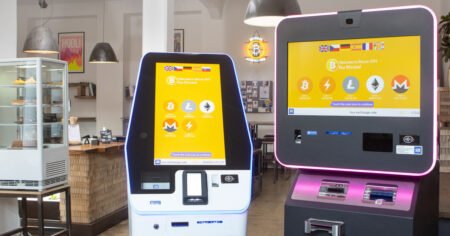
Bitcoin Depot bankruptcy: Chapter 11 filing shuts down 9,000 crypto ATMs as regulatory pressure forces the Nasdaq-listed operator into wind-down.