
For about a year now, Tesla founder Elon Musk has often been accused of influencing the prices of specific cryptocurrencies such as Bitcoin and Dogecoin with his social media activities. A detailed study on the "Musk Effect" and its implications for the crypto markets.
The study „How Elon Musk’s Twitter activity moves cryptocurrency markets“ aims to identify the "Musk effect" in cryptocurrency markets and to quantify how strong its market influence is. For this purpose, an event-study approach was used to analyze the extent to which Musk's Twitter activities influence the returns and volumes of cryptocurrencies in the short term. To this end, the first step was to extract a sample of 47 cryptocurrency-related tweets from Musk's Twitter timeline that represented so-called "events“.
Based on the applied methodology, it was subsequently assessed to what extent the returns and trading volumes of the mentioned cryptocurrencies changed when the information became known or the event took place. For this, market information around the event was compared with historical data. The identified deviations were classified as "abnormal", as they could only be explained by the event, and finally tested for statistical significance.
The first "Musk Effect"
On January 29, 2021, the price of a Bitcoin rose from about $32,000 to $38,000 within a few hours. This increase in value corresponded to an increase in Bitcoin's market capitalization of about 111 billion dollars. Shortly before, Elon Musk, founder of companies such as Tesla or SpaceX and at that time the richest person in the world, had adjusted his Twitter profile.
The adjustment was as follows: On the one hand, Elon Musk exclusively put the term "#bitcoin" in his Twitter account description and on the other hand, he published the tweet "In retrospect, it was inevitable", which suggested his support for the decentralized cryptocurrency Bitcoin. Aspects that were unknown to the general public at that time were that Tesla has not only made a significant investment in Bitcoin prior to the adjustment of Elon Musk´s Twitter account but also intended to accept Bitcoin as a means of payment.
Cryptocurrency returns around a tweet from Elon Musk
The figure below shows the cumulative (log-transformed) returns from 360 minutes before to 120 minutes after a cryptocurrency tweet from Elon Musk. The "all" group includes Bitcoin, Ether, and Dogecoin returns, while the other two groups represent observations for Dogecoin or Bitcoin only. Ethereum (N=1) is omitted. All 47 events saw a price jump of about 3% after the tweet was published. Prices continued to rise in the following hour before eventually declining again.
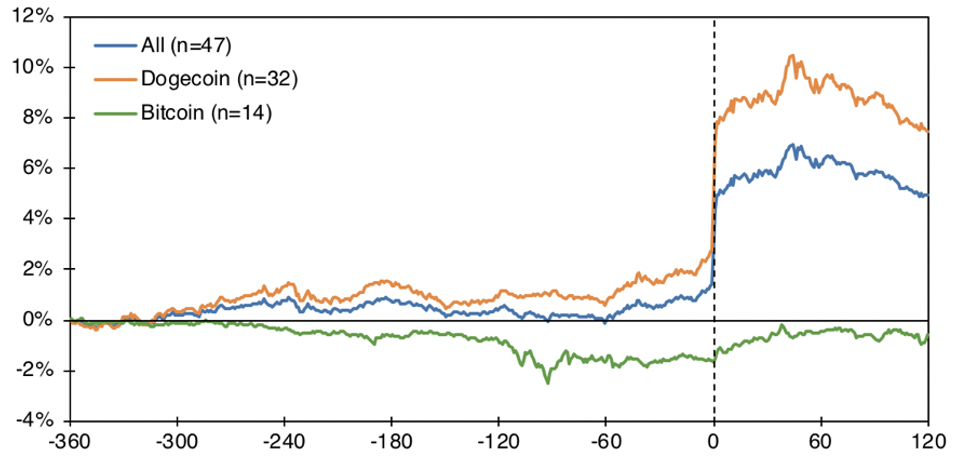
A more differentiated analysis of the events related to Dogecoin and Bitcoin provided further insights into the interplay of the described effects. Bitcoin tweets tended to be posted more during periods of falling bitcoin prices (about -2% in the six hours preceding a tweet), whereas tweets about Dogecoin were, on average, posted after a six-hour long increase of around 2%. These findings may suggest that Musk's Dogecoin tweets were a reaction to the rise in the value of the respective cryptocurrency, whereas Bitcoin-related tweets may have been more of a reaction to falling prices.
Trading volume associated with a cryptocurrency tweets
In addition to the analysis of the return, the trading volume also played a significant role. Thus, the following figure shows the (logarithmized) trading volume around a cryptocurrency-related tweet by Elon Musk. Before the publication of a tweet, trading volumes were comparatively stable, but at the time of publication they increased significantly.

As with returns, the relative effect was significantly larger for Dogecoin than for Bitcoin. Bitcoin's trading volume declined only slightly in the two hours following the tweet compared to that of Dogecoin, with overall volume significantly above pre-tweet levels. The interesting part about these events is that the sudden spike in response to the tweet only lasted about two to three minutes in both returns and trading volume.
Event study results
Within the scope of the event study, we identified highly significant positive effects in the minute of the event and in the following two minutes. The effect in the minute of the event was 1.46%, with 83% of the events having positive returns. In minute 1, the effect was 1.50% and in minute 2, 0.62%. Afterwards, the abnormal returns were generally much lower and no longer significant.
Overall, it can be ascertained that the market reacted just as quickly and clearly to Musk's tweets as it also reverted to its "normal state" at the end. This could also be concluded from the cumulative abnormal returns, which were significantly positive for all time periods considered and varied only slightly in absolute value (3.5% to 4.8% in all time periods beyond two days). 91% of events resulted in a positive abnormal return over the five-minute period.
Significant effects were also seen in Dogecoin. For example, the market reacted with an abnormal return of 2.2% the minute Musk posted a Dogecoin tweet, followed by another 2.2% the following minute. After the third minute (0.8%), the impact was no longer significant. In contrast, no significant impact could be detected for the 14 Bitcoin events. Although the proportion of positive outcomes (with one exception) exceeded 50% in all cases and the overall outcomes were consistently positive, none of them achieved statistical significance. This stark difference between Dogecoin and Bitcoin may be due to the fact that Musk's tweets about Dogecoin were almost exclusively positive in nature, whereas his Bitcoin tweets included both positive and negative aspects, where the effects may have cancelled out accordingly.




Cumulative returns around non-negative and negative Bitcoin tweets from Elon Musk
In light of the above-mentioned findings, additional analyses of Bitcoin tweets were conducted. The 14 Bitcoin tweets referred to neutral, positive or negative opinions or facts. Since some of them contained non-text elements, it was not possible to objectively classify the tweets using methods such as sentiment scoring. Due to this, the subjective assessment of cryptocurrency experts was used, according to which four negative and ten non-negative (positive or neutral) could be classified from the sample of 14 Bitcoin tweets.
The following figure shows the cumulative returns from 360 minutes before to 120 minutes after a Bitcoin-related tweet. The non-negative tweets clearly lead to positive bitcoin returns, while negative events seemed to trigger a negative market reaction.
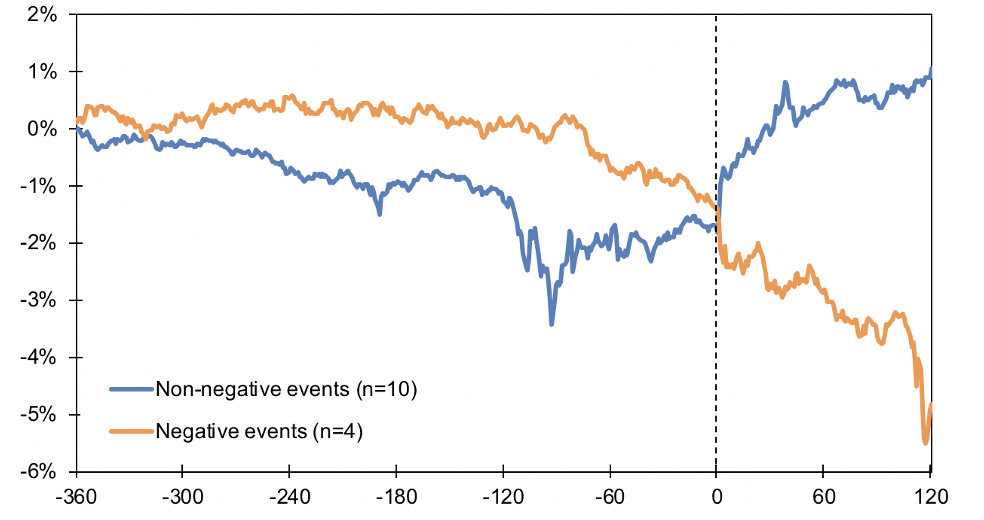
For the ten non-negative events, we were able to observe that - with the exception of the period of two minutes after the event - all the periods considered were associated with significantly positive abnormal returns. Thus, they amounted to about 1% in the first 5 and 10 minutes and reached 3.7% after two hours. However, when considering this data, it should be borne in mind that the effects varied greatly depending on the content of the tweets. In particular, the adaptation of Elon Musk's Twitter profile to #bitcoin (13.6% after one hour and 14.3% after two hours) and the statement regarding Tesla "having diamond hands" (9.3% and 16.9%) triggered very large effects. In contrast, the comparatively largest negative effect was found as a result of the tweet stating Tesla would suspend Bitcoin as a payment method for vehicle purchases. The latter is associated with a significant negative abnormal return of ‑11.9% over a period of two hours after the tweet.
Conclusion of the study
Following the scientific concept of Coherence outlined by Anderson and Baum (1994), the results of our study suggest that Elon Musk's Twitter followers are guided in evaluating new information - in our case about Bitcoin, Ether, or Dogecoin - by what is said or stated on Elon Musk's Twitter profile due to his existing reputation as a successful and innovative businessman, and that this has corresponding impacts on their behavior.
This effect can be explained by the so-called Cognitive Balance Theory. It was developed to explain how people resolve inconsistencies in their interpersonal emotions. Applied to the results of our study, this would mean that Musk's Twitter followers try to create a balance between his statements and their image of Elon Musk as a person. According to the theory, a positive evaluation of Musk as a person would therefore result in a corresponding perception of the tweet by the respective follower and his attitude would also be transferred accordingly to the "product" cryptocurrency.
Further interpretations of the results
In contrast, the Signaling Theory deals with possible interpretations of signals and the conclusions that can be drawn from them. Following this theory, Musk's tweets would be regarded as quality signals to the market that were immediately priced in. Elon Musk does not incur any costs in the conventional sense, but he nevertheless puts his reputation on the line to a certain extent and risks counter-signals, e.g. in form of posts by other influencers. It can be assumed that the market will only react as long as the signal (i.e., the tweet) delivers added value. If the market loses confidence in the quality of the signal, the information will be ignored accordingly.
Following this perspective, it can be stated for the "Musk Effect" that it is an uncritical aspect of the efficiency of financial markets. Nevertheless, the fact that the richest person in the world can increase the price of Bitcoin by 16.9% or decrease it by -11.8% by a simple tweet de facto entails some complex moral issues. As a result, our study was able to prove that the social media activities of influential individuals can have a significant (temporary) impact on cryptocurrencies and that the findings reveal a conflict between the ideals of free speech, morality, and investor protection.