Cardano is a decentralised and open-source proof-of-stake (PoS) blockchain network. The project was launched in 2015 by Charles Hoskinson, co-founder of Ethereum, and was released in 2017 through an ICO. It is overseen by the Cardano Foundation based in Zug, Switzerland.
Without getting too technical too fast… blockchains are sophisticated databases that do not rely on a third party for data validation. Instead, they secure themselves by using a specifically designed system, a consensus mechanism, which validates transactions between users, and adds them to a blockchain’s public ledger. This helps secure the software from attackers, and also regulates the issuance of new units of its supply. A look into Cardano's model and its differences from other popular blockchains.
What makes Cardano special?
Bitcoin and Ethereum secure their network through a system of mining called proof–of-work. This, however, has been criticised of late due to the high energy consumption. A popular alternative to proof-of-work is proof-of-stake, as it limits the amount of energy the network consumes, and can also be faster.
The Cardano project prides itself on the blockchain research done by Input Output Hong Kong (IOHK), and states that project developments are backed by peer reviewed academic research. Through this, the Ouroboros, the proof-of-stake protocol Cardano is based on, is considered to be the first PoS protocol that has mathematically proven to be secure, and is backed by scholarly academic research.
Cardano aims to achieve the scalability, interoperability, and sustainability needed for real-world applications. Currently, it focuses on ways that blockchains can solve real problems in developing countries. The network’s goal is to become a decentralised application (dApp) development platform, with a multi-asset ledger and verifiable smart contracts, allowing it to become an alternative to Ethereum.
Development and Roadmap
After more than two years of development, the Cardano platform was launched in September 2017, together with is native crypto asset ADA. Cardano is laid out to be developed in five stages, or as the project refers to them: eras. They are called Byron, Shelley, Goguen, Basho, and Voltaire.
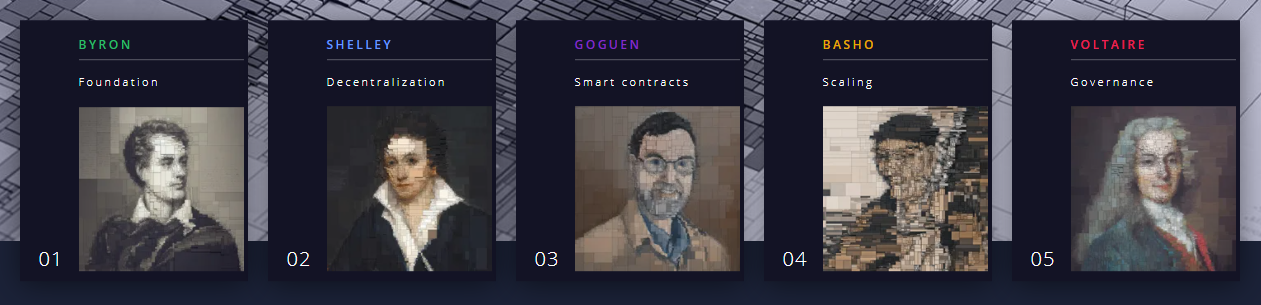
These stages can be summed up as foundation, decentralisation, smart contracts, scaling, and governance. Each era is delivered sequentially; however it is worth noting that work on each era happens in parallel, with research, prototyping, and development often in progress simultaneously across the different development streams. The network is currently in its Shelley era, where it aims to grow in a decentralised fashion through its PoS consensus protocol (Ouroboros).
With the current development of the Goguen era, which commenced in March, Cardano aims to provide users with a dApp development platform that supports multi-asset ledgers and verifiable smart contracts. This recently announced network update will take the project to another level, and allow it to directly compete with Ethereum.
The proof-of-stake protocol Ouroboros
As a proof-of-stake consensus protocol, Ouroboros works through the use of so-called validator nodes. Holders of the Cardano native cryptocurrency ADA can choose to stake their tokens in order to become validator nodes within the Cardano network. Through staking ADA, holders are able to vote on transaction validation. The validators are chosen at random based on the amount of tokens held, as well as on the duration of the holdings.
Chosen validators are given a short time frame in which they vote on the transaction. During this time frame other validators also independently vote on the transaction, and if the votes corroborate each other, the transaction is then recorded onto the blockchain. Validators are reimbursed in the form of ADA tokens. A larger ADA stake is taken to be a more trustworthy vote. Currently, staking rewards provide around 4.5% yield per annum, and around 70% of ADA is staked, representing approximately 30bn USD.
The Future of Cardano
The future of the Cardano project rests on the deployment of smart contracts on its blockchain. The “Alonzo Purple” upgrade aims to introduce a fully functional smart contract solution, and is scheduled for September 12, 2021. The project aims to implement this through a dual layer architecture.
The first layer, the Cardano Settlement Layer (CSL), will be used as a record of all ADA transactions. It will facilitate peer-to-peer transactions (i.e. enabling token transfers). The second layer, the Cardano Computation Layer (CCL), will be used to run smart contracts. The layers are separated from each other to allow for flexibility.
Furthermore, there will be an off-chain protocol for data storage flexibility, as well as customisability in validating transactions. Cardano hopes to address Ethereum issues such as network congestion, slow transaction speeds, and high gas fees through this dual layer architecture.