


Investors pulled about USD 541 million from BlackRock's spot Bitcoin ETF IBIT yesterday. The IBIT outflow is the largest single-day figure since the fund's January 2024 launch, while the Bitcoin price keeps falling.
A spot Bitcoin ETF holds actual bitcoin and tracks its price through exchange-traded fund shares. As a result, investors can access bitcoin in an ordinary brokerage account without having to manage self-custody. When they redeem shares, the fund releases a matching amount of bitcoin or its cash value. An outflow therefore reflects investor redemptions, not a decision by BlackRock itself to sell. IBIT launched in January 2024. Today it is the largest of twelve US spot Bitcoin ETFs, issued by the asset manager BlackRock. On the record day, all twelve funds combined posted net outflows of USD 582 million. IBIT alone accounted for about 93% of that. The fund's previous high stood at USD 528.3 million in January 2026.
Third straight outflow costs IBIT USD 541 million
According to daily data from Farside Investors, IBIT lost exactly USD 541.1 million on Thursday. The fund had already shed USD 209.5 million on Tuesday and USD 148.7 million on Wednesday. Over three trading days, redemptions thus add up to almost USD 900 million. All US spot Bitcoin ETFs together lost USD 239.9 million and USD 306.5 million on those two days, respectively. On Thursday, the total finally reached USD 582.3 million. However, the weighting shifted during the streak. On Wednesday, IBIT made up less than half of total outflows. On the record day, by contrast, its share was about 93%. The other eleven funds accounted for only about USD 41 million combined on Thursday.
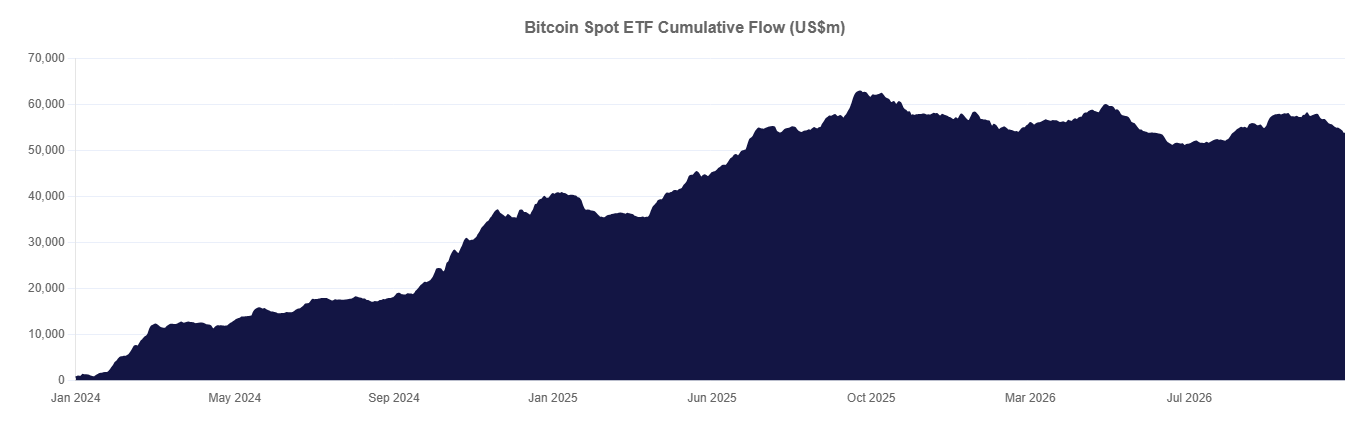
So far in November, outflows from US spot Bitcoin ETFs total USD 3.47 billion. IBIT alone accounts for about USD 2.94 billion of that, the bulk of the total. Moreover, the fund's 93% share on the record day exceeded this monthly average. In the week from November 9 to 13, investors had already withdrawn about USD 1.07 billion from the funds. On the Friday of that week alone, outflows came to USD 185.5 million, including about USD 143.5 million from IBIT.
After that, a single day of inflows on Monday broke the pattern only briefly. It ended a streak of eleven outflow days at IBIT, during which about USD 2.35 billion left the fund. From the next day on, however, redemptions took over again. They peaked on Thursday.
The records come at ever lower prices
The three largest outflow days in IBIT's history all fall in 2026. At the end of January, USD 528.3 million left the fund, right after Bitcoin had hit a ten-month low. In May, outflows of USD 527.84 million followed, as measured by data provider SoSoValue. That figure came in only about USD 0.5 million below the January record. At the time, it was the fund's second-largest outflow day. Bitcoin was already trading lower than in January. Finally, IBIT booked the current record during a selloff at an even lower price level. The pattern stands out because each new redemption high meets a lower price level than the one before.
Still, the gap to the January figure is only about USD 12.8 million. All three days lie within a little over USD 13 million of each other. In addition, the figures come from different data providers: Farside for January and November, and SoSoValue for May. Consequently, the number does not prove a new order of magnitude for redemptions. Instead, it shows that price weakness in 2026 has repeatedly coincided with outflows of similar size. For context, the direction of the price matters more than a difference of a few million.




Hot inflation data and AI concerns weigh on risk assets
On Thursday, the stock market weakened first. Anthropic's market debut failed to hold the gains in AI stocks such as Nvidia. Concerns about valuations and heavy spending on artificial intelligence drove the weakness. At the same time, Bitcoin came under further pressure, and IBIT posted its record outflow. While stocks gave back their AI gains, investors also pulled money from the largest Bitcoin fund.
Furthermore, the latest inflation data came in hot. The US consumer price index rose 0.4% month over month in October, with the core rate up 0.3%. As a result, bets are mounting on a 25 basis point Federal Reserve rate hike in December 2026. The central bank has yet to decide. In the crypto market, forced liquidations added to the pressure. Within 24 hours, exchanges closed leveraged positions worth more than USD 2 billion.
For Bitcoin ETFs, the record thus falls into a market in which investors are broadly cutting risk. The reports reviewed cite no Bitcoin-specific cause, such as a technical problem or a regulatory measure. Only the timing is documented, and it matches the broad flight from risk assets. The record outflow came on the same day as the weak trading session after the Anthropic debut.
Cumulative inflows remain large
Relative to the fund's total, redemptions remain limited. Since launch, IBIT has gathered about USD 63.4 billion in net inflows. The fund's November outflows therefore equal less than 5% of that sum. Across all US spot Bitcoin ETFs, however, 2026 still shows a net outflow of about USD 3.11 billion so far. Without the November outflows of USD 3.47 billion, the funds would be slightly positive for the year.
The concentration of outflows in IBIT partly follows from the fund's size. Because it is a large product, redemptions hit harder in absolute terms. The daily flow data do not show who is redeeming shares. They only report the net amount per fund and trading day, not the individual investors behind it.
Not every issuer lost money on the record day. Morgan Stanley's competing Bitcoin ETF even took in USD 49.6 million that day, the largest inflow of any fund. That amount offsets less than a tenth of the IBIT outflow. Yet it shows that redemptions do not hit every issuer equally. By calculation, the remaining ten funds lost about USD 91 million net combined. BlackRock did not comment on the outflows. With IBIT, the asset manager still leads the segment.