Uniswap is one of the best-known and most influential projects in the DeFi sector. As a decentralized exchange without an order book, the protocol fundamentally changed how tokens are traded and established a new standard for on-chain liquidity.
During periods of strong market movements, Uniswap was often at the center of attention – today, things are quieter. However, this is less due to a loss of relevance and more because Uniswap has matured into core infrastructure. Uniswap is a decentralized exchange (DEX) that operates on Ethereum and its Layer-2 networks. Users can swap tokens directly from their wallets without centralized intermediaries, order books, or custodians. Trading is conducted entirely via smart contracts. Unlike centralized exchanges, Uniswap does not hold customer funds and does not make listing decisions. Any token that meets the technical standards can be traded. This open design was crucial to the early growth of the DeFi sector and made Uniswap the blueprint for many subsequent protocols.
What Uniswap fundamentally is
At the core of Uniswap is the automated market maker model (AMM). Instead of traditional buy and sell orders, so-called liquidity providers supply token pairs in pools, such as ETH/USDC. The price is determined algorithmically based on the ratio of assets in the pool. This model drastically lowered the barriers to entry for trading. New tokens could become tradable immediately, without market makers, listings, or central approvals. At the same time, a new revenue model emerged: users could earn trading fees by providing liquidity.
With each new version, the protocol was further developed. Newer designs in particular improved capital efficiency, reduced slippage, and enabled flexible fee models. This made Uniswap increasingly attractive for larger trading volumes.
Volume, liquidity, and market position
Uniswap has been the leading decentralized exchange by trading volume for years. During peak market phases, daily volumes in the double-digit billions were regularly processed. Even in quieter market phases, Uniswap consistently handles significant volumes and remains the clear market leader among DEXs. Particularly relevant is not only the absolute volume, but the quality of liquidity. Many of the largest token pairs in the DeFi sector – including ETH, stablecoins, and key governance tokens – have the deepest on-chain liquidity pools on Uniswap.
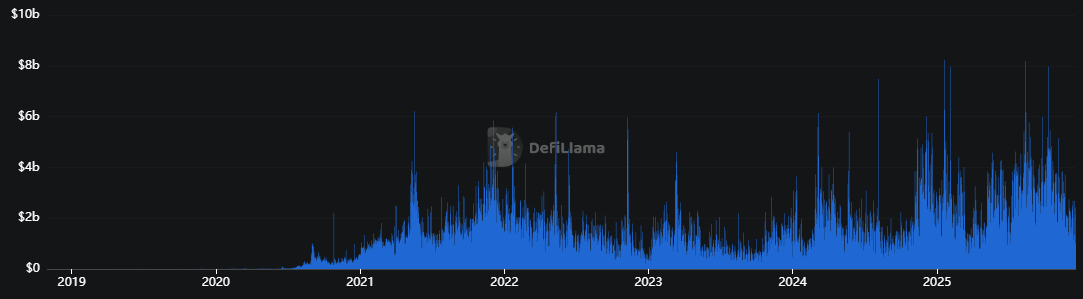
This makes the protocol the preferred trading route for aggregators, wallets, and institutional tools. A substantial portion of decentralized trading volume also flows indirectly through Uniswap. Even when users trade via other interfaces or aggregators, the transaction is often routed through Uniswap liquidity in the background. Uniswap is no longer just a single exchange. It is infrastructure. Numerous DeFi applications rely directly or indirectly on Uniswap – including wallets, payment services, lending protocols, and institutional on-chain solutions.
This systemic role makes Uniswap less dependent on short-term trends or user flows. Even if individual applications come and go, demand for deep, reliable liquidity remains. This is where the protocol’s structural strength lies. In addition, Uniswap is tightly integrated with the Ethereum ecosystem. The deliberate focus on Ethereum and compatible Layer-2 networks prioritizes security, decentralization, and network effects over maximum reach across as many chains as possible.



Governance and economic development
The UNI token serves as the governance token of the protocol. Token holders can vote on protocol changes, parameter adjustments, and strategic decisions. In recent years, the governance debate has become increasingly professionalized. A central topic is the potential activation of a protocol fee, under which a portion of trading fees could flow back to the protocol or governance. This discussion illustrates Uniswap’s transformation: away from an experiment and toward permanently relevant market infrastructure with clear economic interests.
At the same time, it is evident that decisions at Uniswap are made deliberately slowly and conservatively. Stability and trust take precedence over short-term yield optimization. The fact that Uniswap makes headlines less frequently today is primarily a sign of maturity. In the early years, every new version, every metric, and every governance proposal was intensely debated. Today, Uniswap is an established component of the market.
In an environment that is increasingly moving away from speculative narratives, the focus is on efficiency, regulatory compatibility, and sustainable usage. Uniswap meets these criteria better than many younger protocols – precisely because it does not pursue an aggressive growth strategy. Uniswap is the backbone of decentralized trading. With consistently high volume, deep liquidity, and a central role in the DeFi ecosystem, the protocol remains an indispensable part of the Ethereum economy. Anyone who views Uniswap merely as a DEX underestimates its significance.