Close Menu
Crypto Valley Journal
    Facebook X (Twitter) Instagram
    Crypto Valley Journal
    • Hot Topics
      • News
      • Minds
    • Focus
      • Background
      • Blockchain
      • Legal & Compliance
      • Non-Fungible Token (NFTs)
    • Investing
      • Markets
      • Financial Products
      • Decentralized Finance (DeFi)
      • Exchange overview
    • Education
      • Basics
      • Glossary
      • Politicians on crypto
    • Statistics
      • Bitcoin-ETF-Flows
      • Ethereum-ETF-Flows
      • Crypto market data
      • On-chain data
    • Academy
      • Overview
      • Part 1: Blockchain
      • Part 2: Money
      • Part 3: Bitcoin
      • Part 4: Cryptocurrencies
      • Part 5: Decentralized Finance
      • Part 6: Investing
    • English
      • Deutsch
    Crypto Valley Journal
    You are at:Home » Education » Basics » Why Solana is often referred to as an “Ethereum killer”
    Solana überholt Ethereum bei Nutzern – Web3 auf der Überholspur

    Why Solana is often referred to as an “Ethereum killer”

    0
    By 21Shares Research on 16. May 2025 Basics

    A comprehensive research report shows Solana taking the lead in users, developer activity, and Web3 adoption. Ethereum is falling behind. But what makes the “Ethereum killer” so special?

    The 14th edition of the quarterly crypto report by 21Shares analyzes trends, network usage, technological advancements, and macroeconomic developments in the crypto industry. The clear focus is on Solana: the high-performance blockchain dominated the first quarter of 2025 across nearly all key metrics-from active wallets to NFT trading and mobile DeFi. While Ethereum remains the DeFi leader, it is increasingly challenged by networks offering a better user experience and greater scalability.

    Subscribe to our newsletter

    The best articles of the week, directly delivered into your mailbox.

    Difference between ethereum and solana

    What fundamentally sets Solana apart from other blockchains is its unique combination of high transaction speed (TPS), low fees, and monolithic architecture. Unlike Ethereum and its Layer-2 networks, everything on Solana runs on a single layer-from DeFi to NFTs-without bridges or fragmentation. This allows users to interact with minimal friction, while developers benefit from a unified environment.

    The impressive performance is made possible by the Proof-of-History (PoH) consensus mechanism. It enables transactions to be timed and processed extremely quickly-far more efficiently than traditional proof-of-work or proof-of-stake models. On the testnet, the new Firedancer client from Jump Crypto already achieved over 1.2 million TPS-a benchmark that surpasses all existing blockchains.
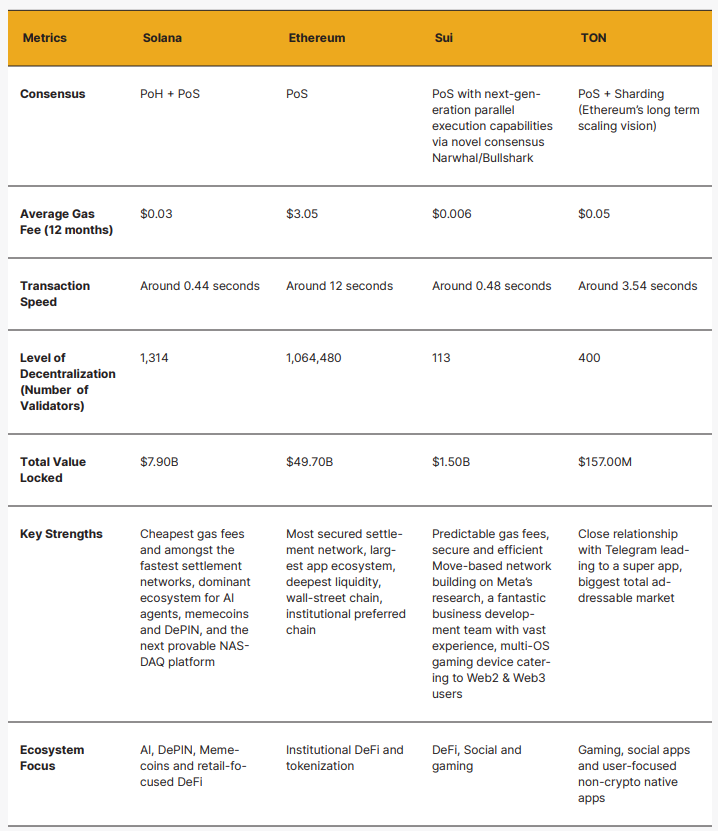
    Solana, Ethereum, Sui, and Ton compared / Source: 21Shares, Artemis, Dune

    Solana: The new powerhouse for web3 and mobile crypto adoption

    Solana has established itself in the first quarter of 2025 as the most dynamic Layer-1 ecosystem, both in terms of user activity and technological development. According to the report, Solana surpassed Ethereum for the first time in the number of active wallets and simultaneously dominated NFT and GameFi usage. Particularly striking: Solana leads in mobile wallet DeFi, highlighting the growing importance of mobile crypto applications.
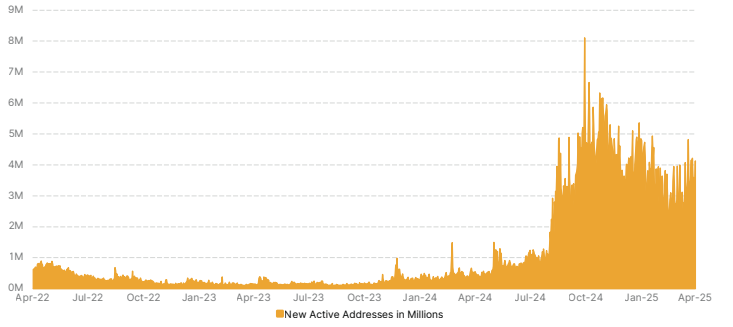
    Number of new wallets on Solana / Source: 21Shares, Artemis, Dune

    A key factor is the local fee model, which allows applications like Jupiter, Tensor, or Drift to remain consistently fast and cost-efficient-regardless of overall network traffic. At the same time, the new Firedancer client from Jump Crypto delivers a massive performance boost: with up to 1.2 million transactions per second in the testnet, Solana is nearing a new level of technological capability.

    Solana is also setting new standards in user experience: the native Phantom wallet offers cross-chain support and intuitive usability, while the Web3 smartphone Saga showcases what blockchain integration on end-user devices can look like. The ecosystem is attracting more developers and capital-a clear signal of long-term growth potential.

    Ray Dalio advises 10 to 15% gold and a small Bitcoin position, because he expects a US debt crisis within about three years. Minds

    Star investor Ray Dalio considers Bitcoin inferior to gold

    Bitcoin in 2026 trades around USD 84,000, while US spot ETFs hold about USD 102 to 104 billion and listed companies 1.27 to 1.29 million BTC. Background

    Bitcoin in 2026: what the numbers actually say

    Financial Products

    Memecoins on Robinhood Chain distort tokenized stock prices

    Basics

    Unit bias in crypto: Why cheap coins mislead investors

    Ray Dalio advises 10 to 15% gold and a small Bitcoin position, because he expects a US debt crisis within about three years. Minds

    Star investor Ray Dalio considers Bitcoin inferior to gold

    Bitcoin in 2026 trades around USD 84,000, while US spot ETFs hold about USD 102 to 104 billion and listed companies 1.27 to 1.29 million BTC. Background

    Bitcoin in 2026: what the numbers actually say

    Tokenization and institutional adoption

    Despite Solana’s rise, Ethereum remains the heavyweight in the DeFi space. However, the report shows that high transaction costs, fragmented Layer-2 solutions, and complex interfaces are hindering further growth. While scaling solutions like Arbitrum or Optimism offer some relief, new projects are increasingly shifting to Solana or alternative chains like Avalanche or Sui.

    Another central theme is the growth trend in real-world assets (RWAs). The tokenization of traditional financial instruments is gaining significant momentum-driven by initiatives such as BlackRock’s BUIDL fund, already operating on Ethereum, and USDC-backed Treasury products from Ondo Finance on Solana. The trend points toward digital capital markets, supported by growing institutional interest.


    Share. Facebook Twitter LinkedIn Email Telegram WhatsApp

    About the author

    21Shares Research
    21Shares Research
    • Website

    The 21Shares Research team provides world-class, data-driven insights into the crypto asset market. Our mission is to improve the professionalism, transparency, and accountability of actors and institutions within the industry whilst helping educate investors. To do this we produce monthly institutional-grade research on the most important topics within the industry.

    Related Articles

    Unit bias in crypto: Why cheap coins mislead investors

    The Chainalysis Crypto Crime Report puts illicit activity below 1% of on-chain volume, countering the myth of Bitcoin as a criminal currency.

    Myth: Bitcoin and cryptocurrencies mainly serve criminal activity

    Zcash hides transaction data with zk-SNARK proofs and now sits between a US spot ETF listing and the EU privacy coin ban of 2027.

    What is the privacy coin Zcash (ZEC)?

    Comments are closed.

    Isabel Schnabel of the ECB presented three models for central bank money onchain in London, ranging from direct issuance to private tokens.
    5. October 2026

    ECB sees three paths to digital central bank money (CBDC)

    CVJ Weekly review
    3. October 2026

    Weekly review: SEC launches crypto offensive without Clarity Act

    The SEC plans to permit crypto custody by investment advisers and funds through state trust companies and, in narrow cases, on their own.
    2. October 2026

    SEC proposes crypto custody rules for investment advisers

    twitter image button instagram image button linkedin image button youtube image button

    About Crypto Valley Journal
    About Crypto Valley Journal

    On the pulse of the movement

    • Academy
    • Contact
    • Advertising
    • About us
    • Partner
    • Imprint
    • Privacy
    • Disclaimer
    Search
    © 2026 ThemeSphere. Designed by ThemeSphere.

    Type above and press Enter to search. Press Esc to cancel.