For years, Ulrich Bindseil, Director General for Market Infrastructure and Payments at the European Central Bank (ECB), and his colleague Jürgen Schaaf have warned of a total loss in bitcoin investments. In a 29-page report, the two reiterate their views on the largest cryptocurrency.
Under the title "The Distributional Consequences of Bitcoin", the authors present their paper. While "most economists" see the bitcoin boom as "a speculative bubble that will eventually burst", Bindseil and Schaaf want to analyse the impact of a "bitcoin positive scenario". This scenario assumes that the price of bitcoin will continue to rise. What intuitively sounds promising, or at least not harmful, is, according to the ECB researchers, problematic for society.
The basic thesis: Bitcoin is worthless
At the end of November 2022, the two payment specialists first published a commentary on bitcoin on the European Central Bank (ECB) blog. At the time, Bindseil and Schaaf wrote that a speculative bubble had burst. The subsequent stabilisation of the price below $20,000 was described as an artificially generated last gasp before the cryptocurrency disappeared into obscurity. Two years later, a spot-based bitcoin ETF was trading in the US, Swiss state banks such as PostFinance were offering direct trading to customers, and the price of the cryptocurrency had risen +160.1%. However, the ECB duo reiterated in February that the recovery in the price of bitcoin does not indicate anything.
Their latest report echoes the same sentiment. Even 16 years after its introduction, bitcoin payments are still cumbersome, slow and expensive. Moreover, its value is considered too volatile to fulfil the classical functions of money, i.e. as a unit of account, medium of exchange and store of value. For more on the characteristics of a medium of exchange, see the resources in the CVJ.CH Academy. Today, according to Bindseil and Schaaf, bitcoin is mainly used for tax evasion, fraud, ransomware, sanctions evasion, terrorism financing, drug trafficking and money laundering. The authors conveniently ignore that illegal activities account for less than 0.5% of crypto volume.
A price increase would "impoverish" society
Since bitcoin is "worthless" and does not increase the productive capacity of the economy. The consequences of a hypothetical sustained increase in value are essentially redistributive, the ECB staff explain. The wealth effects for early bitcoin owners can only come at the expense of the consumption of the rest of society. Thus, if the price of bitcoin were to rise permanently, both non-owners and latecomers would be impoverished. As a result, society loses in a positive bitcoin scenario.
"It’s like filling one bucket by draining water from another — the latecomers have to give up for the benefit of the early holders. Thus, “missing out” on Bitcoin is not merely a lost opportunity for wealth accumulation, but means real impoverishment compared to a world without Bitcoin." - The Distributional Consequences of Bitcoin, Ulrich Bindseil and Jürgen Schaaf
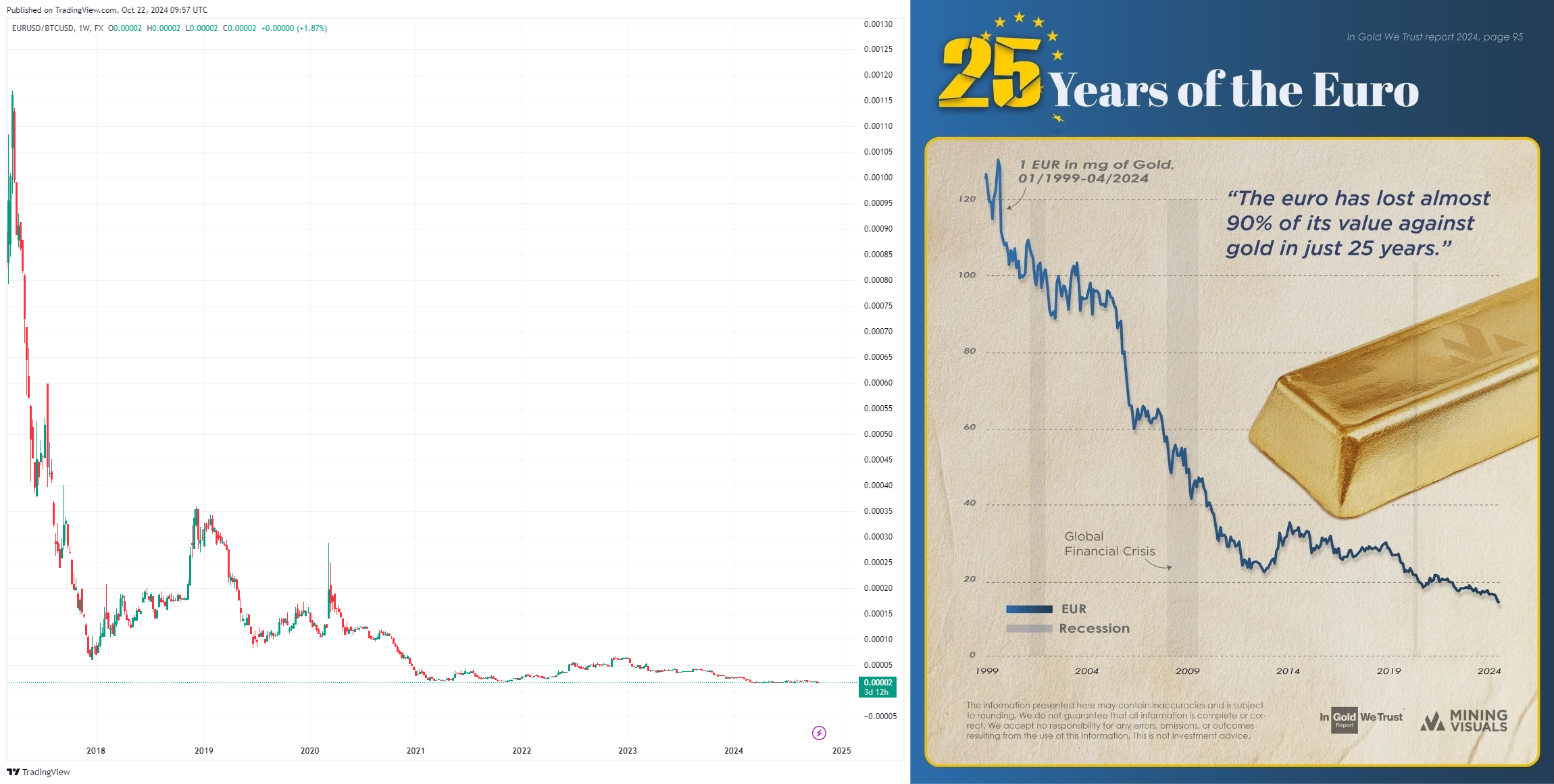
Of course, this concept could be applied to any investment. According to this thesis, a rise in the price of gold enriches the owners of the precious metal at the expense of non-owners. It overlooks the advantage of an inflation-proof asset that protects against the devaluation of an ever-diluting currency. In fact, the big loser in this trend is the EU population, whose money buys fewer goods each year. The irony is clear.
Governments must ban bitcoin
This year, the first part of the MiCA framework came into force in the EU. The comprehensive regulatory framework provides the legal basis for transactions involving crypto-assets. For Bindseil and Schaaf, such frameworks are harmful. Due to the lack of a stable "intrinsic value", the price of bitcoin is heavily influenced by government policies. This includes regulatory measures, legislation and the possible creation of a bitcoin reserve. The authors allude to Republican candidate Donald Trump's campaign promise.
Current non-holders therefore have valid reasons to oppose bitcoin. Government officials should propose legislation to prevent the price of bitcoin from rising, or to eliminate the cryptocurrency altogether. Otherwise, the redistribution of wealth and the division of society will continue. The success of such bitcoin bans can be tracked in real time in China.