
After high-profile bankruptcies of a wide variety of crypto companies, ECB General Director Ulrich Bindseil feels called to share his view in a central bank blog post. After the speculative bubble, he suspects Bitcoin will fade into irrelevance.
On the European Central Bank (ECB) blog, the Director General published an opinion piece in collaboration with ECB Adviser Jürgen Schaff. Its main focus is on the "demise" of Bitcoin (BTC). After all, Bitcoins are rarely used for legal transactions, according to the authors. A safer alternative, they say, are CBDCs. The ECB's words carry weight. After all, the monetary watchdog is the supreme supervisor of eurozone banks and has input into the European Union's financial regulation. How valid are the central bank's arguments?
End of the speculative bubble
According to the ECB Director General, it is likely that after the November 2021 peak at USD 69k and the recent FTX crash, no easing will follow. On the contrary: with high probability Bitcoin will fall into irrelevance. It was already foreseeable before the FTX debacle that the Bitcoin price would have to fall well below 16k USD. The apparent stabilization is a final, artificially induced sigh of relief before the final fall.
Since 2010, the hope for a steady increase in value has been fueled by misinformation. Bitcoin proponents do market Bitcoin as a global and decentralized digital currency. But according to the ECB director general, technical shortcomings make the cryptocurrency questionable as a means of payment. Since Bitcoin neither generates cash flow nor yields dividends, it is also unsuitable as an investment in the eyes of the authors. Finally, Bitcoin has neither a productive (like commodities) nor a social benefit, as is the case with gold, for example. Therefore, the market valuation of Bitcoin is based on pure speculation.
Bitcoin rarely used for legal transactions
Speculative bubbles depend on new money flowing in. Bitcoin, too, has repeatedly benefited from waves of new investors. The manipulations by individual exchanges or stablecoin providers during the first waves are well documented, but the stabilizing factors after the supposed bursting of the bubble in the spring are less so. Moreover, Bitcoin has never been used to any significant extent for legal transactions in the real world.
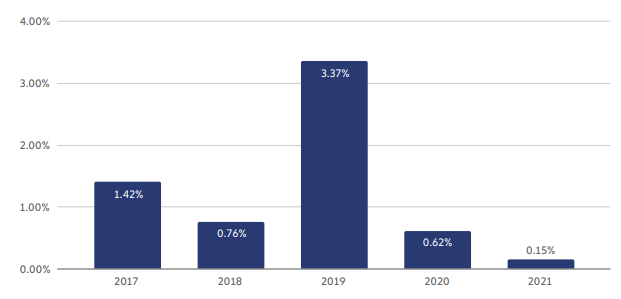
For comparison, the estimated amount of money laundered globally in a year is 2% to 5% of global GDP, or USD 800 billion to USD 2 trillion. Chainalysis statistics suggest a value of USD 14 billion in illicit cryptocurrency-based activities in 2021 - about 0.15% of the total. Of these, USD 8.6 billion can be attributed to money laundering activities. The fact that speculative transactions also do not constitute "legal" activities must be considered questionable.




Regulation provides false security
Regulators around the world are working on rules for the crypto world. It's a complex ecosystem, ranging from stablecoins to various forms of lending that take place on decentralized blockchains. In fact, according to the ECB director general, lawmakers have facilitated the influx of funds. They supported the perceived merits of Bitcoin and offer regulation that gave the impression that crypto assets were just another asset class.
The current regulation of cryptocurrencies is mired in misconceptions, he said. The belief that innovation must be given room at all costs persists. Since Bitcoin is based on a new technology - DLT / blockchain - the cryptocurrency has a high transformation potential, they say. But, according to the authors, these technologies have so far created only limited value for society. It does not matter how great the expectations for the future are, they say. The use of a promising technology is not a sufficient condition for an added value of a product based on it, they say. Cryptocurrencies are best classified by regulators as betting or gambling, Bindseil specified in an email to Reuters.
The perceived sanction of regulation has also tempted the conventional financial industry to make it easier for customers to access Bitcoin. This affects asset managers and payment service providers as well as insurers and banks, he said. The entry of financial institutions suggests to retail investors that investing in Bitcoin makes sense.
"The financial industry should be wary of the long-term damage of promoting bitcoin investment - despite the short-term gains they could make." - Ulrich Bindseil, Director General of the ECB
Competition for the digital euro?
It is worth mentioning Bindseil's central role in the elaboration and evaluation of a digital euro in the form of central bank digital currencies (CBDC). Since 2020, the European Central Bank (ECB) has been working intensively on plans for the digital cash alternative. Issued directly by the central bank, a CBDC is expected to secure new efficiencies and provide EU citizens with a reliable digital means of payment. The digital euro would facilitate settlement between large customers on the one hand and reduce dependence on FinTechs for digital payments on the other.
The legal basis is to be created by a first legislative proposal at the beginning of 2023. The reason for accelerating their existing plans is not least the rapid adoption of cryptocurrencies and stablecoins. Does the currency guardian feel threatened by a new technology?
The apparent stabilisation of bitcoin’s value is likely to be an artificially induced last gasp before the crypto-asset embarks on a road to irrelevance. #TheECBblog looks at where bitcoin stands amid widespread volatility in the crypto markets.
Read more https://t.co/Hk1LuYX2de pic.twitter.com/I3Uidks8Xo— European Central Bank (@ecb) November 30, 2022