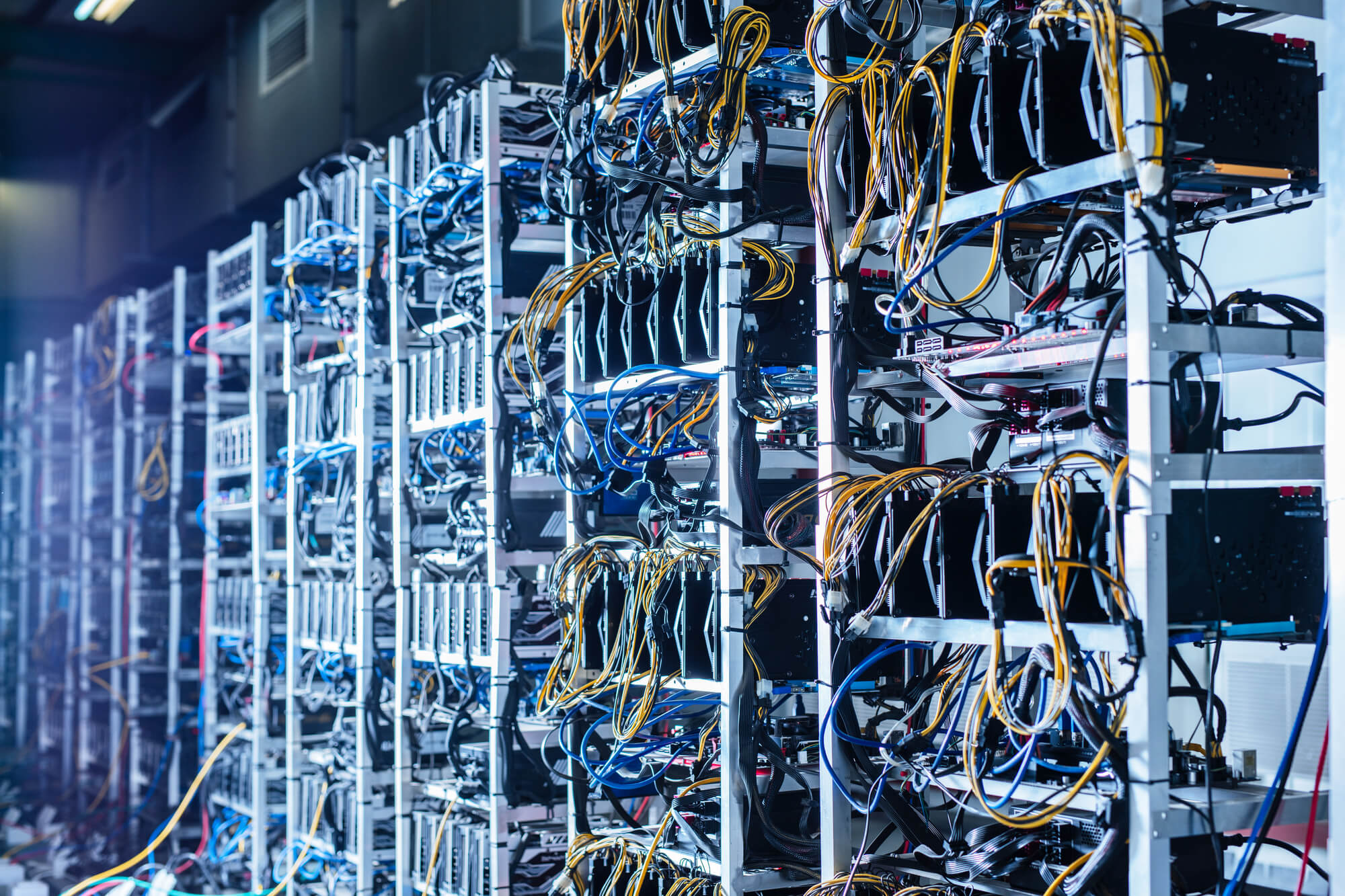
The Bitcoin mining industry is undergoing a fundamental transformation. At least eight publicly listed mining companies have announced plans over the past 18 months to partially or fully pivot toward AI infrastructure.
These include Bitfarms, Core Scientific, Riot Platforms, IREN, TeraWulf, CleanSpark, Bit Digital, MARA Holdings, and Cipher Mining. The hashprice, the key metric for mining revenues, has fallen from around 55 US dollars per petahash per second in the third quarter of 2025 to approximately 35 US dollars in early December. This represents a decline of about 35 percent. At the same time, Bitcoin is trading roughly 30 percent below its all-time high of 126'210 US dollars recorded in October 2025.
The reasons behind this strategic realignment are multifaceted. Following the halving in April 2024, the block reward was reduced to 3.125 BTC. At the same time, network difficulty climbed to record highs of 156 trillion. Average transaction fees are at historically low levels of 0.58 US dollars, eliminating an additional revenue stream. Moreover, massive demand for AI compute capacity has increased the attractiveness of a transition. AI data centers can generate up to 25 times higher revenue per kilowatt-hour than Bitcoin mining.
Bitfarms executes a radical strategic shift
Bitfarms announced the most far-reaching transformation to date in November 2025. The company plans to fully exit Bitcoin mining by 2027 and focus exclusively on AI data centers. The transition begins at its Washington site, where an 18-megawatt mining facility will be converted into a state-of-the-art AI data center equipped with Nvidia GPUs by December 2026. The new infrastructure will support workloads of up to 190 kilowatts per rack, enabled by advanced liquid cooling systems.
The company has entered into a binding agreement worth 128 million US dollars with a major US infrastructure provider, securing the entire supply chain. CEO Ben Gagnon emphasized the potential of the transformation. The conversion of the Washington site could generate more net operating income than the company has ever earned from Bitcoin mining, despite the site accounting for less than one percent of its total developable portfolio. Nevertheless, the announcement triggered a share price decline of nearly 18 percent to 2.60 US dollars, as the market reacted critically to the exit from the core business. Bitfarms reported a net loss of 46 million US dollars in the third quarter of 2025, underscoring the financial urgency of the strategic shift.
Core Scientific and Riot Platforms pursue hybrid strategies
Core Scientific is taking a differentiated approach. The company is positioning itself as a bare-metal AI infrastructure provider, offering H100 cluster rentals to AI startups and research labs. Core Scientific has signed a series of 12-year contracts with CoreWeave, providing more than 200 megawatts of GPU hosting capacity for high-performance computing operations. Total revenues from these agreements are estimated at over 6.7 billion US dollars, with the first contract alone expected to generate more than 3.5 billion US dollars. In October 2025, CoreWeave also announced its intention to acquire Core Scientific for approximately 9 billion US dollars, with the transaction expected to close in the fourth quarter of 2025.
Riot Platforms is simultaneously developing around 112 megawatts of new capacity at its Corsicana data center campus in Texas. Two-thirds of the complex will be repurposed for artificial intelligence and high-performance computing. CEO Jason Les emphasized that Bitcoin mining serves as a tool to unlock power capacity, which is now being leveraged for a new era of computing. In April 2025, the company appointed Jonathan Gibbs as Chief Data Center Officer. He brings more than 15 years of experience in large-scale data center development and investments totaling 17 billion US dollars. Analysts at Bernstein subsequently raised Riot’s price target from 19 to 25 US dollars, citing the AI potential of the 1-gigawatt Corsicana site.



Structural advantages of mining infrastructure for AI deployments
Bitcoin miners possess critical infrastructure advantages that facilitate the transition to AI data centers. Mining farms often have direct access to substations with capacities exceeding 10 megawatts. They also operate efficient cooling systems designed to handle heat-intensive machines in dense clusters. CleanSpark demonstrated this agility clearly by scaling a 100-megawatt facility within approximately six months. Traditional AI data centers, by contrast, typically require three to six years to build.
The economic case is compelling. HIVE estimates that 10 megawatts of Nvidia H100 GPUs can generate similar revenue to 100 megawatts of Bitcoin mining. Core Scientific expects a net return of 71 percent from its CoreWeave partnership contract. CleanSpark reported revenue of approximately 198.6 million US dollars in the third fiscal quarter of 2025, representing a year-over-year increase of 91 percent. MARA posted a record 252.4 million US dollars in revenue, with results swinging from a loss of 124.8 million US dollars in the prior-year quarter to a profit of 123.1 million US dollars. Not all companies were profitable, however. Cipher Mining reported a net loss of 3.3 million US dollars despite tripling revenue to 71.7 million US dollars.
Financing wave and long-term outlook for the industry
The transformation requires substantial capital investment. Publicly listed Bitcoin miners raised more than 4.6 billion US dollars through loans and convertible bonds between late 2024 and early 2025 to finance their AI projects. The CoinShares Bitcoin Mining ETF has risen by 70 percent in 2025, reflecting market expectations surrounding this strategic pivot. Analysts at JPMorgan estimate that Riot, Cipher, and IREN each have a 50 percent probability of securing additional HPC hosting contracts in the near term.
Significant challenges remain. Nick Hansen, CEO of the Luxor mining pool, described resistance to the AI transition as the greatest challenge facing Bitcoin miners in 2026. Most large miners reach break-even at around 90'000 US dollars per Bitcoin, a level currently slightly undershot by market prices. Mining remains profitable for operators with electricity costs below 0.12 US dollars per kilowatt-hour, while long-term viability generally requires costs of 0.08 US dollars or less. Diversification into AI infrastructure therefore does not appear to be an opportunistic expansion. Rather, it represents a strategic necessity for the survival of an industry confronted with shrinking margins and intensifying competition.