With the ever-increasing integration of crypto in the traditional financial world as well as in everyday life, crypto platforms need to become more accessible. Now OpenSea and MetaMask have taken a step in the right direction by enabling new payment methods for their users.
Previously, users of OpenSea and Metamask had to have cryptocurrencies available on their wallets in order to make transactions, buy other cryptocurrencies, or use other digital services. With Apple Pay integration on MetaMask and MoonPay integration on OpenSea, more user-friendly payment methods can now be provided, eliminating the time-consuming process of transferring tokens to a wallet.
Apple Pay as a payment method at MetaMask
ConsenSys' February acquisition of MyCrypto, an Ethereum wallet interface provider, should further enhance the Web3 experience via MetaMask, which is already one of the most successful browser implementations for cryptowallets, with over 20 million active users each month. The consolidation of the two companies should result in being able to offer an even richer and more secure experience.
Shortly after, MetaMask tweeted in a thread on March 29 to implement some significant updates. Besides various updates related to transactions (contract signatures, support for gasless blockchains, etc.), the main point was the integration of Apple Pay and support for Visa and Mastercard credit cards.
📣 MetaMask Mobile v4.3.1 is LIVE with some exciting updates:
Buy crypto on iOS with Apple Pay (@sendwyre), more transparency when interacting with sites, & support for gasless transactions where relevant.
Does it get any better? Yes it does! We now have dark mode! 🌑
1/🧵
— MetaMask 🦊🫰 (@MetaMask) March 28, 2022
With the integration of Apple Pay as a new payment method for MetaMask, the aim was to further increase the user-friendliness for end users and to enable people who are less familiar with the crypto world to access MetaMask. To this end, settlements should be able to be made via Apple Pay, although the application does not support direct payments in cryptocurrencies. With the help of the Wyre app's application programming interface (API) integration, transactions can still be executed via Apple Pay. At the same time, crypto purchases up to $400 can be made using debit or credit cards via the Wyre API. This now also enables the purchase of so-called stablecoins such as USDC, USDT and ultimately DAI.
By eliminating such an intermediate step for users, the acquisition process is greatly simplified and ConsenSys' goal of a user not having to leave the MetaMask app can be achieved as a result. Users love the simplicity and can use everyday payment methods to make crypto transactions without much knowledge.
ConsenSys continues to grow
ConsenSys' mission is to unleash the collaborative power of communities by making Web3 universally easy to use, accessible and extensible. MetaMask is the primary way a global user base interacts with Web3 applications. Compared to 2020, the number of active users has increased by 38 times and they get access to a universe by interacting with about 3,700 unique applications.
In November 2021, ConsenSys announced the closing of a $200 million financing round, bringing the company's valuation to $3.2 billion. In addition to new investors such as Marshall Wace, Third Point, ParaFi Capital and Think Investments, new partners such as Dragonfly Capital, Electric Capital, Spartan Group, DeFiance Capital, Animoca Brands, Coinbase Ventures and HSBC joined the consortium. In March of the following year, the company announced another closing of a $450 million funding round, again increasing the valuation and estimating the company to have a market value of over $7 billion.
With this rapid growth, ConsenSys can continue to expand its position and continue to add new features to applications such as MetaMask or MyCrypto to unleash the potential to make them more and more accessible to the great masses.
MoonPay integration in OpenSea
Since the all-time high in January, OpenSea has felt a decline in NFT trading volume and is therefore also working on usability in terms of payment methods. This is because the decrease in trading volume coincided with an upward trend in crypto prices. Rising cryptocurrency prices lead to more expensive NFTs, as they are based on pricing in cryptocurrencies. ETH rose 12.4% in March and another 8.6% in February, which also caused the prices of NFTs to skyrocket and, as a result, not as many transactions were made.
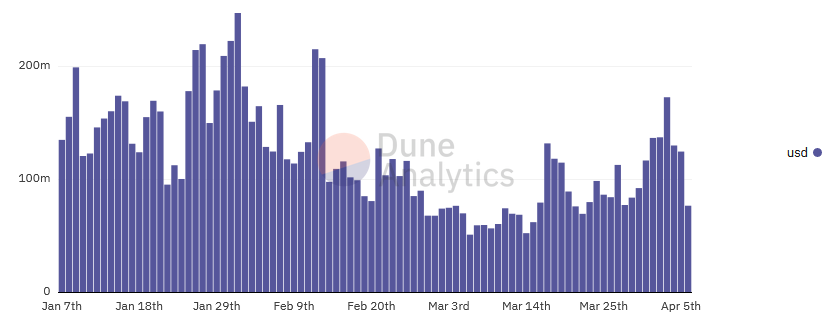
A shift away from crypto prices and payments could decouple the inverse relationship between NFTs and the crypto market. More diversified NFT payment options play a critical role in this. Recently, MoonPay announced a new partnership with OpenSea, whereby OpenSea will offer MoonPay payment options to provide OpenSea users with greater access to NFTs.
Tighter NFT regulations
As more NFT marketplaces partner with payment providers, regulatory oversight could become a factor. Since the beginning of the year, the NFT space has seen a significant increase in illegal activity. Counterfeiting, NFT hacks, wash trading, money laundering and rug pulls are some of the many issues facing NFT marketplaces today.
The ability to buy NFTs with credit or debit cards will force regulators to introduce further measures to protect investors. Such an outcome could initially hurt the NFT market before demand picks up. This week, EU lawmakers even voted in favor of KYC of "private cryptowallets." It is quite possible that regulators will target the NFT market next.