
What is a bonding loss? In its simplest form, a bonding loss occurs when a stablecoin is traded at a discount to the fiat currency it is supposed to represent. However, in strict terms and in practice, this doesn't really work.
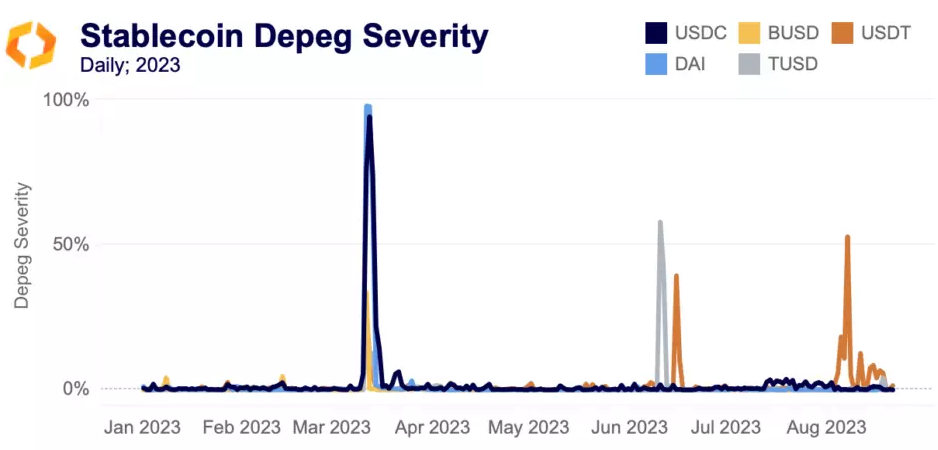
USD stablecoins consistently trade at a slight discount, typically in tenths, hundredths, or thousandths of a percent, to the US dollar. The term begins to lose its significance when we say that TUSD was traded at $0.99998 USD. Therefore, Riyad Carey of Kaiko Research has developed a better metric that uses the total volume of a stablecoin to establish a threshold for bonding loss while assigning higher values to systemically important pairs like USDC-USDT on Binance. Using this metric, he found that the most significant bonding losses among the top five stablecoins this year occurred with USDC and DAI on March 12, TUSD on June 12, and USDT on August 7.
Threshold value for the definition of a loss of binding
The global volume of stablecoins (e.g., BTC-USDT for USDT) was used to create a bonding loss threshold, which decreases as the volume of a stablecoin increases. The underlying idea is that as the volume of a stablecoin grows, the value lost due to deviations becomes more significant. Put simply, a stablecoin with a monthly volume of $10 billion USD traded at $0.995 USD is much more significant than a stablecoin with a monthly volume of $10 million USD traded at the same price. Applied to the top five stablecoins, the following results emerge:
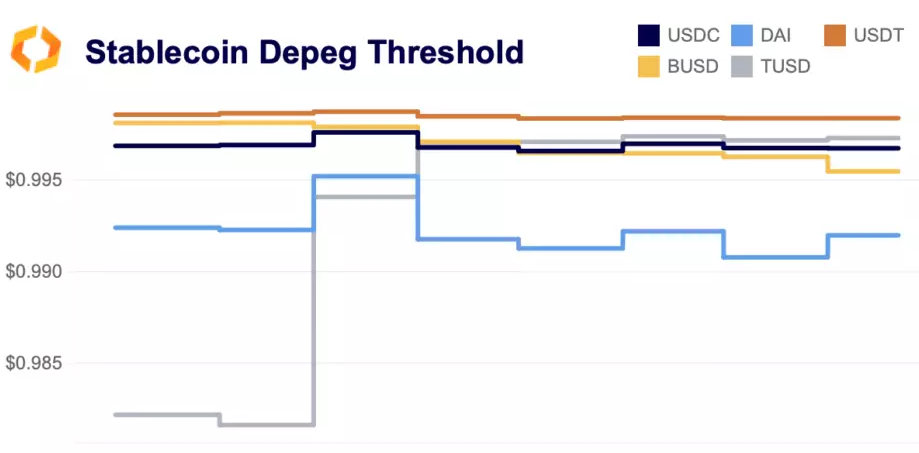
TUSD’s depeg threshold tightened rapidly from February to March as Binance began promoting the stablecoin by removing fees for BTC-TUSD. BUSD’s threshold has widened from $0.998 to $0.9955 as its volumes have fallen. USDT has had the smallest threshold throughout, at $0.998 in August despite low volumes across all markets.
Volume weighting
The chart below shows YTD stablecoin-stablecoin instrument volumes, with colors representing different exchanges. DAI has the lowest volumes of the bunch at just $17bn, nearly $13bn of which was on Uniswap V3 and Curve. TUSD is next up, with just $24.5bn in volumes, $23.5bn of which came on a single instrument: TUSD-USDT on Binance.
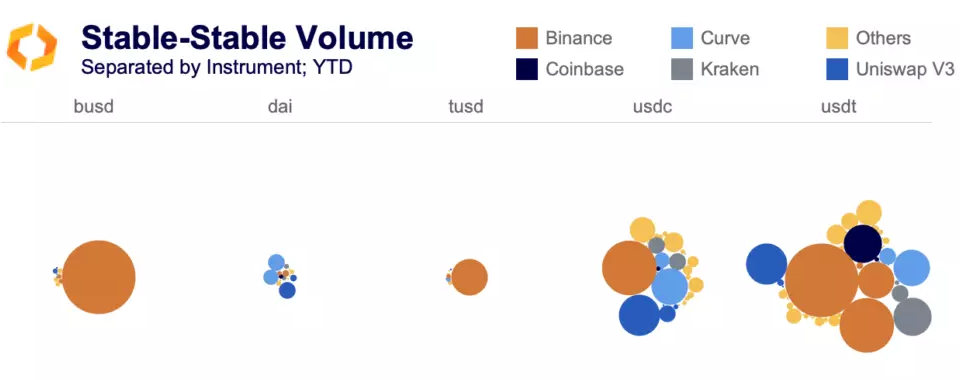
BUSD measures in at $97.5bn and is similarly concentrated, with $93bn of that coming from BUSD-USDT on Binance. USDC and USDT look quite different from the others; USDC has $150bn in volume distributed across 48 instruments while USDT has $320bn distributed across 75.
I’ve used this to create a weighting system for the instruments. For example, in TUSD’s case, TUSD-USDT on Binance is 95% of TUSD’s stablecoin-stablecoin volumes, thus it is assigned 95 points in TUSD’s data set. USDC-USDT on Uniswap V3 is 9 points in USDT’s data set and 19 points in USDC’s data set; it accounts for more of USDC’s volume and is thus relatively more important to its peg stability than it is to USDT’s. I’ve also excluded any instrument that accounted for less than 0.01% of a stablecoin’s volume. In USDC’s case, this eliminated 15 out of 48 instruments. The example below uses USDC to show why the weighting is so important.
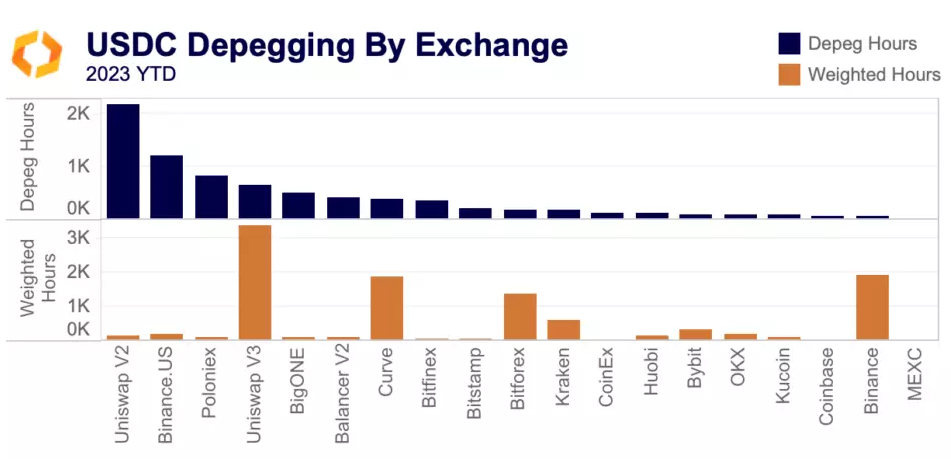
Unweighted, Uniswap V2 has by far the most “depeg hours”, which is just the number of hours that USDC has dipped below its threshold on the exchange. But Uniswap V2 is not a significant driver of USDC’s stablecoin-stablecoin volume. The same is true for Binance.US, where there have been many depegs since the exchange was included in an SEC lawsuit. There were very few USDC depeg hours on Binance, yet it is the second highest in “weighted hours” because of its high volumes. Note that I’ve excluded some exchanges with suspicious volumes; a future version of this metric may exclude more exchanges.




Summarized results
This method allows for different sensitivities to depegging. For example, looking at the beginning of August using an hourly granularity shows hours of very severe USDT depegs.
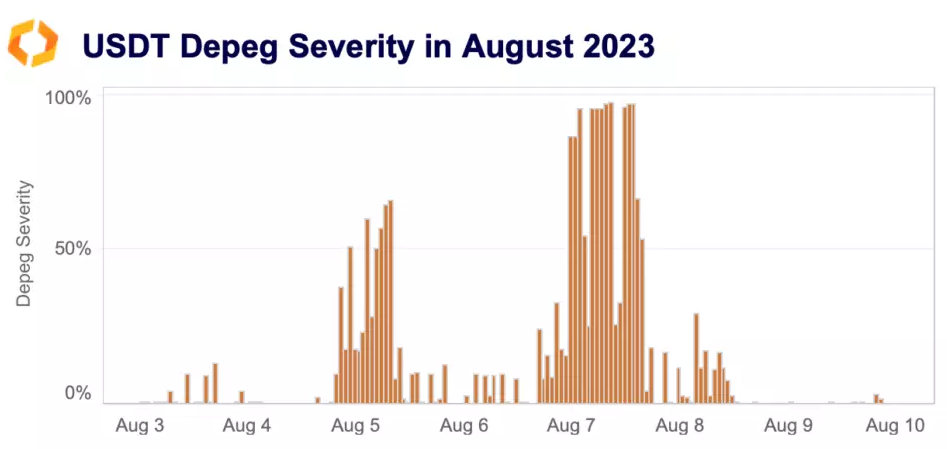
Why wasn’t this bigger news? Because the depeg wasn’t as dramatic as some past depegs in pure price terms. However, on August 7 at 8am UTC, it hit a 98% depeg severity, meaning that USDT traded at a discount on virtually every instrument. These depegs came after $500mn total net selling of USDT in just a few days on Binance, Huobi, and Uniswap. As I’ve written about previously, Tether’s redemption fee and minimum make USDT’s supply less elastic than it should be; combined with decreasing liquidity it’s not surprising to see more frequent USDT depegs.
Alternatively, it’s possible to use daily granularity for a less sensitive measure. This shows that the most severe depeg since May was TUSD on June 7, hitting nearly 60% as TUSD traded at a discount on its main Binance pair for most of the day.
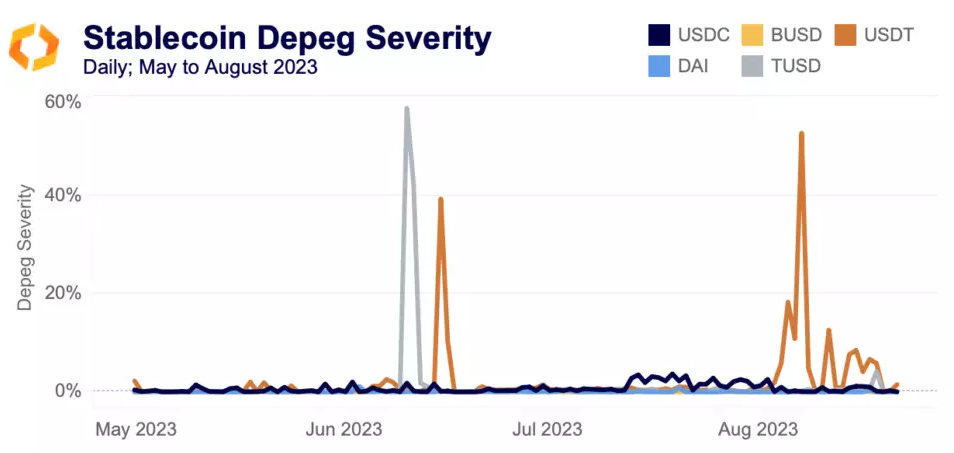
I like to refer to the daily metric using depeg magnitudes, where the magnitude is just the percentage divided by 10 [3]. So, the TUSD depeg on June 7 was a magnitude 6, while the USDT depeg that came after was a magnitude 4. To stretch the metaphor further, the magnitude 5 depeg on August 7 was preceded by a magnitude 2 foreshock on August 5 and followed by magnitude 1 aftershocks the rest of the month. Like earthquakes, anything under magnitude 2.5 isn’t usually felt. USDC, BUSD, and DAI haven’t had a magnitude 1 in the last 4 months. Finally, we can see which exchanges have been contributing the most to each stablecoin’s depegs.
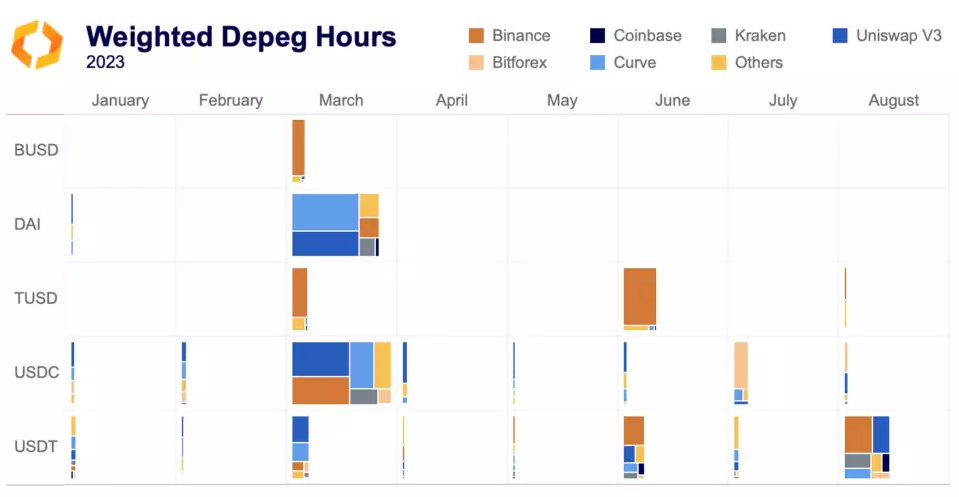
Moving chronologically, it’s interesting to note that USDT barely depegged on Binance amidst the March craziness. Instead, it depegged on Uniswap V3 and Curve. June was a bad month for both USDT and TUSD. In both July and August, Bitforex has accounted for nearly all of USDC’s weighted depeg hours. Throughout the year, BUSD has been a model of stability, which may be unexpected given its NYDFS-ordered expiration date coming early next year, but isn’t surprising to anyone who has been watching its liquidity.