
Close Menu
Crypto Valley Journal
    Facebook X (Twitter) Instagram
    Crypto Valley Journal
    • Hot Topics
      • News
      • Minds
    • Focus
      • Background
      • Blockchain
      • Legal & Compliance
      • Non-Fungible Token (NFTs)
    • Investing
      • Markets
      • Financial Products
      • Decentralized Finance (DeFi)
      • Exchange overview
    • Education
      • Basics
      • Glossary
      • Politicians on crypto
    • Statistics
      • Bitcoin-ETF-Flows
      • Ethereum-ETF-Flows
      • Crypto market data
      • On-chain data
    • Academy
      • Overview
      • Part 1: Blockchain
      • Part 2: Money
      • Part 3: Bitcoin
      • Part 4: Cryptocurrencies
      • Part 5: Decentralized Finance
      • Part 6: Investing
    • English
      • Deutsch
    Crypto Valley Journal
    You are at:Home»Focus»Background»Examining the on-chain footprint of the Bitcoin ETFs
    On-Chain Footprint of Bitcoin ETFs transaction inflows

    Examining the on-chain footprint of the Bitcoin ETFs

    By CVJ.CH Content Partner Kaiko Research on 1. March 2024 Background

    The approval of the spot Bitcoin ETFs has brought traditional finance and crypto closer together than ever before. In a new dynamic, financial institutions are interacting with on-chain bitcoin, with each ETF issuer taking a slightly different approach to management of its assets.

    In this deep dive, we’ll explore some of the behind-the-scenes movements of Bitcoin related to the ETFs to better understand how they operate. Since the new funds are all based on the spot markets, it's possible to monitor the movement on the bitcoin blockchain itself. Our findings show that:

    • Tuesday seems to be the most popular day for asset management.
    • Most transactions happen during U.S. hours and nearly all are on weekdays.
    • Outflows from Grayscale have been offset by other ETFs, which could explain BTC's current rally.

    All of these on-chain transactions affect Bitcoin’s supply, which ripples into spot markets, thus impacting price. The more we know about what is happening on-chain, the more insights we can gain into market movements.

    Subscribe to our newsletter

    The best articles of the week, directly delivered into your mailbox.

    An overview of ETF-related transactions

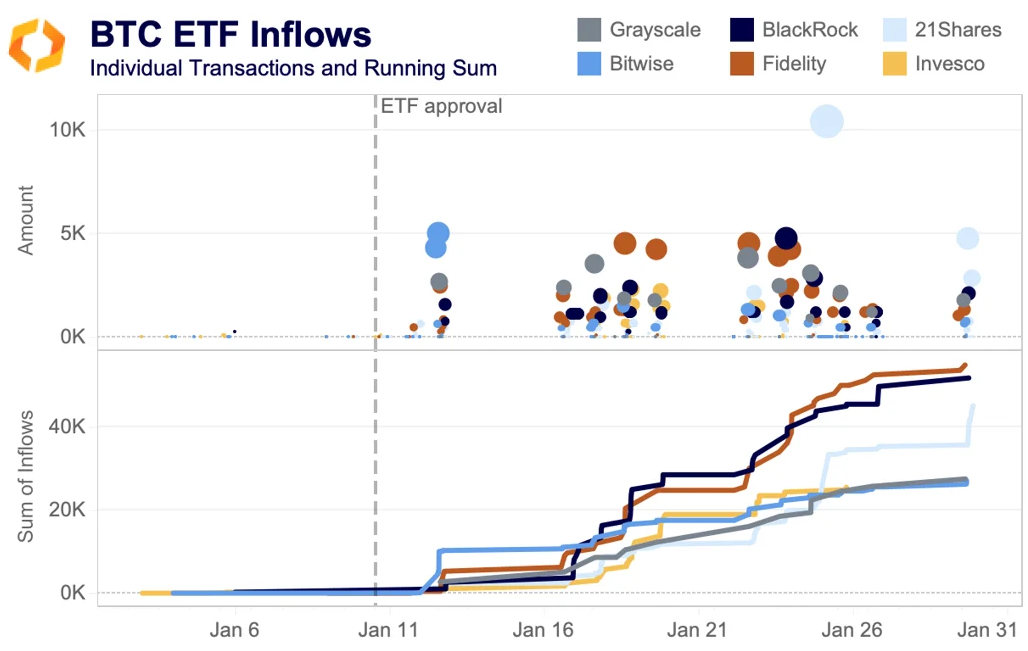
    We can begin first by looking at the first month of inflows, showing only those issuers with more than 20k BTC in total inflows. Bitwise and Invesco each registered some very small transactions, likely tests, in the days leading up to approval.
    BTC ETF inflows
    Bitcoin ETF inflows / Source: Kaiko

    What is especially interesting is the difference between strategies of the issuers, though Coinbase is the custodian for most of the ETFs and likely plays a big role in defining the strategies. For example, Bitwise showed the largest inflow on the first two days after approval, with more than 10k BTC sent to its addresses. After that, there were relatively few inflows. 21Shares had the largest single deposit in January, at more than 10k BTC. Grayscale was the outlier in that it had just a single deposit most days.
    BTC ETF On-Chain Transactions

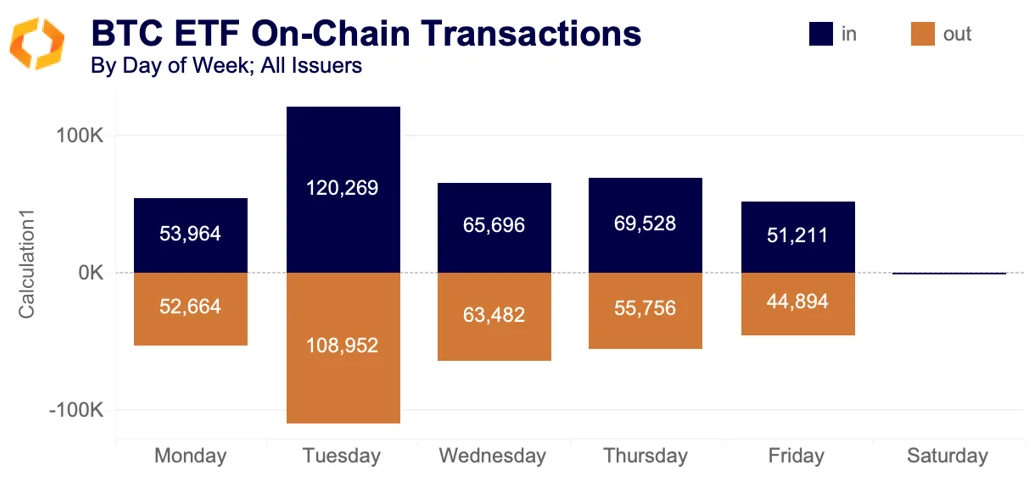
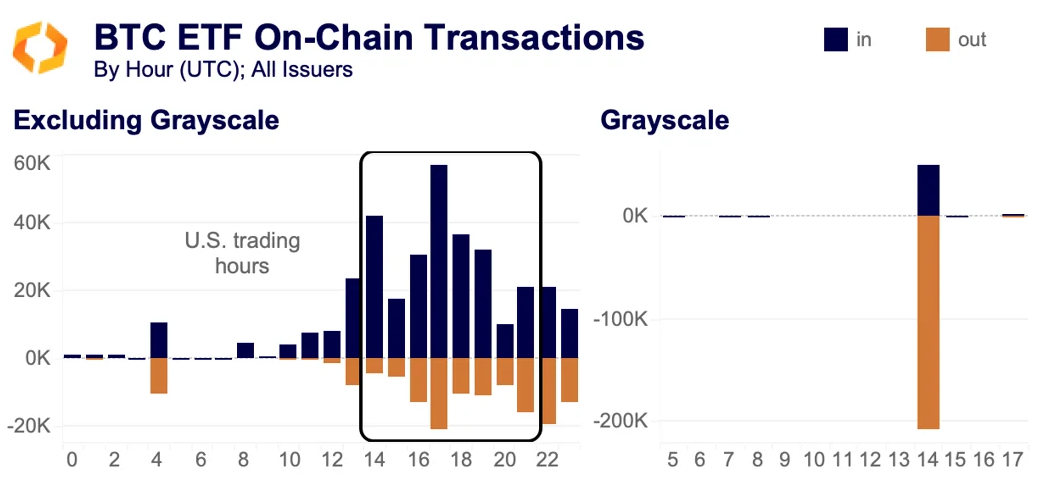
    On the whole, Tuesdays have been by far the most popular day for on-chain transfers related to the ETFs. This is largely due to Fidelity’s on-chain transfers, seemingly redistributing BTC amongst its wallets each Tuesday. The only issuers to register transactions on the weekend were Bitwise and VanEck. When it comes to timing of on-chain transactions, the vast majority occur during U.S. trading hours.
    BTC ETF On-Chain Transactions

    The only issuer with significant transactions far outside of U.S. trading hours (the bar above at 4am UTC) was the Swiss company 21Shares. Notably, Grayscale conducts virtually all of its on-chain transactions at 2pm UTC (9am ET), the start of the U.S. trading day.

    Differences between ETF issuers

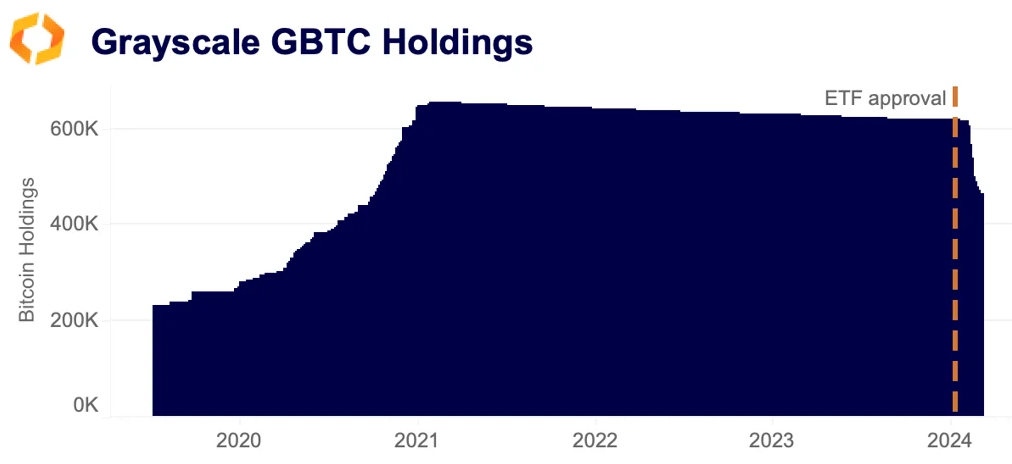
    Grayscale is the outlier in more than one way. The Grayscale Bitcoin Trust (GBTC) held over 600k BTC before it was allowed to convert into an ETF. Because of frictions with redemptions, GBTC traded at a discount to BTC for much of the bear market. Now that these frictions (and the discount) are gone, there have been persistent outflows.
    Grayscale GBTC holdings

    GBTC held 615k BTC when the ETFs were first approved, it currently holds just over 450k. Below we can see how its outflows compare to inflows in other ETFs, as well as how its outflows have slowed significantly in the last two weeks.
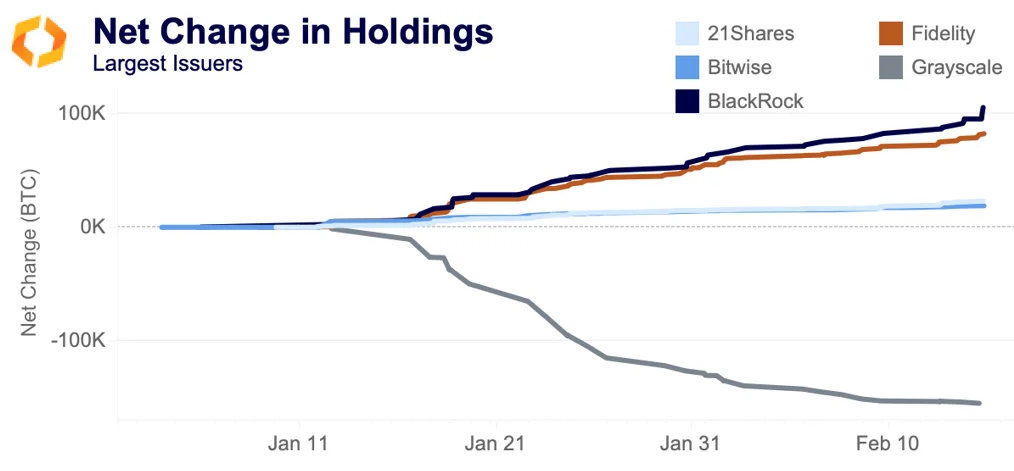
    net change in holdings

    While Grayscale stabilizes, BlackRock and Fidelity have shown the largest net inflows, with BlackRock recently breaching 100k BTC, while Fidelity stands at 80k. Both have grown at a consistent rate since trading began in January. 21Shares and Bitwise are the last two with over $1bn in holdings; they have been growing at a nearly identical rate. The inflows into new ETFs have been more than enough to offset outflows from Grayscale, with 20 out of 29 trading days showing net inflows.
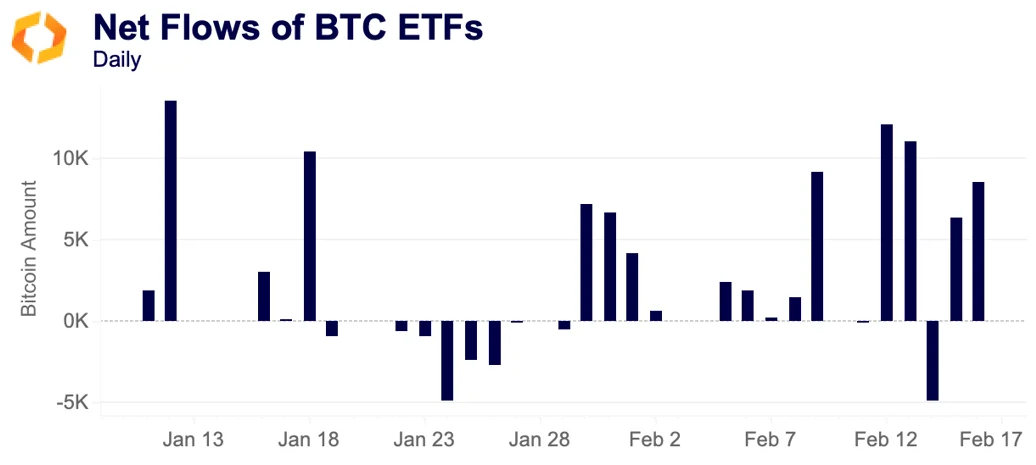
    net flows of BTC ETFs

    Bitcoin’s supply is increasingly flowing into the ETFs, suggesting consistent demand for these products. BTC has begun to rally as outflows have slowed.


    Ray Dalio’s Bridgewater Associates Minds

    Star investor Ray Dalio considers Bitcoin inferior to gold

    Analysis by Bitget Research on Bitcoin quantum computing risks, ECDSA exposure, NIST post-quantum standards, and BIP-360 migration paths. Background

    Bitcoin quantum computing: What recent developments mean for network security

    JPMorgan warns: Recurring DeFi exploits and stagnant ETH-denominated TVL curb institutional engagement in the DeFi sector. DeFi

    JPMorgan: DeFi hacks and TVL losses weigh on institutional investors

    Basics

    Unit bias in crypto: Why cheap coins mislead investors

    Ray Dalio’s Bridgewater Associates Minds

    Star investor Ray Dalio considers Bitcoin inferior to gold

    Analysis by Bitget Research on Bitcoin quantum computing risks, ECDSA exposure, NIST post-quantum standards, and BIP-360 migration paths. Background

    Bitcoin quantum computing: What recent developments mean for network security

    Conclusion

    The first month of this new interaction between traditional finance and crypto has gone remarkably well, with no obvious hiccups present in the on-chain data. The ETFs are already large holders of BTC, representing about 3.5% of supply; the growth of their holdings shows no sign of slowing down. Because of this, it will become increasingly important to monitor on-chain transactions to determine where this supply is coming from and how it is being held. The change in on-chain dynamics will likely affect existing spot markets, potentially impacting liquidity going forward.


    Share. Facebook Twitter LinkedIn Email Telegram WhatsApp

    About the author

    CVJ.CH Content Partner Kaiko Research
    • Website

    Kaiko is one of the leading cryptocurrency market data providers for institutional investors and enterprises. They aim to empower market participants with accurate, transparent, and actionable financial data to be leveraged for a range of market activities. Kaiko’s mission is to be the foundation of the new digital finance economy by serving as a single source for market information.

    Related Articles

    Admiral Paparo confirmed to the US Senate: INDOPACOM operates an active Bitcoin node and is conducting operational tests to protect military networks.

    US military operates Bitcoin node in the Indo-Pacific

    Bitcoin fails again at the 80'000 USD mark, profit-taking weighs on ETH, SOL and XRP despite Strategy purchase and ceasefire.

    Bitcoin price climbs to 80’000 USD – profit-taking hits ETH, SOL and XRP

    Satzlänge: 32.7% der Sätze enthält mehr als 20 Wörter, was mehr als das empfohlene Maximum von 25% ist. Du solltest versuchen, die Sätze zu kürzen. Bindewörter: Keiner der Sätze beinhaltet Bindewörter. Verwende welche. Gute Ergebnisse (5) Passiv: Du verwendest nicht zu viel Passiv. Das ist großartig! Abgeschlossene Sätze: Es gibt keine sich wiederholenden Satzanfänge. Das ist großartig! Verwendung von Zwischenüberschriften: Gut gemacht! Absatzlänge: Es gibt keine Absätze, die zu lang sind. Gut gemacht! Wortkomplexität: Du nutzt nicht zu viele komplexe Worte, was deinen Text leicht zu lesen macht. Gute Arbeit!

    New documentary seeks to unveil the mystery behind Satoshi Nakamoto

    The US Senate has unanimously passed a prediction market ban for members and staff. The trigger is a series of insider trading scandals.
    1. May 2026

    US Senate bans members from trading on prediction markets

    Robinhood misses Q1 2026: crypto revenue halved to 134 million USD, stock falls 11 percent. Schwab and Coinbase intensify competition.
    30. April 2026

    Robinhood misses Q1 estimates: Crypto revenue cut in half

    Canada announces national crypto ATM ban. Roughly 4,000 machines are affected as Ottawa targets fraud and money laundering.
    29. April 2026

    Canada bans crypto ATMs

    twitter image button instagram image button linkedin image button youtube image button

    About Crypto Valley Journal
    About Crypto Valley Journal

    On the pulse of the movement

    • Academy
    • Contact
    • Advertising
    • About us
    • Partner
    • Imprint
    • Privacy
    • Disclaimer
    Search

    Type above and press Enter to search. Press Esc to cancel.