Close Menu
Crypto Valley Journal
    Facebook X (Twitter) Instagram
    Crypto Valley Journal
    • Hot Topics
      • News
      • Minds
    • Focus
      • Background
      • Blockchain
      • Legal & Compliance
      • Non-Fungible Token (NFTs)
    • Investing
      • Markets
      • Financial Products
      • Decentralized Finance (DeFi)
      • Exchange overview
    • Education
      • Basics
      • Glossary
      • Politicians on crypto
    • Statistics
      • Bitcoin-ETF-Flows
      • Ethereum-ETF-Flows
      • Crypto market data
      • On-chain data
    • Academy
      • Overview
      • Part 1: Blockchain
      • Part 2: Money
      • Part 3: Bitcoin
      • Part 4: Cryptocurrencies
      • Part 5: Decentralized Finance
      • Part 6: Investing
    • English
      • Deutsch
    Crypto Valley Journal
    You are at:Home » Focus » Background » Ripple launches own stablecoin: the end of XRP?
    Ripple lanciert eigenen Stablecoin: das Ende für XRP?

    Ripple launches own stablecoin: the end of XRP?

    By Editorial Office CVJ.CH on 8. April 2024 Background

    The US dollar stablecoin market is currently concentrated in the hands of two companies: Tether and Circle. Now, Ripple wants to enable blockchain payments with a dollar stablecoin via the XRP ledger. Is the company waving the white flag and admitting the failure of its own XRP cryptocurrency?

    Ripple was founded in 2012 as a crypto startup with the goal of creating a decentralized digital payment system. The company wanted to enable low-cost cross-border transactions and differentiate itself from Bitcoin by offering a more scalable solution. The foundation of this payment network was to be the XRP cryptocurrency, formerly known as "Ripple". However, over the past decade, the company has struggled to establish XRP as a means of payment. Instead, Ripple is now looking to enter the lucrative stablecoin market.

    Subscribe to our newsletter

    The best articles of the week, directly delivered into your mailbox.

    Stablecoins: a billion-dollar business

    Stablecoins are a type of cryptocurrency designed to offer the best of both worlds: the instant processing and security of crypto payments, along with the stable valuations of fiat currencies. Essentially, the value of a stablecoin is tied to a fiat currency such as the US dollar. As a result, they are popular as a base pair for crypto trading on both centralized and decentralized exchanges. Currently, there is an impressive $154 billion of stablecoins in circulation.
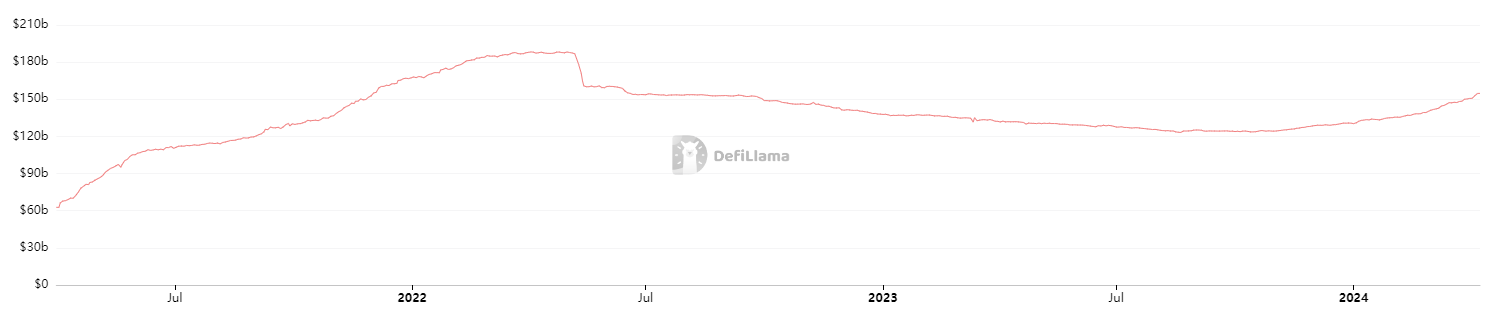
    Total market capitalization of all stablecoins / Source: DeFi Llama

    The leading stablecoins are centrally managed and backed by liquid dollar equivalents. The USDT stablecoin of the first and largest player, Tether, stands at over $100 billion. According to its own website, about 65% of this is invested in US Treasury bonds. The remaining 35% is covered by reverse repo agreements, money market funds and smaller individual positions. The returns generated go to Tether itself; users of the stablecoin do not receive any payouts. It is estimated that Tether generated $6.2 billion USD from this strategy last year, huge numbers for a company with only 100 employees. It is easy to see why Ripple would want to get into the stablecoin business.

    USDT @tether_to produced an estimated $6.2 billion in net income in 2023.

    That's 78% of the number Goldman Sachs did ($7.9bn) and 72% of Morgan Stanley's ($8.5b).

    They have ~100 employees. GS has 49,000. MS has 82k.

    Source @MaelstromFund pic.twitter.com/4GjVZZHjBr

    — Teddy Fusaro (@teddyfuse) April 7, 2024

    Ripple launches its own stablecoin

    The Ripple stablecoin will also be backed 1:1 by dollar equivalents, according to CNBC. The company will determine the mix of dollar deposits, U.S. Treasuries and cash equivalents. All reserves will be disclosed in publicly available monthly certification reports. Competitors Tether and Circle also publish similar reports, although the lack of a comprehensive audit of the USDT stablecoin has been a topic of discussion for years. Ripple also did not mention an auditing firm.

    According to Ripple CEO Brad Garlinghouse, the company is entering the stablecoin business in response to the losses it has suffered in recent years due to pegging issues. Last March, USDC briefly dipped below 80 cents when one of the custodians of the underlying assets, Silicon Valley Bank (SVB), filed for bankruptcy. USDT also deviated slightly from $1 when the algorithmic stablecoin TerraUSD (TUSD) collapsed in 2022. Garlinghouse also hinted that there is some uncertainty about Tether's support.


    Ray Dalio’s Bridgewater Associates Minds

    Star investor Ray Dalio considers Bitcoin inferior to gold

    Most crypto cards hide who issues them. After mapping the licensed issuers, here is why Switzerland's self-issuing model reads differently. Background

    The bank you never chose: who really issues Switzerland’s crypto cards

    Robinhood Perpetual Futures in Europe now cover commodities and currencies, and the broker plans a crypto launch in the United Kingdom. Financial Products

    Robinhood Perpetual Futures expand to commodities in Europe

    Digital finance transparency relies on Proof of Reserves, Merkle trees, MPC custody and 24/7 monitoring to verify solvency and user assets. Basics

    Transparency as the foundation of security in digital finance

    Ray Dalio’s Bridgewater Associates Minds

    Star investor Ray Dalio considers Bitcoin inferior to gold

    Most crypto cards hide who issues them. After mapping the licensed issuers, here is why Switzerland's self-issuing model reads differently. Background

    The bank you never chose: who really issues Switzerland’s crypto cards

    Is Ripple abandoning the XRP cryptocurrency?

    For years, Ripple has been trying to convince financial institutions to use XRP as a payment method. The company's website lists some of the world's largest banks as partners. However, actual adoption of the cryptocurrency has lagged behind its market valuation. The underlying XRP ledger processes an average of $20 billion in volume per month. By comparison, bitcoin processes the same amount every twelve hours. And the vast majority of on-chain volume is attributed to token speculation.

    But the launch of its own stablecoin does not mean that Ripple has abandoned the XRP cryptocurrency as a payment token, said CEO Brad Garlinghouse. Rather, it is a complementary product to the XRP ecosystem.

    "We believe that native liquidity pools on the XRP Ledger complement the XRP ecosystem and contribute to its growth. In fact, the most common request we receive from the XRP community is the introduction of a USD-backed stablecoin on the XRP Ledger." - Brad Garlinghouse, CEO of Ripple


    Share. Facebook Twitter LinkedIn Email Telegram WhatsApp

    About the author

    Editorial Office CVJ.CH
    • Website
    • Twitter
    • LinkedIn

    Since 2018, the editorial team at Crypto Valley Journal has been reporting from Zug - the heart of Switzerland’s Crypto Valley - on Bitcoin, cryptocurrency, blockchain, and regulatory developments in digital assets. Behind the publication’s collective editorial voice is a team of writers with backgrounds in financial markets, law, and technology.

    Related Articles

    The US banking regulator OCC grants Circle National Trust final approval to operate as a federal trust bank for digital assets.

    OCC grants Circle National Trust a bank license

    Most crypto cards hide who issues them. After mapping the licensed issuers, here is why Switzerland's self-issuing model reads differently.

    The bank you never chose: who really issues Switzerland’s crypto cards

    More than 100 financial firms, including BlackRock, Visa, and Mastercard, are founding the Open Standard consortium and planning to launch the OpenUSD stablecoin in the second half of the year.

    OpenUSD: BlackRock, BNY, Visa, Stripe, and others plan dollar stablecoin

    A field hearing in New York aims to push the CLARITY Act through the US Senate before the summer recess. Here is what is at stake.
    13. July 2026

    July 17: House hearing aims to push the CLARITY Act through the Senate

    The DOJ dropped its USD 722 million BitClub Ponzi case against Goettsche just before trial, after two Trump-linked lawyers intervened.
    13. July 2026

    DOJ drops charges against BitClub founder Goettsche

    CVJ Weekly review
    11. July 2026

    Weekly review: 80mn bank customers in Germany gain access to crypto

    twitter image button instagram image button linkedin image button youtube image button

    About Crypto Valley Journal
    About Crypto Valley Journal

    On the pulse of the movement

    • Academy
    • Contact
    • Advertising
    • About us
    • Partner
    • Imprint
    • Privacy
    • Disclaimer
    Search

    Type above and press Enter to search. Press Esc to cancel.