
Close Menu
Crypto Valley Journal
    Facebook X (Twitter) Instagram
    Crypto Valley Journal
    • Hot Topics
      • News
      • Minds
    • Focus
      • Background
      • Blockchain
      • Legal & Compliance
      • Non-Fungible Token (NFTs)
    • Investing
      • Markets
      • Financial Products
      • Decentralized Finance (DeFi)
      • Exchange overview
    • Education
      • Basics
      • Glossary
      • Politicians on crypto
    • Statistics
      • Bitcoin-ETF-Flows
      • Ethereum-ETF-Flows
      • Crypto market data
      • On-chain data
    • Academy
      • Overview
      • Part 1: Blockchain
      • Part 2: Money
      • Part 3: Bitcoin
      • Part 4: Cryptocurrencies
      • Part 5: Decentralized Finance
      • Part 6: Investing
    • English
      • Deutsch
    Crypto Valley Journal
    You are at:Home » Focus » Background » The rise of decentralized exchanges (DEXes)
    The rise of decentralized exchanges (DEXes)

    The rise of decentralized exchanges (DEXes)

    By Editorial Office CVJ.CH on 23. October 2025 Background

    Decentralized exchanges (DEXes) have established themselves in 2025 as a stable pillar within the crypto ecosystem. Despite the recent market crash, they continue to sustain high trading volumes, demonstrating that decentralization is no longer a niche topic.

    After years of rapid development, decentralized exchanges (DEXes) are entering a new market phase: rising trading volumes, growing institutional adoption, and robust systems even under stress conditions. The recent crash served less as a setback and more as a stress test, showing just how resilient DEX infrastructures have become.

    Subscribe to our newsletter

    The best articles of the week, directly delivered into your mailbox.

    Difference and market structure

    Unlike centralized exchanges (CEXes) such as Binance or Coinbase, DEXes operate without intermediaries – transactions are executed directly via smart contracts. Two main types have emerged: spot DEXes (e.g. Uniswap, Balancer) for direct token swaps, and perpetual DEXes (e.g. Hyperliquid, dYdX, Aevo) for derivative trading with no expiry.

    Both segments are expanding rapidly, though their momentum differs: spot DEXes benefit from growing retail activity, while perp DEXes are increasingly attracting institutional interest.


    Ray Dalio’s Bridgewater Associates Minds

    Star investor Ray Dalio considers Bitcoin inferior to gold

    CLARITY Act DeFi Background

    CLARITY Act: The year’s most important crypto deal heads for a decision

    Hyperliquid ETFs post record daily inflows of 25.5 million USD. HYPE token gains double digits and beats Bitcoin on a market-adjusted basis. Financial Products

    HYPE all-time high: Hyperliquid ETFs post record inflow of 25 million USD

    Digital finance transparency relies on Proof of Reserves, Merkle trees, MPC custody and 24/7 monitoring to verify solvency and user assets. Basics

    Transparency as the foundation of security in digital finance

    Ray Dalio’s Bridgewater Associates Minds

    Star investor Ray Dalio considers Bitcoin inferior to gold

    CLARITY Act DeFi Background

    CLARITY Act: The year’s most important crypto deal heads for a decision

    Record volumes and market shares

    Spot DEX trading volume exceeded around 900 billion USD in the third quarter of 2025, up more than 25% from the previous quarter. Perpetual trading operated at a similar level – led by Hyperliquid, which dominates the sector with over 70% market share and more than 6 billion USD in total value locked (TVL).

    New challengers like Aster show, however, that market shares are shifting. Following its token generation event in September 2025, Aster’s token price surged by more than 1,650%, TVL reached 1 billion USD – and at times, Aster even surpassed Hyperliquid in trading volume.
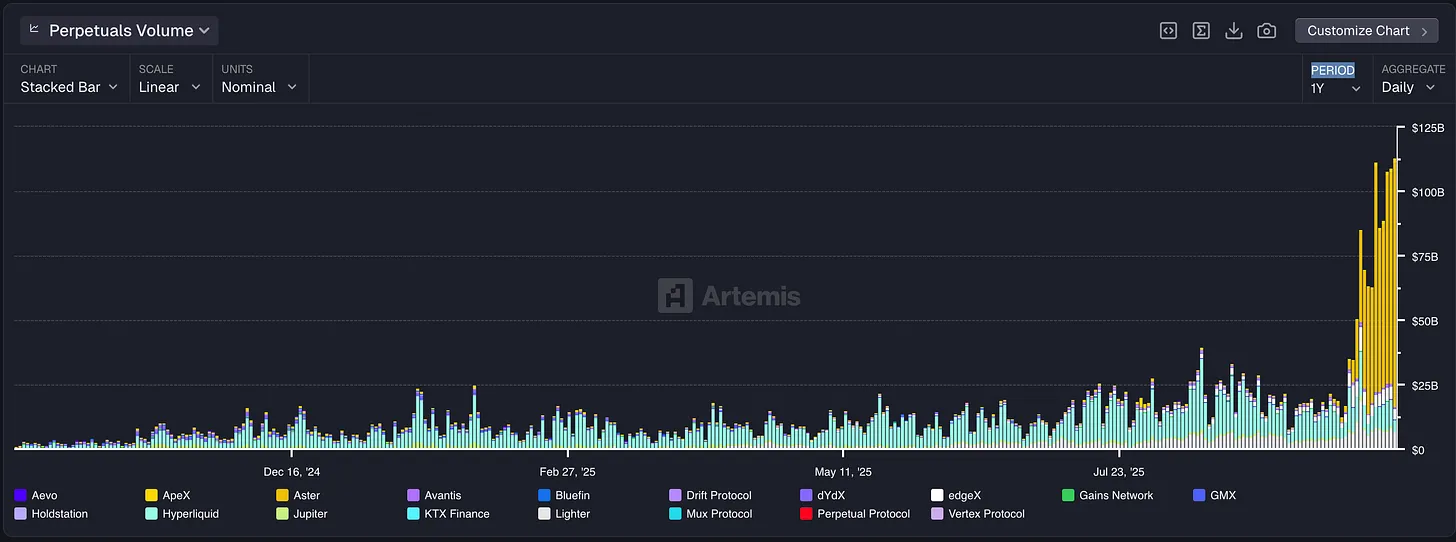
    Perpetual trading volume of leading decentralized exchanges (DEXes) / Source: Artemis

    Crash and volatility as stress test

    The crypto crash on October 10, 2025 – which saw over 20 billion USD in leveraged positions liquidated – also affected DEXes, yet they remained remarkably stable. While centralized exchanges experienced temporary outages, major DEX protocols continued operating. On Solana-based platforms alone, more than 8 billion USD was traded during the crash.

    Such periods of extreme volatility also expose weaknesses: slippage, liquidity withdrawals, and oracle-induced price deviations can temporarily affect trade quality. Nevertheless, activity remained high – reflecting growing confidence in decentralized trading infrastructures.

    Despite crashes and price swings, the DEX market continues to consolidate. Platforms like Hyperliquid and Aster demonstrate that decentralized trading venues are not only technologically mature but also crisis-resilient. DEXes have passed their stress test – and are moving step by step toward the mainstream.


    Share. Facebook Twitter LinkedIn Email Telegram WhatsApp

    About the author

    Editorial Office CVJ.CH
    • Website
    • Twitter
    • LinkedIn

    Since 2018, the editorial team at Crypto Valley Journal has been reporting from Zug - the heart of Switzerland’s Crypto Valley - on Bitcoin, cryptocurrency, blockchain, and regulatory developments in digital assets. Behind the publication’s collective editorial voice is a team of writers with backgrounds in financial markets, law, and technology.

    Related Articles

    Hyperliquid ETFs post record daily inflows of 25.5 million USD. HYPE token gains double digits and beats Bitcoin on a market-adjusted basis.

    HYPE all-time high: Hyperliquid ETFs post record inflow of 25 million USD

    SpaceX Pre-IPO perpetual on Hyperliquid implies valuation above USD 2 trillion, four weeks before the planned Nasdaq listing on 12 June.

    Hyperliquid prices SpaceX IPO above USD 2 trillion

    Goldman Sachs liquidiert im Q1 2026 alle XRP- und SOL-ETF-Positionen, kürzt Ethereum um 70% und eröffnet HYPE-Treasury-Position PURR.

    Goldman Sachs fully liquidates XRP and Solana ETFs

    The SEC delays its innovation exemption for tokenized stocks indefinitely. Third-party tokens have emerged as the central sticking point.
    25. May 2026

    SEC delays innovation exemption for tokenized stocks

    cvj weekly review
    23. May 2026

    Weekly review CW 21: SpaceX reveals $1.5 billion Bitcoin investment

    Polymarket exploit on Polygon: the UMA CTF Adapter loses more than 520,000 USD to labelled exploiter addresses.
    22. May 2026

    Polymarket exploit: prediction market loses $520k to attackers

    twitter image button instagram image button linkedin image button youtube image button

    About Crypto Valley Journal
    About Crypto Valley Journal

    On the pulse of the movement

    • Academy
    • Contact
    • Advertising
    • About us
    • Partner
    • Imprint
    • Privacy
    • Disclaimer
    Search

    Type above and press Enter to search. Press Esc to cancel.