


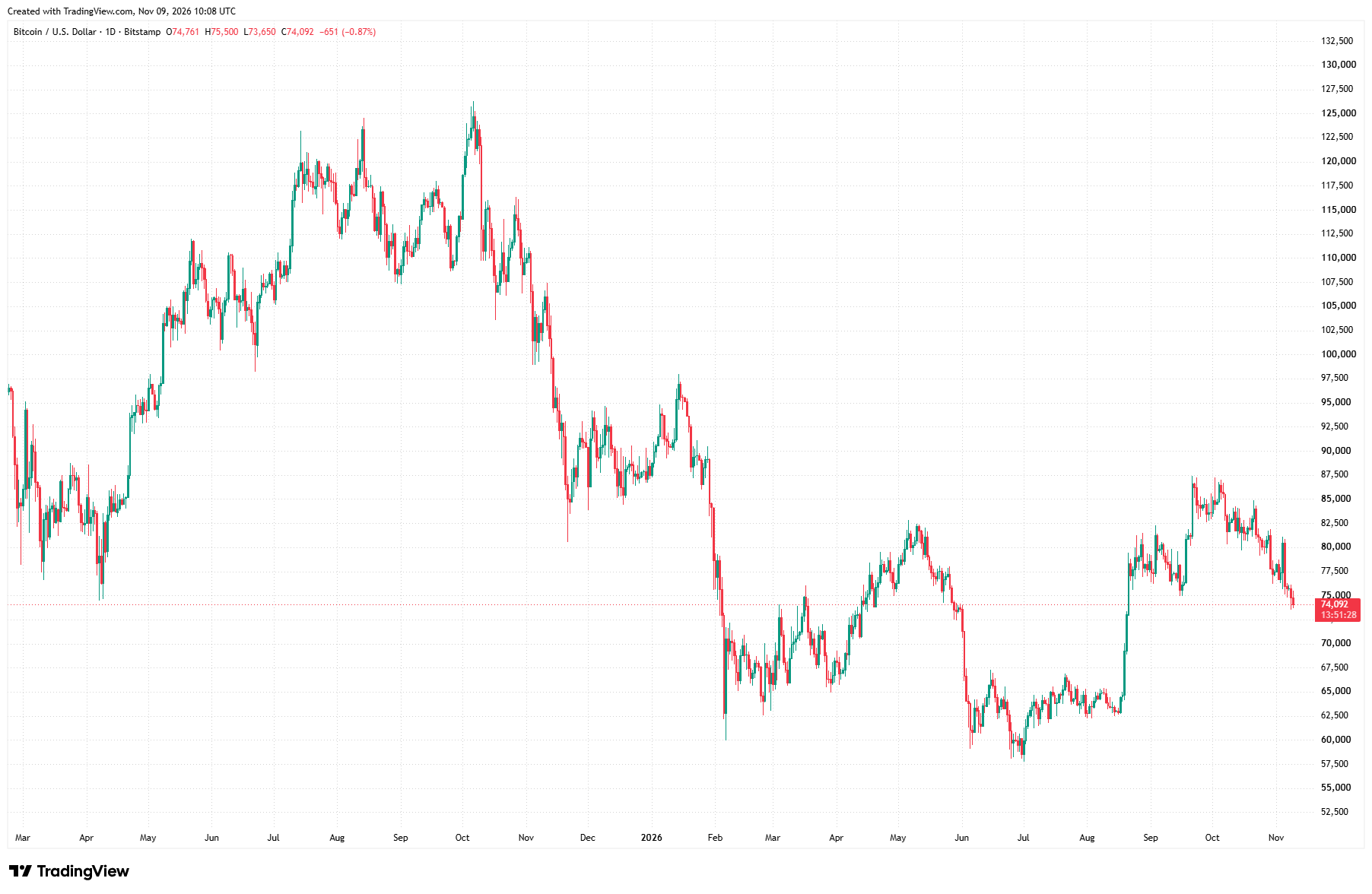
Bitcoin fell to USD 73,708 overnight into Monday following the US midterms, its lowest level since August. Ether even lost around 5% and briefly slipped below USD 2,100, because investors fear stricter regulation from a Democrat-controlled Congress.
The midterms are the elections held halfway through a US president's term. Voters elect the entire House of Representatives and part of the Senate. Both chambers write the laws for the crypto market, and their committees also set the political agenda. In early November, the Democrats secured both chambers. Before that, the Senate had let the market structure bill CLARITY Act fail in September 2026. At the end of October, Bitcoin still traded above USD 80,000. Then, on the day of the Binance hack, a slide liquidated more than USD 356 million in leveraged long bets. After the latest low, the price briefly recovered to above USD 75,000, but the rebound stalled.
The midterms give Democrats both chambers
The Associated Press called both chambers for the Democrats in early November. In the Senate, the party gained seven seats and currently holds 54 to 44 seats. Alaska and Mississippi are still undecided. Among others, it flipped Texas, which last voted Democratic in 1988, as well as Ohio and Iowa. The Republicans, by contrast, did not flip a single seat. According to CNN, Democrats are heading for more than 250 House seats, the largest majority in almost 20 years. However, counting there continues.
The election went badly for the crypto industry. In Ohio, Sherrod Brown, former chair of the Senate Banking Committee, defeated Republican Jon Husted. The industry had previously spent heavily against Brown. In addition, crypto-friendly Republicans Bryan Steil, Zach Nunn and Ann Wagner lost their House seats. At the same time, prominent crypto critics won their races, according to Reuters. As a result, the bet on a friendly Congress did not pay off.
Committee assignments now become decisive. Observers see Elizabeth Warren as the favorite to chair the Senate Banking Committee. Maxine Waters is likely to take over the House Financial Services Committee, although Sean Casten is challenging her. Neither is settled yet, especially since the new Congress only convenes in January 2027. As chair, Warren would gain subpoena power and control over the committee's agenda. What tends to get overlooked is the Senate filibuster rule, which still requires 60 votes for legislation. The new majority therefore gives Democrats hearings and subpoenas at first, but no free hand on legislation.
CLARITY Act expires in January
The CLARITY Act is the central market structure bill for crypto assets in the US. It aims to define which tokens fall under the securities regulator SEC and which under the futures regulator CFTC. The House passed the bill in July 2025 by 294 to 134 votes. Later, the Senate Banking Committee advanced it in May 2026 by 15 to 9 votes.
On the Senate floor, however, the bill failed in September 2026. The cloture motion, which would have opened debate, received only 49 to 50 votes. Thus, it fell eleven votes short of the required 60, and no final vote took place. Disputes centered on ethics rules for crypto dealings by officials and the Trump family. Furthermore, the banking lobby resisted yields on stablecoins, and another conflict concerned banking activities. Notably, the bill failed under a Republican Senate majority, not because of resistance from the incoming Democratic majority.
On January 3, 2027, the bill expires with the outgoing Congress. Consequently, the new Congress would have to start the process from scratch. Yet the SEC is not waiting for lawmakers. In August 2026, it proposed the "Regulation Crypto Assets" rulebook, followed in September by an order on tokenization. Finally, SEC Chair Paul Atkins promised to act with or without legislation. For now, market structure regulation is shifting to the agencies. So the legislative path had already stalled before the election.




Binance hack, Nvidia and Iran add pressure on the market
At the end of October, attackers drained around USD 6.3 billion from wallets at the crypto exchange Binance. It is the largest crypto theft to date, ahead of the USD 1.5 billion Bybit hack in 2025. The stolen funds ended up on ten blockchains, and most of them left within about 20 minutes. TRM Labs and Chainalysis attribute the attack to the North Korean group TraderTraitor, while Pyongyang denied involvement. Binance estimates the frozen funds at around USD 3 billion. Tether and Circle also froze around USD 2.6 billion in their stablecoins. In addition, the exchange plans to cover the loss from its SAFU emergency fund. Binance has set aside USD 6 billion for it. The initial investigation names an engineer's laptop as the point of entry. In the wake of the hack, the Fed and the OCC are now asking banks about vulnerabilities.
On Sunday, two triggers from outside the crypto industry added to the pressure. Nvidia's board opened an independent investigation into CEO Jensen Huang. A committee of independent directors runs it together with outside lawyers. Huang nevertheless remains in office. In an email to employees, he admitted to an affair. According to reports, US intelligence agencies classified the woman as a Chinese spy, although Reuters could not independently verify this. The board sees no reason to believe that the matter affects national security or company secrets. Meanwhile, talks with Iran collapsed. US Secretary of State Marco Rubio called Iran's demands "outrageous." Since the start of the Iran war in March, Bitcoin has mostly fallen during oil rallies.
The available evidence does not clearly show which factor drove the weekend decline. Reuters mainly attributes it to regulatory concerns and cites the Binance hack as an additional burden. CoinDesk, on the other hand, sees Nvidia and the Iran talks as the immediate triggers of the swings. And the hack happened ten days ago. A direct link to weekend prices is therefore an interpretation, not an established fact.
Bitcoin holds just above the 200-day average
Forced liquidations in the futures market accompanied the decline. Within 24 hours, exchanges forcibly closed leveraged positions worth more than USD 1 billion. Of that, USD 913 million came from long positions, meaning bets on rising prices. Ether accounted for USD 448 million and Bitcoin for USD 272 million. The largest single liquidation likewise involved Ether, an order worth USD 48 million.
On Monday morning, Bitcoin traded at around USD 74,100 and Ether at around USD 2,106. That leaves Bitcoin between two closely watched technical levels. Traders treat the 200-day average at around USD 73,150 as support. The 100-day average at around USD 77,430 serves as resistance. The overnight low was just under USD 560 above the lower level. On a weekly basis, Ether lost comparatively more than Bitcoin, at around 7.1% versus around 4.6%. The crypto market trades on weekends too. Stock markets, however, only react to the Nvidia investigation and the Iran talks from Monday. Consequently, whether the rebound holds depends heavily on traditional markets. The key political decisions come later, when the new Congress convenes in January 2027.