
As the crypto market stages its latest recovery, numerous altcoins are posting significant gains. NEAR Protocol has emerged as one of this year’s standout performers, with its token more than quadrupling since its February low. A closer look at the fundamentals behind the rally.
Following a prolonged downtrend, NEAR briefly fell below $1 in February 2026. Since then, its price has recovered to over $4.50, with particularly strong gains in the second half of September. On September 17, NEAR unveiled new features for confidential derivatives trading. At the same time, the platform reached $70 million in total value locked (TVL). These announcements coincided with a sharp price rally and a broader recovery in the crypto market.
However, NEAR has evolved beyond a traditional Layer-1 blockchain. The network is increasingly positioning itself as infrastructure that enables users and applications to move assets across different blockchains. At the heart of this strategy is NEAR Intents.
NEAR Intents: Trading Across Blockchains
NEAR Protocol’s key growth product is NEAR Intents, a technology that simplifies transactions across different blockchains. Instead of manually transferring assets through a bridge and then swapping them on a decentralized exchange, users simply specify their desired outcome. For example, they can swap Bitcoin for USDC on Ethereum without having to execute each step themselves.
Specialized service providers known as solvers compete to execute these orders. They source the required liquidity and handle the technical execution. This positions NEAR Intents as a cross-chain trading infrastructure that can also be seamlessly integrated into existing wallets and trading platforms.
Adoption is expanding through integrations with platforms such as Ledger Wallet and SimpleSwap. For these platforms, Intents can serve as an additional source of liquidity, without requiring users to interact directly with the NEAR blockchain.
This opens up a business model that extends beyond NEAR’s own blockchain. NEAR could potentially benefit from trading activity on Ethereum, Solana and other networks. However, this depends on whether integration partners continue to use its infrastructure over the long term and whether NEAR captures a share of the resulting fees.
Confidential Transactions for Institutional Applications
With Confidential Intents, NEAR is expanding its trading infrastructure to support confidential transactions. Trade sizes and other sensitive information do not have to be fully disclosed publicly, while the technology still allows selective disclosure for compliance purposes.
In September, NEAR introduced confidential derivatives trading using Hyperliquid’s infrastructure
. Separately from derivatives trading, the total value locked (TVL) in Confidential Intents surpassed $70 million. The official NEAR dashboard now reports approximately $113 million.
The combination of cross-chain trading and confidential execution could be particularly attractive to institutional market participants. However, the integrations announced so far do not yet provide evidence of widespread institutional adoption.
Artificial Intelligence as a Second Growth Driver
In parallel, NEAR is developing NEAR AI, an infrastructure for confidential AI applications and autonomous software agents. This year’s developments include the IronClaw agent platform and partnerships with Venice AI, Brave and the Government of Bermuda.
Since July, users have also been able to stake NEAR and earn credits for AI computing resources, creating an additional use case for the token. Unlike Intents, however, meaningful public data on revenue, paying customers and actual utilization remains limited. Its economic potential is therefore difficult to quantify.
Core Blockchain Activity Remains Limited
Activity on NEAR’s underlying blockchain has been less dynamic. A comparison with established Layer-1 competitors such as Solana shows that usage remains relatively modest. According to DefiLlama, NEAR records around 60,000 daily active addresses, compared with 3.11 million on Solana. NEAR’s total value locked (TVL) stands at just 3% of Solana’s, while its market capitalization is approximately 8.5% of Solana’s.
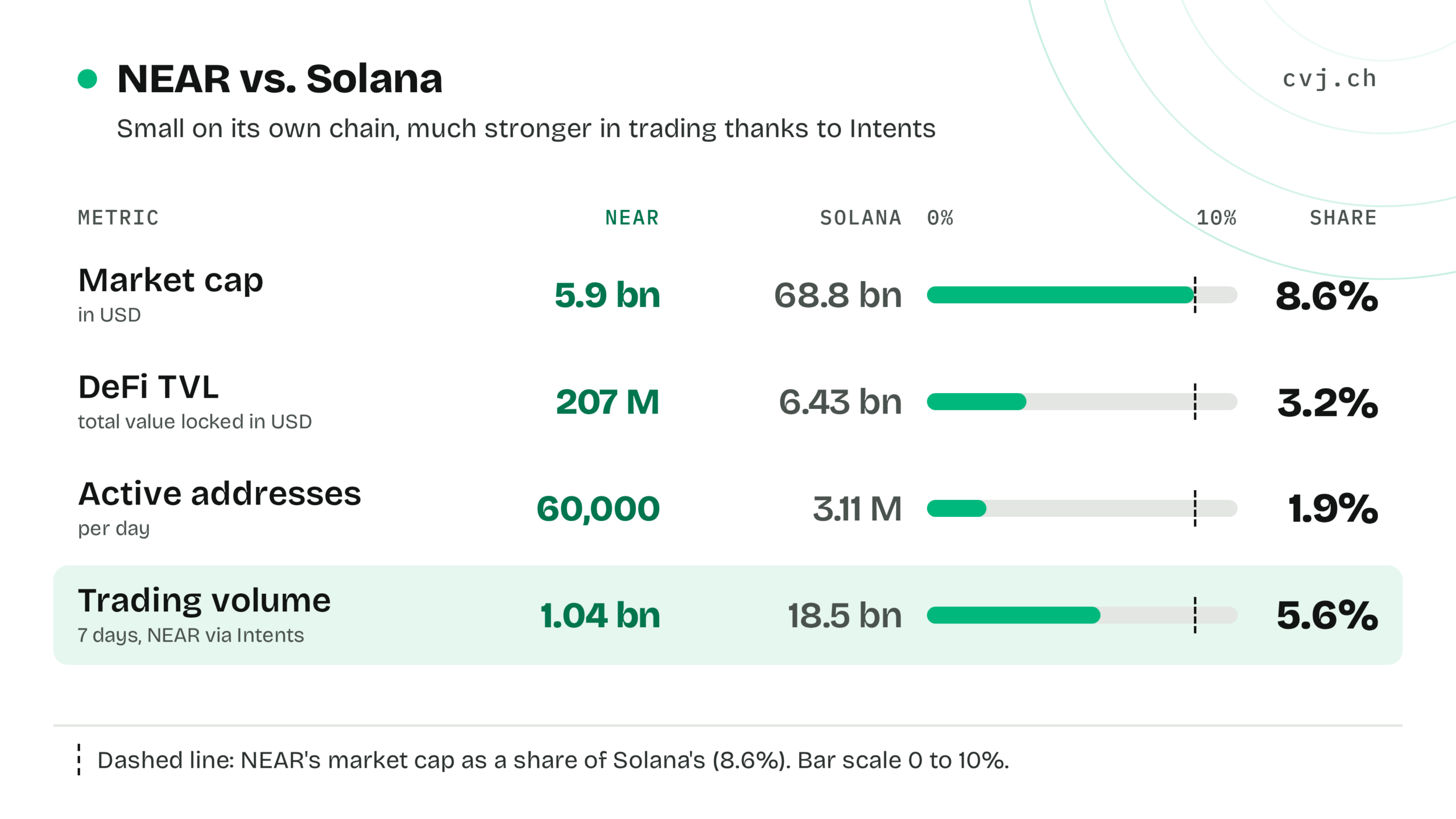
NEAR Intents now processes around $1.3 billion in weekly trading volume, equivalent to approximately 6–7% of Solana’s DEX volume. However, the comparison is of limited significance, as some of these transactions are also executed on Solana. The figures highlight how NEAR’s growth is increasingly taking place beyond its traditional Layer-1 activity.
Tokenomics: Lower Inflation and New Token Buybacks
NEAR’s tokenomics have also evolved. At the end of 2025, the maximum annual token inflation rate was halved from 5% to 2.5%. Since February, NEAR has also been using revenue generated by Intents to buy back tokens on the open market.
The official NEAR dashboard
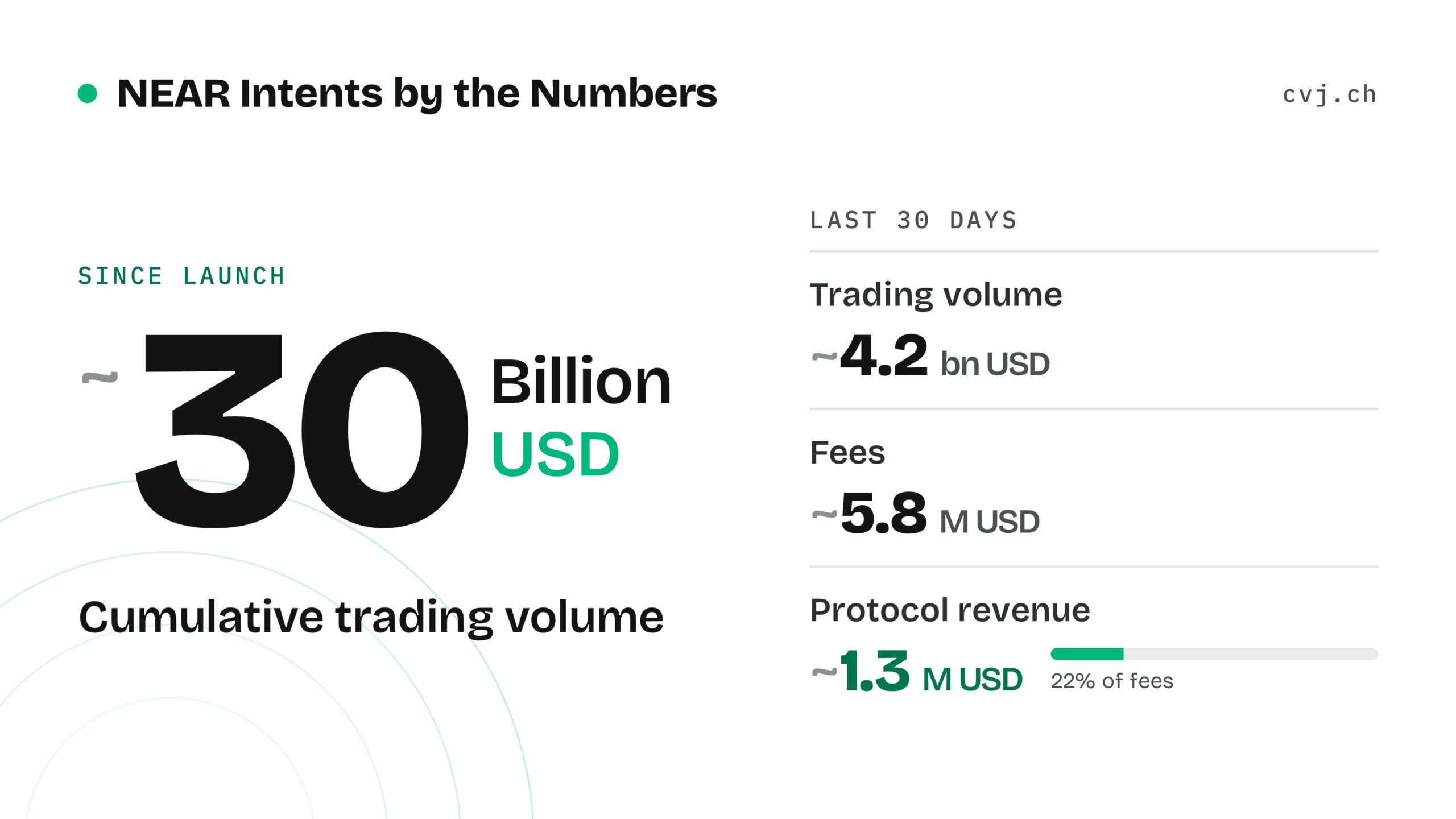
currently reports around $2 million in monthly net revenue, equivalent to approximately $24 million on an annualized basis. At a market valuation of roughly $6 billion, this compares with an annual value of approximately $150 million in new token issuance at the maximum inflation rate.
Buybacks therefore currently offset only a limited portion of token inflation. However, they establish a direct link between the growth of Intents and demand for the NEAR token.



How Much Growth Is Already Priced In?
At a valuation of approximately $6 billion, NEAR currently trades at around 250 times its annualized net revenue, according to the official NEAR dashboard. A substantial portion of its current valuation therefore still depends on future growth.
If Intents were to increase its monthly trading volume from the current $4.3 billion to $40 billion, annualized net revenue could reach approximately $230 million, assuming the ratio between trading volume and total net revenue remains unchanged. This would bring the valuation multiple down to around 26. Such a multiple would be easier to justify for a fast-growing technology platform than today’s valuation, but would require sustained growth and a corresponding increase in revenue over time.
At the same time, the resulting token buybacks could theoretically exceed the value of the maximum annual new token issuance. This would significantly reduce inflationary selling pressure, without automatically reducing the total token supply.
Beyond a Traditional Layer-1 Blockchain
NEAR has increasingly evolved from a direct competitor to other Layer-1 blockchains into a cross-chain trading infrastructure. With Intents, the network now has a product processing billions of dollars in trading volume and generating measurable revenue. NEAR AI opens up additional use cases, although its economic significance remains uncertain.
The key to NEAR’s future fundamental development will be whether Intents can sustain its growth, secure additional institutional integrations and generate lasting revenue growth. At a valuation of approximately $6 billion, substantial growth expectations are already priced in.