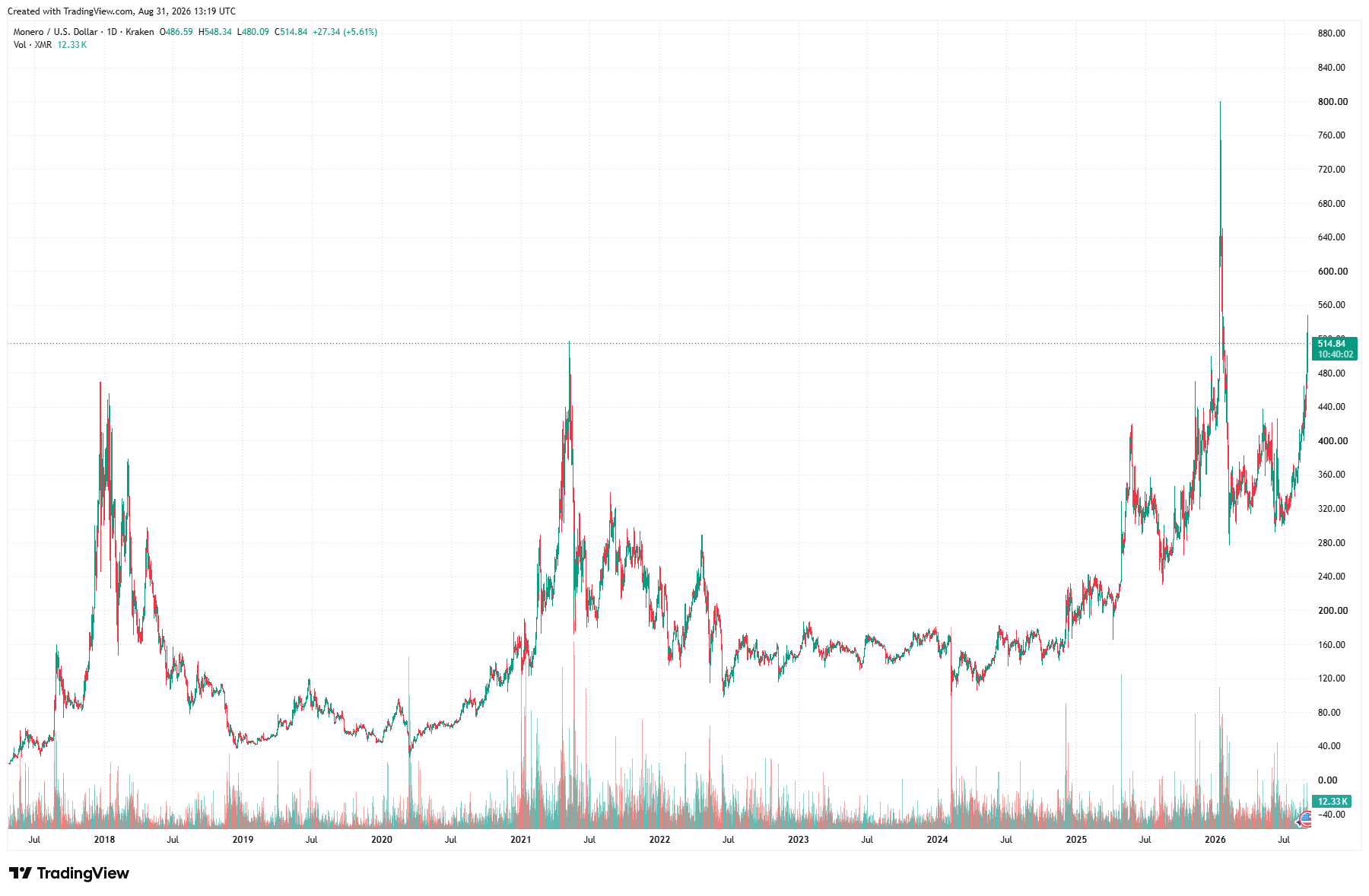
Monero (XMR) has reached a 7-month high and now trades at around USD 546. Over 30 days, the price thus gained 50.67%, in parallel with the THORChain upgrade to version 3.20.
Monero is the largest privacy coin by market capitalization. The network hides sender, receiver and amount of every payment through ring signatures and stealth addresses. Yet that property also makes it a recurring target for regulators. Centralized exchanges have therefore dropped the coin from their offerings over the years. Monero itself dates back to 2014. The latest impulse came from THORChain, a decentralized cross-chain liquidity protocol for swaps between blockchains. In late August, the protocol laid the technical groundwork for native Monero swaps with version 3.20. Immediately after the release, the price rose by roughly 8.9%. Overall, market capitalization stands at USD 10.27 billion. That places XMR at rank 12 among all cryptocurrencies. Over one year, XMR also sits 108.67% higher.
THORChain groundwork lifts Monero to a 7-month high
THORChain connects several blockchains through a network of liquidity pools and validators. Users swap assets directly between chains there, without entrusting them to an exchange. Centralized venues, by contrast, demand an account, verification and custody of the holdings. Until now, that has not worked for Monero. Anyone who wanted to swap XMR for Bitcoin first needed a centralized exchange or a wrapped token. Wrapped versions map a coin onto a foreign chain and therefore require trust in the issuer.
Version 3.20 shipped in late August. The accompanying press release announced native swaps of Monero and Zcash against Bitcoin, Ethereum and stablecoins. Two days later, THORChain corrected that description on its own blog and postponed the activation of both coins. On the protocol website, Monero is still missing from the list of supported chains. So XMR is not yet tradable through THORChain. Instead, the upgrade delivered the underlying infrastructure. That includes FROST threshold signatures, key generation, vault rotation and the observation of transactions. In addition, memoless swaps arrived. Monero's transaction field holds only 16 bytes and cannot carry the usual THORChain memos.
Version 3.20 also changes several things beyond the privacy coins. The protocol introduces protocol-owned liquidity and can thus place its own capital into the later XMR and ZEC pools. A so-called stable reserve furthermore enables swaps between stablecoins without liquidity fees. Moreover, the team restored trading on Solana, Base and BNB Chain. A vault exploit of roughly USD 10.7 million had temporarily paralyzed the protocol in May 2026. Version 3.19 had previously resumed operations.
Binance, OKX and Coinbase avoid Monero
Access through the large trading venues has been shrinking for years. Binance announced the delisting of Monero in February 2024. The exchange then halted trading and deposits at the end of October that same year. Withdrawals stayed open until the end of the year. Finally, the platform converted remaining balances automatically. As a result, the deadlines put holders under time pressure. OKX likewise removed XMR from its offering in 2024. Both firms rank among the largest crypto exchanges worldwide. The withdrawal thus hit one of the most important markets for XMR.
Coinbase has never listed Monero. In the US, owning XMR remains legal. FinCEN, the IRS and the Treasury Department, however, classify the coin as an elevated risk. The limited traceability of transactions drives that assessment. At the same time, the classification raises compliance requirements for regulated providers. Consequently, the largest privacy coin gradually vanished from the offerings of the market leaders.
XMR nevertheless remains tradable. Kraken still lists the coin outside the European Economic Area, and KuCoin and MEXC do the same. Access now depends more on a user's residence than on the choice of exchange. A decentralized protocol, meanwhile, ties trading to no listing decision. That is where the planned THORChain integration comes in. However, that route is not open yet.



EU anonymity ban hits Monero from July 2027
In Europe, the sharpest intervention still lies ahead. The EU anti-money laundering regulation, Regulation (EU) 2024/1624, targets anonymous accounts. As of 10 July 2027, it bars regulated crypto service providers from offering them. From that date, the rules also forbid handling anonymity-enhancing coins such as Monero. Crypto service providers include exchanges, custodians and brokers with a license in the EU. The regulation applies directly in all member states and therefore needs no national transposition. Ownership by private individuals, though, remains legal. The rules target regulated access, not the holding of the coins.
Individual providers have already anticipated the rule. Kraken dropped XMR for users in the European Economic Area at the end of 2024. The exchange pointed to the coming MiCA regulation. With the deadline, licensed platforms in all EU member states lose the option to offer XMR. For now, the firms still have a good ten months of lead time. The switch affects customer accounts, custody and trading pairs alike. Switzerland belongs to neither the EU nor the EEA and consequently falls outside the regulation. Rather, the Anti-Money Laundering Act and the practice of FINMA remain decisive here. Swiss providers with EU-licensed subsidiaries or branches nevertheless face the rule through those entities.
The EU is not alone on this course. Japan barred its exchanges from listing privacy coins back in 2018. South Korea followed in 2020 with a directive from the financial regulator. Subsequently, the requirement became legally binding in 2021. Dubai's financial regulator DFSA similarly banned licensed platforms in the DIFC free zone from trading Monero and Zcash. Regulated access keeps narrowing worldwide as a result. Licensed platforms are retreating, while a trading route without a listing decision should emerge through THORChain. The protocol has announced this route and prepared it technically, but has not switched it on so far.