In a 2022 revision of the Anti-Money Laundering Act, the Swiss Financial Market Supervisory Authority lowered the requirements for a Know Your Customer (KYC) procedure for crypto transactions to CHF 1,000. Now, Neuchâtel-based crypto broker Bity is fighting back against FINMA's regulations with a complaint.
Swiss crypto company Bity filed a complaint against the Swiss Financial Market Supervisory Authority (FINMA) last week, according to a recent fundraising appeal by the broker. The initiative is against the reduced limits for bitcoin transactions without Know Your Customer (KYC) verification. While the Money Laundering Ordinance-FINMA (AMLO-FINMA) allows cash transactions of up to CHF 5,000 per transaction, the authority has introduced a limit of CHF 1,000 per month for KYC-free Bitcoin purchases. Bity now argues that these changes for crypto service providers violate the goals of the Federal Council and were enacted in violation of several articles of the Financial Market Supervision Act (FINMASA).
Combating Money Laundering in Switzerland
In Switzerland, the Anti-Money Laundering Act (AMLA) regulates measures to prevent money laundering and terrorist financing. The regulation obliges all financial intermediaries to fulfill certain due diligence obligations in order to detect suspicious activities at an early stage. These include identifying and verifying customers (Know Your Customer, KYC), recording transactions, and reporting suspicious transactions to the relevant supervisory authorities. As a supplement to the AMLA, the Money Laundering Ordinance-FINMA concretizes the provisions contained therein. The ordinance contains practical instructions on how the due diligence requirements are to be implemented by service providers and clarifies certain requirements that are formulated more generally in the AMLA.
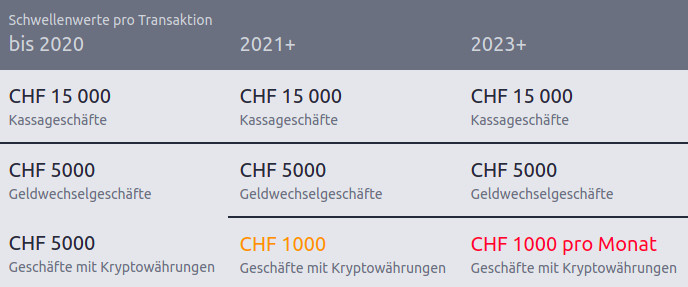
Among other things, financial intermediaries are required to perform customer identification (KYC) for money exchange transactions of more than CHF 5,000 and cash transactions of more than CHF 15,000. Until the end of 2020, crypto transactions were subject to the same CHF 5,000 limits as money exchange transactions. On January 1, 2021, a reduction of the threshold from to CHF 1,000 came into effect, which the Financial Market Authority specified to CHF 1,000 per month in a partial revision in May 2022. In addition to Bity, some industry representatives were already critical of FINMA's adjustments at that time. The latter justified the revision by the increased money laundering risk in dealing with virtual currencies. When asked by CVJ.CH, FINMA declined to comment on details in "possible clarifications and proceedings." In general, however, the financial market regulator said:
"The risk of money laundering in the area of virtual currencies is increased due to the potentially higher anonymity and speed as well as the cross-border nature of the transactions. Virtual currencies are often misused as a means of payment for illicit trade on the darknet or for ransom payments after cybercrime attacks."
"The background for the lowering of the threshold is not only the International Standards (recommendation of the FATF, the standard setter in the field of anti-money laundering, which has set the threshold of USD/EUR 1000 for virtual currencies), but also the high money laundering risks for such services. Indeed, there are concrete indications that e.g. cryptocurrency ATMs in Switzerland have been misused as a common means of payment by certain drug trafficking networks (e.g. media reports on the Vitamintaube case)." - Swiss Financial Market Supervisory Authority (FINMA) in a statement to CVJ.CH




Crypto broker Bity criticizes FINMA's decision
According to Neuchâtel-based Bity Group, FINMA used "soft power" to influence the interpretation of the law without democratic processes. The regulator had classified all crypto transactions as "high-risk" without providing concrete evidence of increased money laundering risk. The industry was happy to follow the same regulations as the rest of the financial industry, but was now subject to special rules. By imposing technical measures (proofs of control), According to Bity, FINMA has also increased the complexity of crypto transactions, making Bitcoins less user-friendly. In doing so, the regulator had been guided by the recommendations of the Financial Action Task Force (FATF), which has no democratic authority in Switzerland.
The financial market supervisory authority initiated a consultation process for the partial revision of the AMLO-FINMA following pressure from the crypto industry. However, according to Bity, there was not a single contribution supporting FINMA's position. Nevertheless, the amendment to the ordinance was implemented. The crypto broker believes this was done in violation of several articles of the Financial Market Supervision Act. Therefore, Bity filed a complaint against FINMA before the Federal Administrative Court last Wednesday. The Swiss service provider called for a fundraising campaign to finance the lawsuit. When CVJ.CH reached out for comment, the crypto broker stated:
"In a digital society we must be able to transact in ways that respects the privacy of users. FINMA just wants to get rid of private transactions at any cost, without giving any evidence and even by making non-democratic actions. We had to react!" - Alexis Roussel, Co-Founder Bity