Close Menu
Crypto Valley Journal
    Facebook X (Twitter) Instagram
    Crypto Valley Journal
    • Hot Topics
      • News
      • Minds
    • Focus
      • Background
      • Blockchain
      • Legal & Compliance
      • Non-Fungible Token (NFTs)
    • Investing
      • Markets
      • Financial Products
      • Decentralized Finance (DeFi)
      • Exchange overview
    • Education
      • Basics
      • Glossary
      • Politicians on crypto
    • Statistics
      • Bitcoin-ETF-Flows
      • Ethereum-ETF-Flows
      • Crypto market data
      • On-chain data
    • Academy
      • Overview
      • Part 1: Blockchain
      • Part 2: Money
      • Part 3: Bitcoin
      • Part 4: Cryptocurrencies
      • Part 5: Decentralized Finance
      • Part 6: Investing
    • English
      • Deutsch
    Crypto Valley Journal
    You are at:Home»Glossary»Paper Wallet
    BTC Paper-Wallet

    Paper Wallet

    By Editorial Office CVJ.CH on 9. April 2020 Glossary

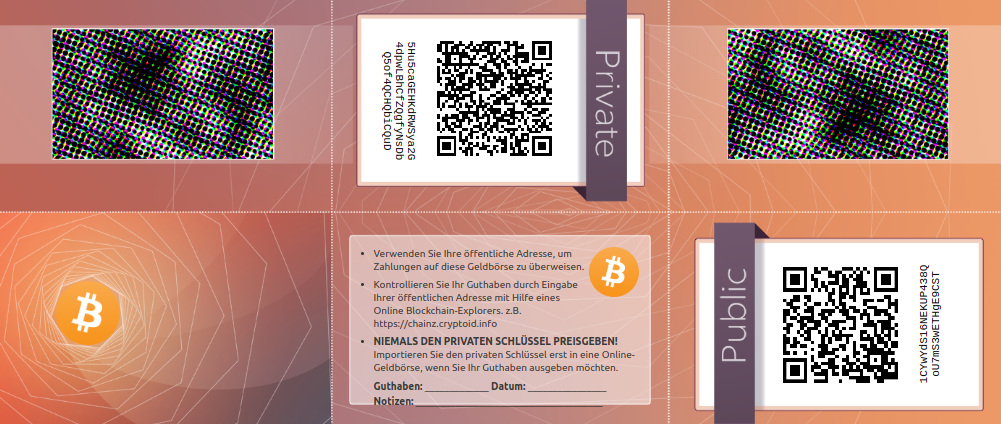
    A paper wallet is a piece of paper on which the public and private keys are written. The keys allow to access and send the stored cryptocurrencies. Paper wallets are classified as cold wallets, which are the safest way to store cryptocurrencies. These are however very unsuitable for everyday use.

    Paper wallets are one option for storing cryptocurrency (typically bitcoin) on an offline medium. Paper wallets can be a great addition to any storage strategy for those looking for a middle ground between convenience and security. A typical way to acquire a paper wallet is through the purchase of cryptocurrency at a cryptocurrency ATMs. Cryptocurrency ATMs are a a convenient fiat-on-ramp option.

    Uses and benefits of paper wallets

    The paper is a tangible document that contains essential information for accessing the cryptocurrencies. These are the public and private key. The public key can be likened to a sort of "bank account number". Tokens can be sent to the public key and then assigned to the wallet. The private key, on the other hand, should never be shared with anyone. It works in a similar way to a password or PIN number. A private key acts as a code that is essential for accessing a cryptocurrency wallet and authorising transactions. It is important to note that if unauthorised individuals obtain the private key, they can acquire the stored cryptocurrencies.

    Paper wallets are more secure than digital wallets because they don't rely on the internet to store funds. Because they are not connected to the internet, they are safe from viruses and hacking efforts that are directed at digital wallets. Paper wallets fall into the category of 'cold storage' wallets, which refers to the practice of removing data from the internet. The increased security of paper wallets is their main selling point.

    The disadvantage of a paper wallet is that it is susceptible to damage or loss, so it is important to store it securely. To ensure that the paper wallet withstands time and physical damage, users can consider options such as laminating the document or choosing materials that are resistant to wear and tear. Users should also be careful about the way the paper wallet is made. The paper wallet should only be produced on trusted, secure equipment.

    Digital finance transparency relies on Proof of Reserves, Merkle trees, MPC custody and 24/7 monitoring to verify solvency and user assets. Basics
    12. May 2026

    Transparency as the foundation of security in digital finance

    Digital finance transparency relies on Proof of Reserves, Merkle trees, MPC custody and 24/7 monitoring to verify solvency and safeguard user assets.

    CLARITY Act DeFi Background
    7. May 2026

    CLARITY Act: The year’s most important crypto deal heads for a decision

    The CLARITY Act is set to shape the future market structure of digital assets in…

    Analysis by Bitget Research on Bitcoin quantum computing risks, ECDSA exposure, NIST post-quantum standards, and BIP-360 migration paths.
    17. April 2026

    Bitcoin quantum computing: What recent developments mean for network security

    XRPL validator analyzes quantum risk: only 0.03% of XRP supply is exposed, compared to up to 35% for Bitcoin. Google sets 2029 deadline.
    14. April 2026

    Quantum risk: Is XRP more secure than Bitcoin?

    13. April 2026

    Power Shift in Crypto Exchanges: Retail Overtakes Institutional

    Entdecken Sie die Vorteile von Bitcoin im Portfolio als Werkzeug zur Renditesteigerung und zum Schutz vor Inflation.
    9. April 2026

    Bitcoin’s role within an institutional portfolio

    AI agent security risks grow as autonomous systems shift from analysis to execution in crypto markets, a Bitget and SlowMist report warns.
    8. April 2026

    New research highlights security risks as AI agents shift to execution

    6. April 2026

    Crypto Myths 2026: Four Costly Mistakes Investors Make

    Popular Posts
    About Crypto Valley Journal
    About Crypto Valley Journal

    On the pulse of the movement

    • Academy
    • Contact
    • Advertising
    • About us
    • Partner
    • Imprint
    • Privacy
    • Disclaimer
    Search

    Type above and press Enter to search. Press Esc to cancel.