The crypto arm of billionaire asset manager Fidelity believes the benefits of adding Bitcoin to reserves will outweigh the risks for many countries. The likelihood is high that more sovereign nation-states will acquire Bitcoin in 2022, it said.
Fidelity Digital Assets concludes that given the decentralized and anonymous nature of digital assets, countries will not be able to enforce a complete ban on mining and trading crypto. On the contrary, in fact, the asset manager would not be at all surprised if other sovereign nation-states acquired Bitcoin this year. While it is too early to tell whether El Salvador's first step toward Bitcoin adoption has been successful, they said, principles of game theory would lead more countries to follow in its footsteps and accept cryptocurrencies as a means of payment.
Bitcoin as a pawn in the geopolitical context
The rise of non-fungible tokens (NFTs), "GameFi" and unprecedented institutional adoption has brought cryptocurrencies into the mainstream in 2021. As a result, the industry's market capitalization was driven to an all-time high. Aside from price performance, one of the biggest impacts has been the recognition of cryptocurrencies by governments and regulators. In its annual review, Fidelity stated that certain regulatory developments observed this year could not have been more opposite.
China, for example, issued several bans during the year. The country cracked down on bitcoin mining in May and then banned all cryptocurrency transactions in September. Later in November, cryptocurrency mining in the country was halted entirely, wiping out the thriving Chinese mining ecosystem. In El Salvador, however, the government took a completely different approach. The South American country is the first ever sovereign nation to adopt Bitcoin as legal tender. The government of El Salvador also purchased Bitcoin for the state reserves. In addition, a Bitcoin bond worth $1 billion will be issued by the government. The government is using half of it to further expand its cryptocurrency reserves.
Adoption is already in full swing
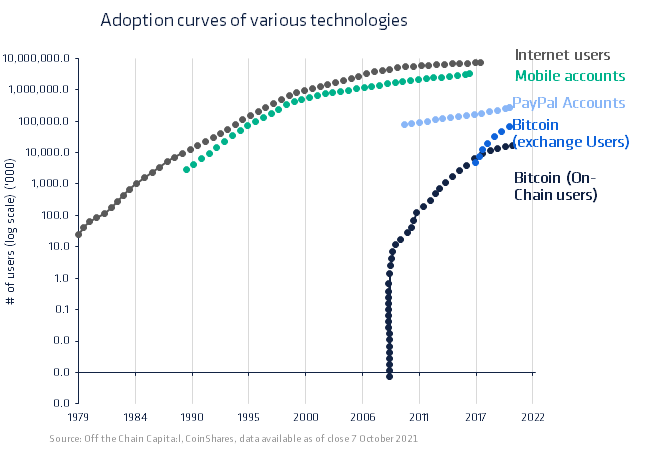
The number of Bitcoin users has grown at an annual rate of 113% so far. These numbers are impressive even compared to the internet's 63% growth over the same period. If Bitcoin adoption were to slow to the level of the internet, it would still result in 1 billion users by 2024 and 4 billion users by 2030. Institutions like Visa, Mastercard, Paypal, BNY Mellon, Morgan Stanley, Goldman Sachs, and JP Morgan have already changed their stance on Bitcoin - so adoption is already in full swing.
From a macroeconomic perspective, signs of a potential inflation problem are beginning to emerge. In particular, tightening employment conditions (and the resulting increase in wages) combined with rising producer and commodity prices worldwide. Given rising energy prices, the increasing retirement of the baby boomer generation, and the risk of further wage declines, higher inflation remains a real risk. However, no one knows exactly how inflation will evolve over the next five years. Therefore, adding Bitcoin and other real assets could be a prudent measure to protect portfolios from the risk of out-of-control inflation.
The future of digital assets
Fidelity believes China's effort will lead to a significant loss of wealth and opportunity. However, the asset manager doubts that China can enforce a complete ban. The country is hardly in a position to do so, given the decentralized and anonymous nature of digital assets, according to them.
“As Bitcoin proliferates, the countries that secure Bitcoin today will be in a better competitive position. Therefore, even if other countries do not believe in the investment thesis or the acceptance of Bitcoin, they will be forced to acquire Bitcoin as a hedge.” - Fidelity Digital Assets
More and more high-profile individuals and institutional investors invested in Bitcoin, more and more companies included the cryptocurrency in their balance sheets, and even the first sovereign state declared it legal tender. The Bitcoin network has proven its resilience despite the fact that the world's second largest economy has practically banned it. All this and more led Fidelity to ask what else a skeptic would need to see to be convinced that digital assets are not going away.