
Close Menu
Crypto Valley Journal
    Facebook X (Twitter) Instagram
    Crypto Valley Journal
    • Hot Topics
      • News
      • Minds
    • Focus
      • Background
      • Blockchain
      • Legal & Compliance
      • Non-Fungible Token (NFTs)
    • Investing
      • Markets
      • Financial Products
      • Decentralized Finance (DeFi)
      • Exchange overview
    • Education
      • Basics
      • Glossary
      • Politicians on crypto
    • Statistics
      • Bitcoin-ETF-Flows
      • Ethereum-ETF-Flows
      • Crypto market data
      • On-chain data
    • Academy
      • Overview
      • Part 1: Blockchain
      • Part 2: Money
      • Part 3: Bitcoin
      • Part 4: Cryptocurrencies
      • Part 5: Decentralized Finance
      • Part 6: Investing
    • English
      • Deutsch
    Crypto Valley Journal
    You are at:Home » Hot Topics » News » Goldman Sachs recognizes Ether (ETH) as a deflationary asset
    Goldman Sachs recognizes Ether (ETH) as a deflationary asset

    Goldman Sachs recognizes Ether (ETH) as a deflationary asset

    By Editorial Office CVJ.CH on 12. May 2023 News

    Since the implementation of the EIP1559 upgrade and the transition to the Proof of Stake consensus protocol, a significant portion of Ethereum transaction fees are permanently destroyed or "burned." This feature makes the native asset Ether (ETH) an attractive deflationary investment, according to Goldman Sachs.

    Ether (ETH) is the digital asset that powers and secures the Ethereum protocol. As the second-largest cryptocurrency by market capitalization, it serves as a means of executing transactions and interacting with self-executing applications (smart contracts). Users pay transaction fees in Ether for these purposes, which are distributed to validators (stakers) and a portion is sent to a "burn address." During periods of high network activity, the burning of these transaction fees can surpass the inflation of Ether, as outlined in a note by the banking giant Goldman Sachs.

    Subscribe to our newsletter

    The best articles of the week, directly delivered into your mailbox.

    Drastic changes to the Ether tokenomics

    The Ethereum network was launched on July 30, 2015, with an initial supply of 72 million coins for its native asset, Ether. Unlike Bitcoin, Ether does not have a fixed inflation rate; instead, its issuance follows a variable annual rate known as the "inflation plan." Over the past eight years, the circulating supply of Ether has increased to nearly 120 million coins. The two most significant changes to this inflation plan came through two network upgrades: the London Hard Fork (EIP1559) and the Merge.

    The London Hard Fork (EIP1559) modified the fee mechanism on Ethereum, introducing a base fee and an optional priority fee (or tip) for validators. The base fee is burned, while validators receive the priority fee and block rewards. The burning of this base fee effectively reduces the net Ether inflation. However, the mechanism is highly dependent on the activity of the Ethereum network: the more activity on the chain, the more Ether is burned. EIP1559 is barely noticeable during periods of low network activity.


    Ray Dalio’s Bridgewater Associates Minds

    Star investor Ray Dalio considers Bitcoin inferior to gold

    Bitcoin overtakes gold in the US: per River's report, 49.6 million Americans own Bitcoin, while just 28.8 million still hold gold. Background

    Bitcoin overtakes gold among US investors for the first time

    S&P and Pantera launch the S&P Pantera Index, a crypto benchmark of 18 constituents that excludes Bitcoin for lack of protocol revenue. Financial Products

    New S&P Pantera Index leaves Bitcoin out entirely

    What separates Dogecoin from Bitcoin is its unlimited supply, and the 2013 satire coin now trades through its own US spot ETF. Basics

    What is Dogecoin? From satire project to ETF asset

    Ray Dalio’s Bridgewater Associates Minds

    Star investor Ray Dalio considers Bitcoin inferior to gold

    Bitcoin overtakes gold in the US: per River's report, 49.6 million Americans own Bitcoin, while just 28.8 million still hold gold. Background

    Bitcoin overtakes gold among US investors for the first time

    The second change to the Ether token model was part of Ethereum's transition from Proof of Work to Proof of Stake, known as the Merge. The new consensus protocol reduced the inflationary selling pressure on Ether in two ways. Firstly, the block rewards were reduced from 13,000 to 1,700 ETH per day, resulting in an 85% decrease in inflation. Additionally, miners providing computational power for block validation were replaced by validators/stakers, who must stake a certain amount of Ether instead of consuming energy. The inflation in the form of block rewards now goes to actors with skin in the game. Since the Merge, this deflationary combination has led to a reduction in supply by 221,000 Ether (approximately $390 million).
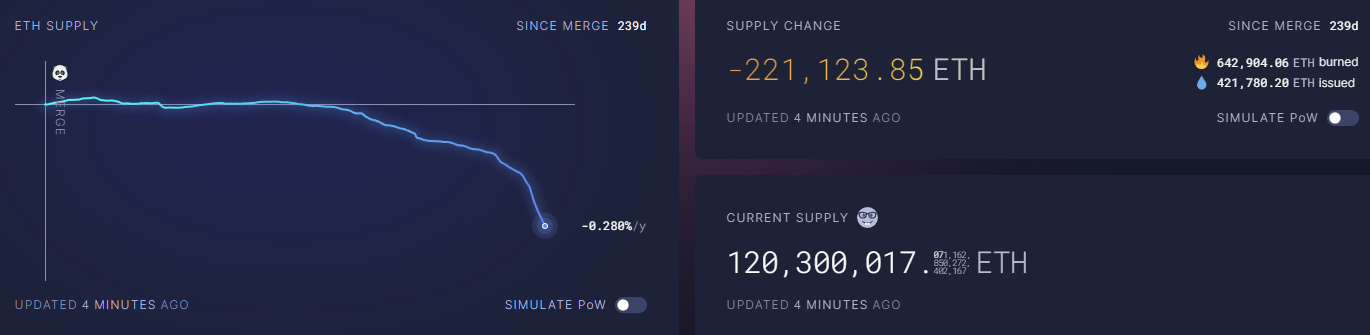
    Ether deflation since the merge / Source: ultrasound.money

    Memecoins drive deflationary pressure on Ether

    The recent resurgence of memecoins has been responsible for accelerating Ether inflation. Memecoins, typically created as jokes and primarily used for speculation, reside primarily on the Ethereum blockchain, requiring Ether as gas fees for transaction settlements. The rapid increase in memecoin activity, as seen in the emergence of tokens like Pepe (PEPE) in recent weeks, has a deflationary impact on the supply of Ether.
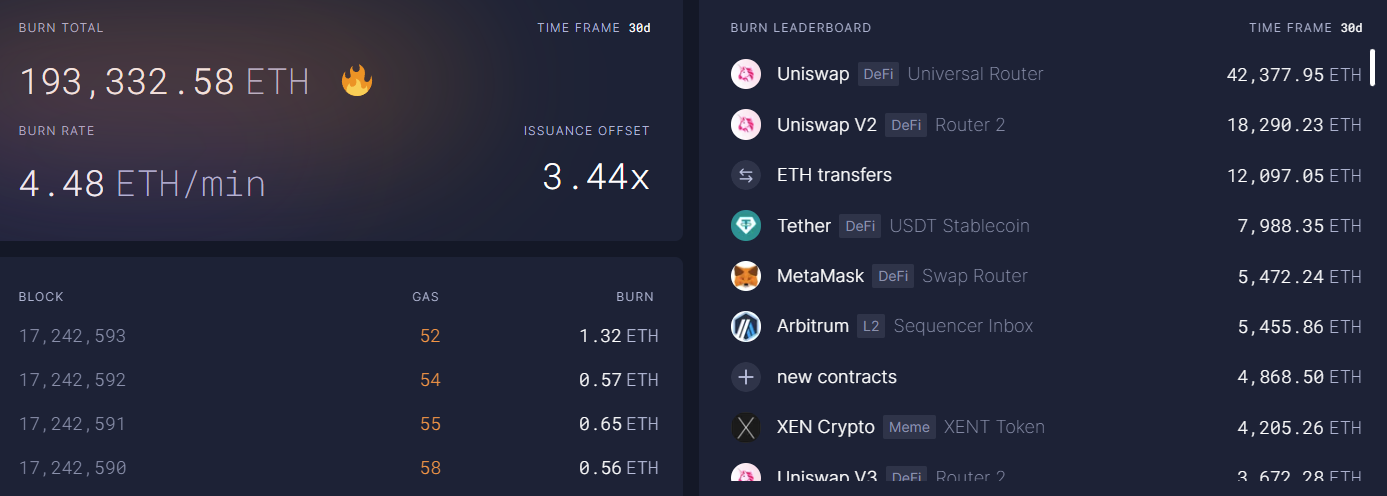
    Ether burn leaderboard / Source: ultrasound.money

    In the past 30 days alone, the smart contract of the leading decentralized trading protocol Uniswap has burned 112 million Ether. This, combined with the additional benefit of passive returns through staking, enhances the attractiveness of Ether as an investment over the long term. By comparison, Bitcoin's inflation rate stands at approximately 1.8% annually until the next halving event in 2024.


    Share. Facebook Twitter LinkedIn Email Telegram WhatsApp

    About the author

    Editorial Office CVJ.CH
    • Website
    • Twitter
    • LinkedIn

    Since 2018, the editorial team at Crypto Valley Journal has been reporting from Zug - the heart of Switzerland’s Crypto Valley - on Bitcoin, cryptocurrency, blockchain, and regulatory developments in digital assets. Behind the publication’s collective editorial voice is a team of writers with backgrounds in financial markets, law, and technology.

    Related Articles

    The Bitcoin BIP-110 split left the minority chain at two blocks, while the main chain kept mining and moved 111 blocks ahead.

    Bitcoin split via BIP-110 stalls after two blocks

    CVJ weekly review

    Weekly review: Coldcard hack hits Bitcoin in hardware wallets

    An EIP draft would burn staking rewards on Ethereum and cut net issuance to zero once 60.25 million ETH sit in the validator set.

    Ethereum researchers want to burn staking rewards gradually

    The Clarity Act vote now falls on September 15, and Republicans need seven Democratic votes to clear the Senate cloture hurdle.
    11. August 2026

    US Senate delays Clarity Act vote to September 15

    The Bitcoin BIP-110 split left the minority chain at two blocks, while the main chain kept mining and moved 111 blocks ahead.
    10. August 2026

    Bitcoin split via BIP-110 stalls after two blocks

    Since the MiCA transition period ended on July 1, phishing scams have impersonated ESMA or AMF and demanded crypto transfers to fake sites.
    8. August 2026

    Beware of phishing scams after MiCA deadline

    twitter image button instagram image button linkedin image button youtube image button

    About Crypto Valley Journal
    About Crypto Valley Journal

    On the pulse of the movement

    • Academy
    • Contact
    • Advertising
    • About us
    • Partner
    • Imprint
    • Privacy
    • Disclaimer
    Search

    Type above and press Enter to search. Press Esc to cancel.