
Close Menu
Crypto Valley Journal
    Facebook X (Twitter) Instagram
    Crypto Valley Journal
    • Hot Topics
      • News
      • Minds
    • Focus
      • Background
      • Blockchain
      • Legal & Compliance
      • Non-Fungible Token (NFTs)
    • Investing
      • Markets
      • Financial Products
      • Decentralized Finance (DeFi)
      • Exchange overview
    • Education
      • Basics
      • Glossary
      • Politicians on crypto
    • Statistics
      • Bitcoin-ETF-Flows
      • Ethereum-ETF-Flows
      • Crypto market data
      • On-chain data
    • Academy
      • Overview
      • Part 1: Blockchain
      • Part 2: Money
      • Part 3: Bitcoin
      • Part 4: Cryptocurrencies
      • Part 5: Decentralized Finance
      • Part 6: Investing
    • English
      • Deutsch
    Crypto Valley Journal
    You are at:Home»Hot Topics»News»Has EIP-1559 turned Ether deflationary?
    Has EIP-1559 turned Ether deflationary?
    Big fire of trees in a wood with a smoke and a flame

    Has EIP-1559 turned Ether deflationary?

    By CVJ.CH Content Partner BeInCrypto on 26. November 2021 News

    The burning mechanism that was introduced as a part of the Ethereum London upgrade in early August has now destroyed more than one million Ether (ETH) worth over $4 billion. The London hard fork introduced EIP-1559, a mechanism to burn a portion of the transaction fees on the network.

    Since the London update, over a million Ether (ETH) has been burnt at the time of writing according to the Ultrasound.Money tracker. At current prices, that is equivalent to over 4 billion dollars. The milestone was celebrated by Ethereum advocates on Twitter, but those using the network on layer 1 are still suffering those painful transaction fees.

    Ether still inflationary

    The current daily burn rate is 11,588 ETH worth around $50 million per day. Over the past 24 hours, the network has destroyed 8 ETH per minute on average. At these rates, the network will burn roughly 4.2 million ETH per year which is $18 billion at current prices. Uniswap is the leader of the burn table at the moment, destroying 1,360 ETH, or $5.8 million, over the past 24 hours. It is not surprising considering a simple token swap on the DEX can cost as much as $100 in transaction fees at the moment.
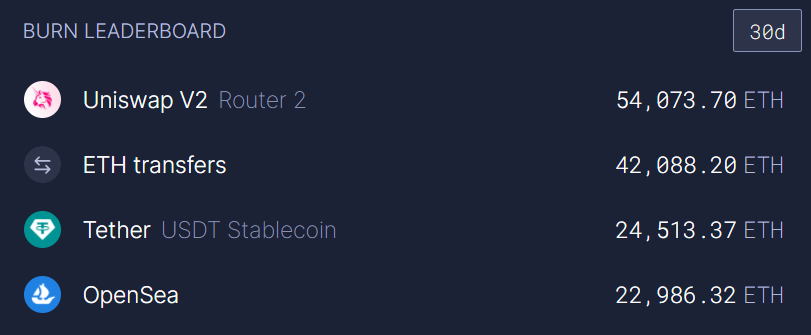
    The burn rate means that Ethereum supply inflation has been reduced to just 1% per year since there is around 5.4 million ETH mined per year. The network switched to a deflationary issuance several times over the past couple of months as more ETH was being burnt than being produced. Once "the merge” takes place sometime in the first half of 2022, the issuance is expected to become fully deflationary. The simulation currently estimates that Ethereum issuance will be -3.2% per year meaning that the supply will decrease.

    Transition to Ethereum 2.0

    The merge occurs when the current ETH 1.0 chain will merge or “dock” with the ETH 2.0 Beacon Chain marking the end of proof-of-work and a transition to proof-of-stake. Before that happens, the Arrow Glacier update will be deployed in early December to extend the Ethereum difficulty bomb.
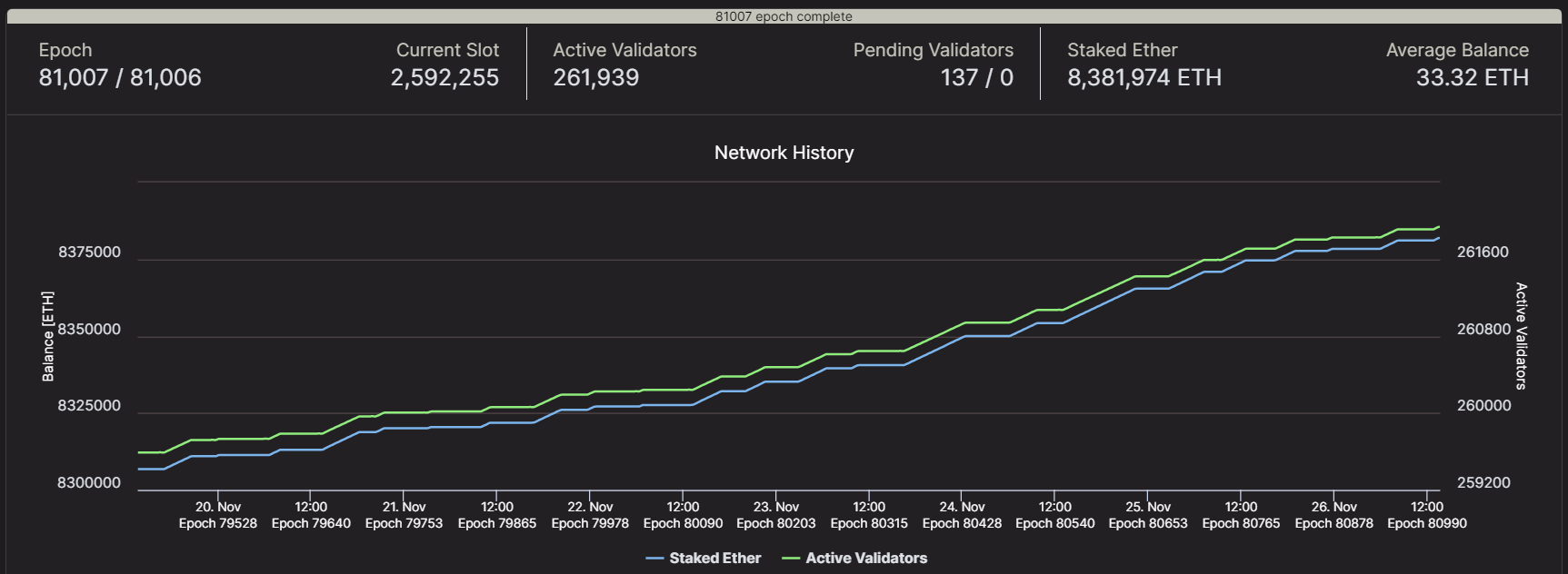
    Amount of Ether deposited into the ETH 2.0 staking contract

    Ethereum staked on the Beacon Chain currently totals around 8.37 million ETH according to Beaconcha.in. This is worth approximately $36 billion and around 7% of the entire supply. Stakers can enjoy annual earnings of around 5.2% in which is soon about to become a deflationary asset.


    Share. Facebook Twitter LinkedIn Email Telegram WhatsApp

    About the author

    CVJ.CH Content Partner BeInCrypto
    • Website

    BeInCrypto is a news website founded in August 2018 that specializes in cryptographic technology, privacy, fintech, and the Internet — among other related topics. The primary goal is to inject transparency into an industry rife with disingenuous reporting, unlabeled sponsored articles, and paid news masquerading as honest journalism.

    Related Articles

    FalconX and Sygnum open institutional access to tokenized credit via the Desygnate platform and the FalconX Credit Vault.

    FalconX and Sygnum open regulated access to tokenized credit

    Coinbase backs the CLARITY Act compromise on stablecoin rewards, now the Senate committee markup path opens, with passage likely.

    Crypto industry backs down: Coinbase accepts CLARITY Act compromise

    CNB Governor Michl argues in Las Vegas for a 1% Bitcoin allocation in central bank reserves - despite rejection by his own Bank Board.

    Czech National Bank CNB advocates for Bitcoin as a reserve asset

    FalconX and Sygnum open institutional access to tokenized credit via the Desygnate platform and the FalconX Credit Vault.
    6. May 2026

    FalconX and Sygnum open regulated access to tokenized credit

    FINMA tightens consumer protection in crypto, grants first DLT license to BX Digital, and plans new license categories for stablecoin issuers.
    5. May 2026

    FINMA tightens crypto supervision and warns of consumer risks

    Coinbase backs the CLARITY Act compromise on stablecoin rewards, now the Senate committee markup path opens, with passage likely.
    4. May 2026

    Crypto industry backs down: Coinbase accepts CLARITY Act compromise

    twitter image button instagram image button linkedin image button youtube image button

    About Crypto Valley Journal
    About Crypto Valley Journal

    On the pulse of the movement

    • Academy
    • Contact
    • Advertising
    • About us
    • Partner
    • Imprint
    • Privacy
    • Disclaimer
    Search

    Type above and press Enter to search. Press Esc to cancel.