Close Menu
Crypto Valley Journal
    Facebook X (Twitter) Instagram
    Crypto Valley Journal
    • Hot Topics
      • News
      • Minds
    • Focus
      • Background
      • Blockchain
      • Legal & Compliance
      • Non-Fungible Token (NFTs)
    • Investing
      • Markets
      • Financial Products
      • Decentralized Finance (DeFi)
      • Exchange overview
    • Education
      • Basics
      • Glossary
      • Politicians on crypto
    • Statistics
      • Bitcoin-ETF-Flows
      • Ethereum-ETF-Flows
      • Crypto market data
      • On-chain data
    • Academy
      • Overview
      • Part 1: Blockchain
      • Part 2: Money
      • Part 3: Bitcoin
      • Part 4: Cryptocurrencies
      • Part 5: Decentralized Finance
      • Part 6: Investing
    • English
      • Deutsch
    Crypto Valley Journal
    You are at:Home»Focus»Legal & Compliance»US court overrules OFAC sanctions on Tornado Cash smart contracts
    Tornado Cash court case

    US court overrules OFAC sanctions on Tornado Cash smart contracts

    By Victor Koetter on 13. December 2024 Legal & Compliance

    End of November 2024, the US Court issued a landmark decision overturning sanctions imposed by the Office of Foreign Assets Control (OFAC) on immutable smart contracts related to the Tornado Cash mixer protocol. The trial of co-founder Roman Storm has been postponed until April 2025, facing up to 45 years if found guilty.

    The decision marks a pivotal moment for the blockchain space, challenging regulatory boundaries and raising important questions about decentralized governance. Smart contracts are self-executing code that execute agreements or rules automatically, without the need for intermediaries. They are a fundamental element of blockchain technology, enabling decentralized applications (dApps). Immutable smart contracts, which are at the heart of the Tornado Cash case, are smart contracts that cannot be modified once they have been deployed. Their classification in the legal framework now sets an important precedent for future blockchain-based technologies.

    Subscribe to our newsletter

    The best articles of the week, directly delivered into your mailbox.

    OFAC's overreach and ongoing case against co-founders

    On the same day that the Treasury Department's Office of Foreign Assets Control (OFAC) sanctioned Tornado Cash founders Roman Semenov and Roman Storm, the U.S. Department of Justice (DOJ) indicted and arrested them. They were charged with conspiracy to commit money laundering, operating an unlicensed money transmitter, and evading US sanctions. Following his arrest, Storm was released on $2 million bail. In early November, it was announced that Roman Storm's trial, originally scheduled for 2 December 2024 in New York, has been postponed until 14 April 2025.

    Prosecutors allege that Storm helped launder more than $1 billion in illicit funds through Tornado Cash. The protocol became a popular tool for cybercriminals, including the North Korean-linked Lazarus Group, which laundered more than $455 million in cryptocurrency through the protocol. Storm and his co-founders profited from Tornado Cash's operations. In his defence, Storm argues that Tornado Cash is self-executing software that he cannot modify or control once deployed. He also claims that the code is protected as free speech under the First Amendment. The case may inspire further litigation, particularly in relation to DeFi platforms and other dApps. Regulators may need to adjust their approaches to better reflect technological realities.


    Ray Dalio’s Bridgewater Associates Minds

    Star investor Ray Dalio considers Bitcoin inferior to gold

    CLARITY Act DeFi Background

    CLARITY Act: The year’s most important crypto deal heads for a decision

    JPMorgan warns: Recurring DeFi exploits and stagnant ETH-denominated TVL curb institutional engagement in the DeFi sector. DeFi

    JPMorgan: DeFi hacks and TVL losses weigh on institutional investors

    Basics

    Unit bias in crypto: Why cheap coins mislead investors

    Ray Dalio’s Bridgewater Associates Minds

    Star investor Ray Dalio considers Bitcoin inferior to gold

    CLARITY Act DeFi Background

    CLARITY Act: The year’s most important crypto deal heads for a decision

    Smart contracts are public tools, not property

    Tornado Cash is a decentralized cryptocurrency mixer protocol running on Ethereum and other EVM-compatible blockchains. It allows users to deposit cryptocurrency into a shared pool and withdraw an equivalent amount to another address. This obscures the connection between the source and destination of funds, making it a target for money launderers.

    The US Court of Appeals for the Fifth Circuit clarified that immutable smart contracts are not "property" under the International Emergency Economic Powers Act (IEEPA). Unlike traditional property, these contracts operate independently of human intervention. This classification removes them from OFAC's scope, which traditionally covers items that can be owned or controlled by a person or entity. The decision reflects the decentralized nature of blockchain technology and supports its autonomy and neutrality.

    However, the Department of Justice (DOJ) argues that Roman Storm's protocol provided services that violated sanctions by facilitating illegal transfers and money laundering. This leaves room for further regulatory challenges targeting other components of the protocol or the team involved. OFAC retains the option to appeal this decision to the Supreme Court. Despite the regulatory uncertainty and the sanctioning of Tornado Cash in August 2022, the dApp has steadily regained popularity, as evidenced by the growing total volume locked (TVL), similar to the assets under management (AuM) metric.
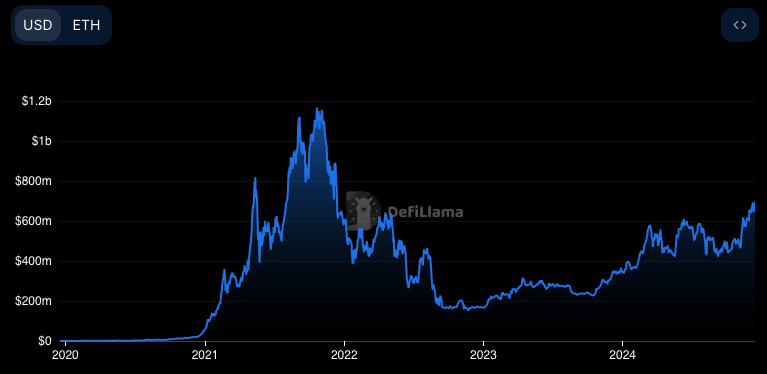

    Tornado Cash TVL
    Tornado Cash TVL in USD / Source: DefiLlama
    Share. Facebook Twitter LinkedIn Email Telegram WhatsApp

    About the author

    Victor Koetter

      Victor has been actively involved in the crypto scene since 2019 and sees great potential in the possible applications of the technology and the resulting innovations. At the Crypto Valley Journal, he is responsible for the coverage of the topics NFTs & Metaverse. In 2021, he also co-founded the Swiss NFT Association. The association forms a knowledge hub around the topic of NFTs and organizes regular informative events.

      Related Articles

      FINMA tightens consumer protection in crypto, grants first DLT license to BX Digital, and plans new license categories for stablecoin issuers.

      FINMA tightens crypto supervision and warns of consumer risks

      Canada announces national crypto ATM ban. Roughly 4,000 machines are affected as Ottawa targets fraud and money laundering.

      Canada bans crypto ATMs

      New York sues Coinbase and Gemini over prediction markets. AG James demands 3.4 billion USD. COIN stock falls 6 percent.

      New York sues Coinbase and Gemini over prediction markets

      CVJ.CH Weekly review calendar week
      9. May 2026

      Weekly review calendar week 19 – 2026

      JPMorgan sees Bitcoin ahead of gold in the debasement trade: GLD loses 2.7% AUM, IBIT gains 1.5% AUM since Iran war outbreak.
      8. May 2026

      JPMorgan: Bitcoin overtakes gold in the debasement trade

      Bitcoin regime shift in question as April rally pushes BTC above $80k, with $2.4 billion in ETF inflows and patient capital building support.
      8. May 2026

      Spring cleaning: Bitcoin tests the regime shift above $80k

      twitter image button instagram image button linkedin image button youtube image button

      About Crypto Valley Journal
      About Crypto Valley Journal

      On the pulse of the movement

      • Academy
      • Contact
      • Advertising
      • About us
      • Partner
      • Imprint
      • Privacy
      • Disclaimer
      Search

      Type above and press Enter to search. Press Esc to cancel.