A monthly review of what's happening in the crypto markets enriched with institutional research on the most important topics in the industry in cooperation with the Swiss digital asset specialist, 21Shares AG.
October was a turbulent month in macroeconomics, bringing tailwinds to crypto. Bitcoin has decoupled from the S&P500 amidst the turbulent macro environment, recording a 0.3 correlation this month. Historically, Bitcoin has been considered a risk-on asset, but recent price action suggests that investors may turn to Bitcoin as a flight to quality.
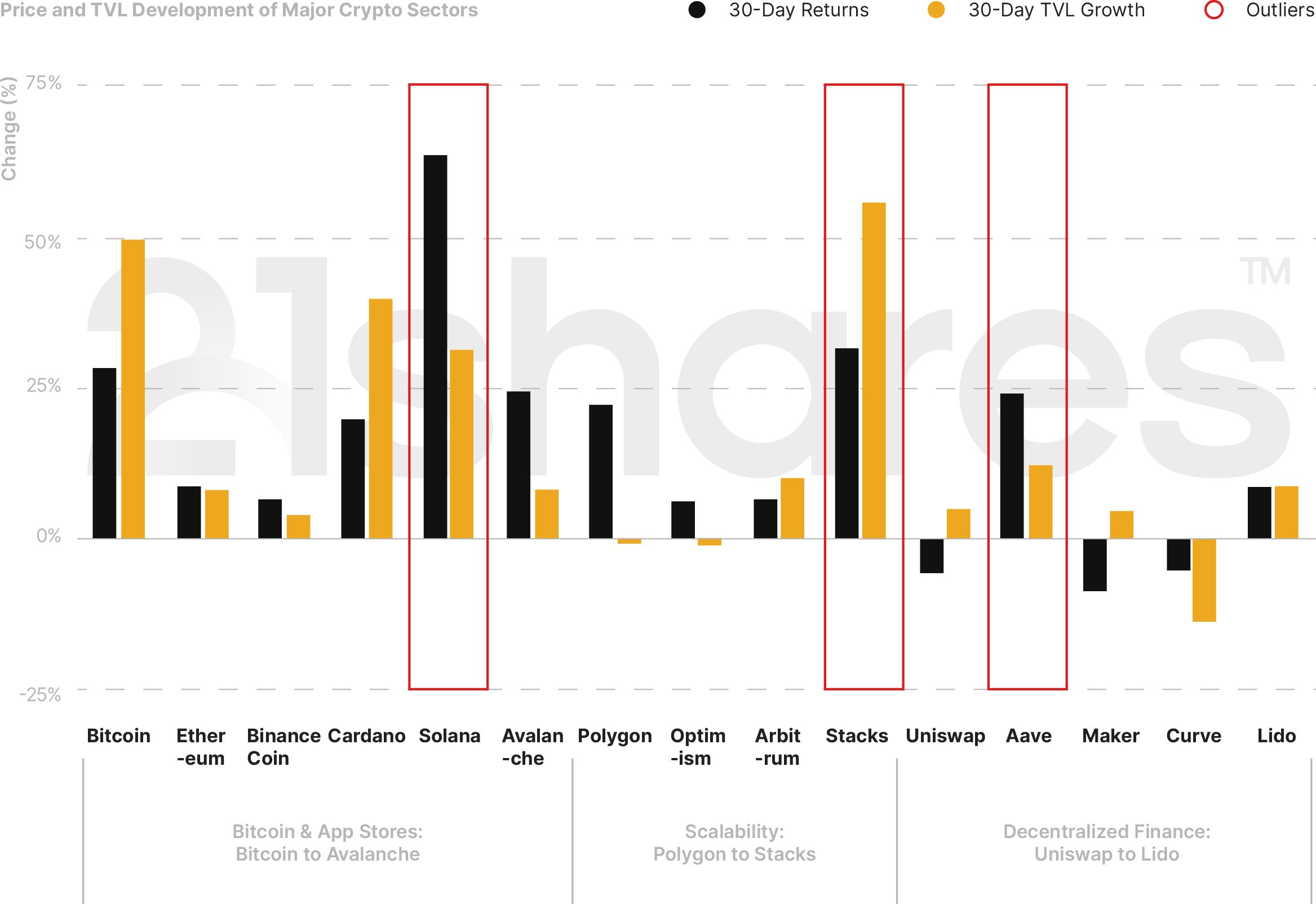
Bitcoin and Ethereum increased by 27.92% and 8.30% over the past month, respectively. The biggest winner of this month was Solana, soaring by 63.44% on the back of a recent upgrade on its network that would make it a more favorable option for developers; we delve deeper into what this upgrade means later in this report. Bitcoin’s scalability solution, Stacks, also increased by 31.44% in price and 55.49% in assets under management after speeding up the transaction process. Within decentralized finance applications, Aave was the biggest winner, increasing by 23.99%.
Macro factors contributing to Bitcoin’s performance
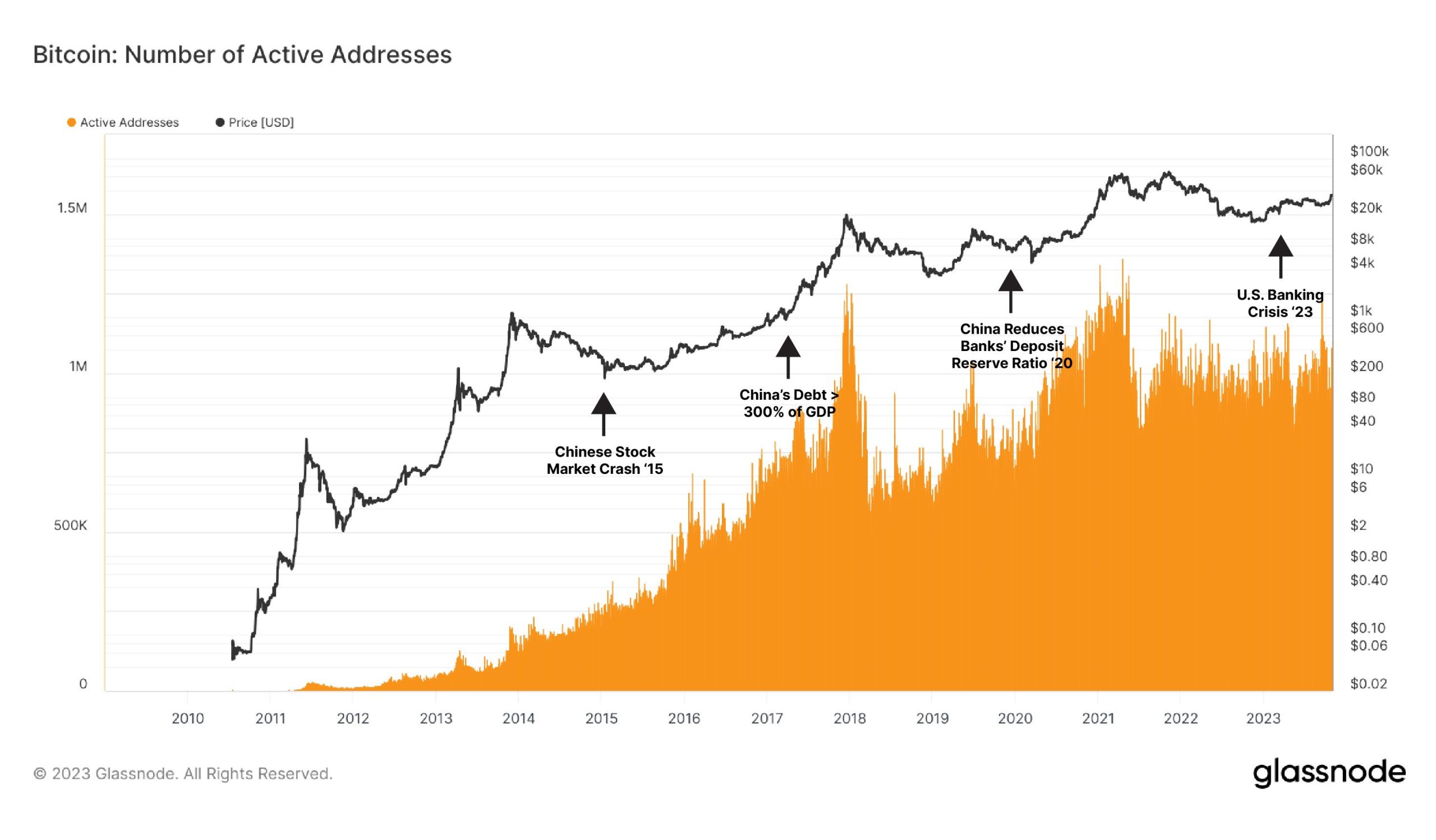
China’s $14 trillion debt crisis, instigated by Chinese real estate giants a few months ago, seems to have contributed to Bitcoin’s performance over the past month. Historically, financial crises in China are inversely correlated with Bitcoin’s price and active addresses, as shown in the figure below. At the brink of the pandemic in January 2020, the People’s Bank of China injected $115B into the economy by reducing the deposit reserve ratio in financial institutions by 0.5 percentage points. A week after the announcement, Bitcoin’s price jumped by 13%, and active BTC addresses increased by 48%, according to data provider Glassnode.
Another contributor to the flight to Bitcoin could be the U.S. public debt-to-GDP ratio, estimated to have reached 97.6% in October. In 2022, the Federal Reserve added $267.1B to its money supply, and it will need to print more in the long term to service its 33 trillion-dollar debt, up from $30.93 trillion last year.
Bitcoin’s narrative as a hedge against monetary debasement shines brighter amid this macroeconomic environment. Moreover, Bank of America's unrealized losses on securities rose to $131.6B after the 10-year U.S. Treasury yield reached 4.93%, a figure not seen since 2007, before the Global Financial Crisis. Many investors consider U.S. Treasuries the best proxy of a “risk-free” rate and thus view them as an opportunity cost - lower expected yields lead to lower discount rates, which result in a higher value for risky assets like stocks and crypto.
CBDCs coming more into the spotlight
Central bank digital currencies (CBDCs) have emerged this month across many jurisdictions. For the first time, the world’s first CBDC, the digital yuan, was used to settle a cross-border deal of 1 billion barrels of crude oil on the Shanghai Petroleum and Natural Gas Exchange (SHPGX) on October 19 - a significant milestone for e-CNY, which has seen a 35% yearly increase in cross-border settlements. Moreover, Ethereum also rose as an infrastructure layer for Mastercard’s initiative to tokenize the eAUD, implementing the KYC verification through the fintech giant’s digital identity solution to govern the CBDC’s transactions.
On October 18, the European Central Bank (ECB) announced the beginning of the preparation phase of its digital euro. The ECB has been exploring the design and distribution parameters of its CBDC since October 2021. Established payment providers such as Mastercard are actively working on initiatives to foster collaboration between CBDCs and stablecoins. A recent example is their pilot program, which aims to establish interoperability between CBDCs and stablecoins, ensuring compatibility with DeFi platforms, which should reduce the gap and introduce further synergy.




Extrapolating blockchain’s value proposition beyond traditional finance
Vodafone completed a proof of concept that enhances the outdated global trade ecosystem. The initiative, done in collaboration with Sumitomo Corporation, Chainlink Labs, and InnoWave, introduces a system for seamlessly exchanging digitized trading documents dispersed across multiple blockchains and platforms to overcome the fragmentation present in traditional systems.
By leveraging Chainlink’s CCIP, the initiative demonstrated how trading firms could avoid unnecessary cargo movement delays by streamlining the exchange of shipping receipts in a standardized way across multiple parties while offering an automated mechanism for executing certain trading agreements, such as triggering cargo insurance if a ship detects fire across its inventories. This is a noteworthy development as switching from the current system of transferring physical paper bills could save $6.5B in direct costs. However, there needs to be a mechanism for interconnecting the plethora of platforms involved in the digitization process, which is why this could be a key business opportunity for Chainlink to expand its interoperability services beyond financial applications and target the 32T global industry.
Solana to become more decentralized while enabling confidential transactions
Solana’s latest software upgrade (v1.16) introduced several notable enhancements. The improvements include reducing validator hardware requirements by reducing RAM usage from 120 GB to 39 GB and fine-tuning for bandwidth constraints. However, the standout feature is the ability to encrypt transactional details, such as the number of transferred tokens and the total balance of both counterparties, while preserving auditing rights to ensure compliance via Zero Knowledge Proofs (ZKP) decryption mechanism. ZKP refers to a method where one party can prove possession of certain information without revealing the underlying content.
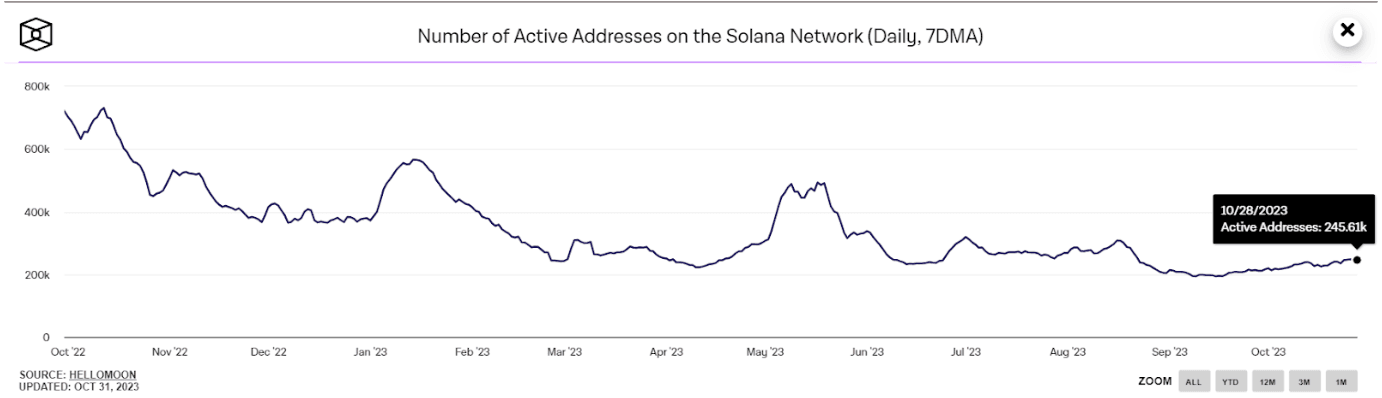
This is vital as it enables users to transact confidentially, a key factor for institutional adoption. In addition, the reduced hardware requirements make it easier to be supported by a broader range of validators, thus making it less prone to centralization. Solana's recent surge in inflows, reaching levels not seen since 2022 ($24M), coupled with a consistent rise in daily active users for five consecutive weeks, underscores the enthusiasm for this overlooked upgrade. It is worth noting that FTX-related wallets were spotted sending ~$35M worth of SOL to a few exchanges, as well as unstaking $50M worth of the token. This might exert some selling pressure in the coming weeks, so we’ll be closely monitoring.
Next Month’s Calendar
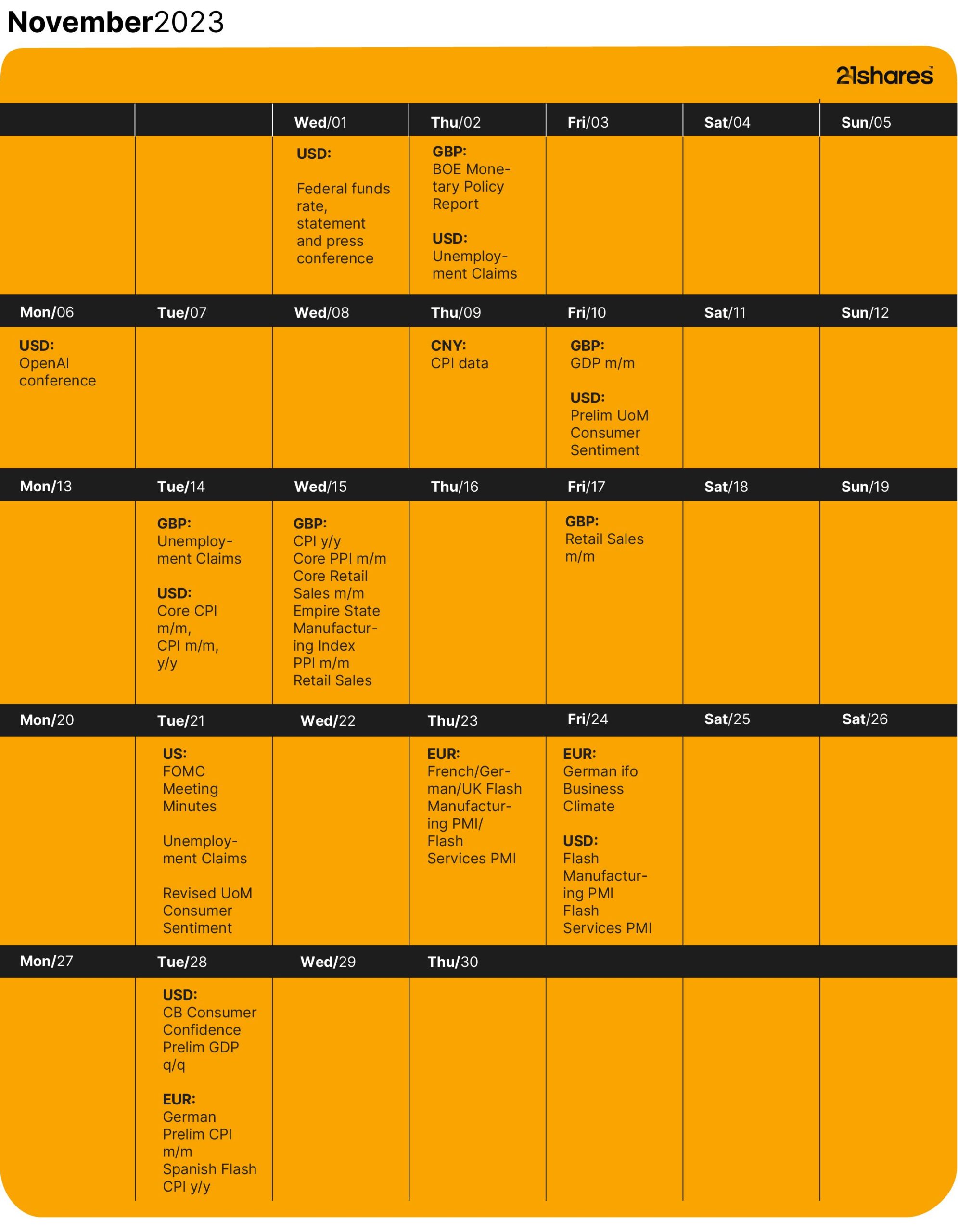
These are the top events we're closely monitoring in November: