A summarizing review of what has been happening at the crypto markets of the past week. A look at trending sectors, liquidity, volatility, spreads and more. The weekly report in cooperation with market data provider Kaiko.
The last 7 days in cryptocurrency markets:
- Price Movements: Bitcoin closed December down nearly 20% in sharp contrast to last year's +40% gains.
- Volume Dynamics: Whale activity was observed on Coinbase during a period of low global volumes.
- Order Book Liquidity: Price slippage spiked in early December and has since then recovered on most exchanges.
- Derivatives: Despite a $6 billion expiry, options trade volumes remained relatively low.
- Macro Trends: Inflation expectations dipped in December after reaching multi-year highs last month.
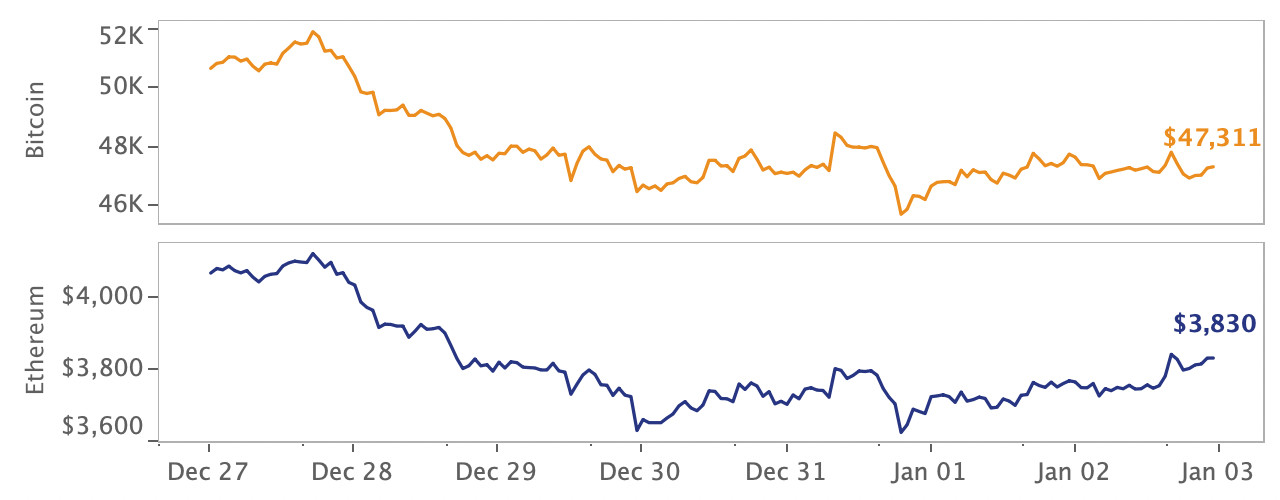
Liquidity tends to be lower over the holidays, and the absence of trading activity and a $6 billion options expiry likely contributed to the bearish pullback experienced by cryptocurrency markets over the past week. Although 2021 ended on a gloomy note, Bitcoin and Ethereum closed the year up 57% and 403%, far surpassing returns for traditional financial assets. The year was truly standout for the entire industry, with crypto companies raising more VC money than any other year combined. In case you missed it, check out 2021 Year in Review for data-driven trends of the year.
Crypto diverges from traditional markets in December
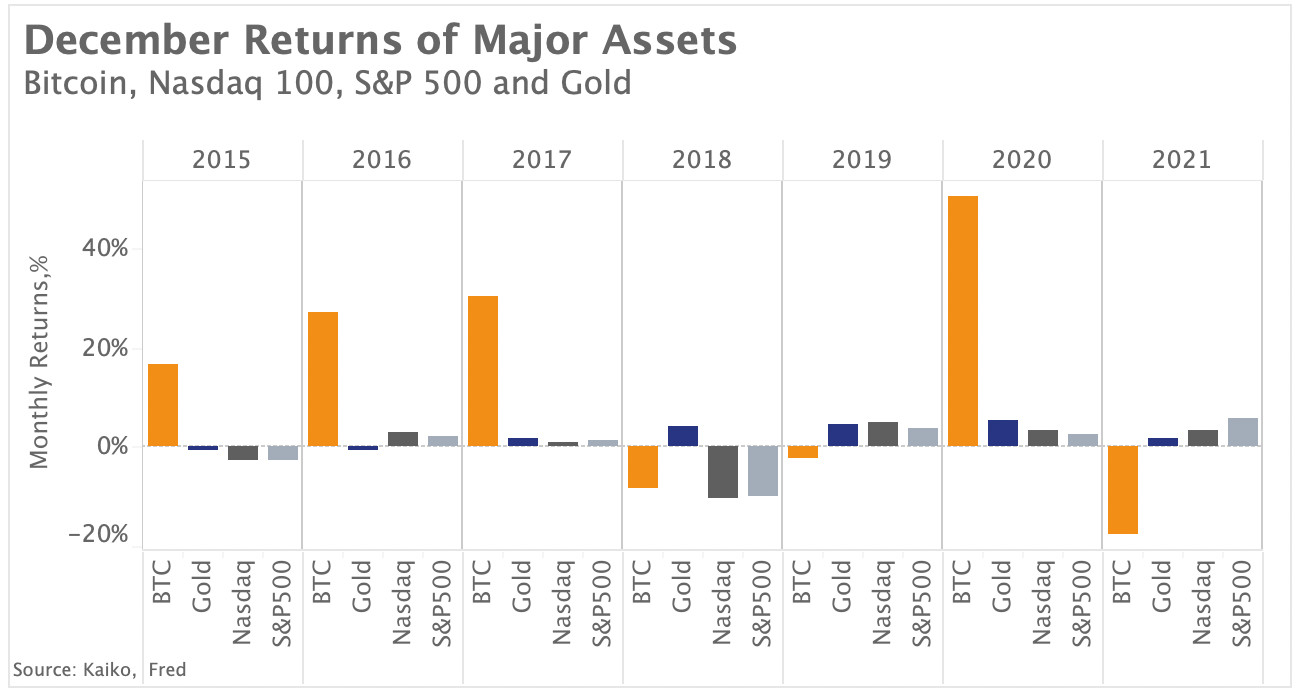
Crypto markets experienced a bearish December while traditional equities and safe-haven gold rallied. Above, we chart December returns for major financial assets over the past six years. December is a historically strong month for equity markets with major indexes registering mostly positive returns during the so-called Santa Claus rally (last 5 days of the year and 2 first days of January). Both the S&P 500 and the technology-focused Nasdaq 100 ended the month in the green for the third year in a row. Bitcoin dropped nearly 20%, closing the year some $20k below its all-time high, in stark contrast to the 2020 bull run.
Abnormal volumes during period of low liquidity
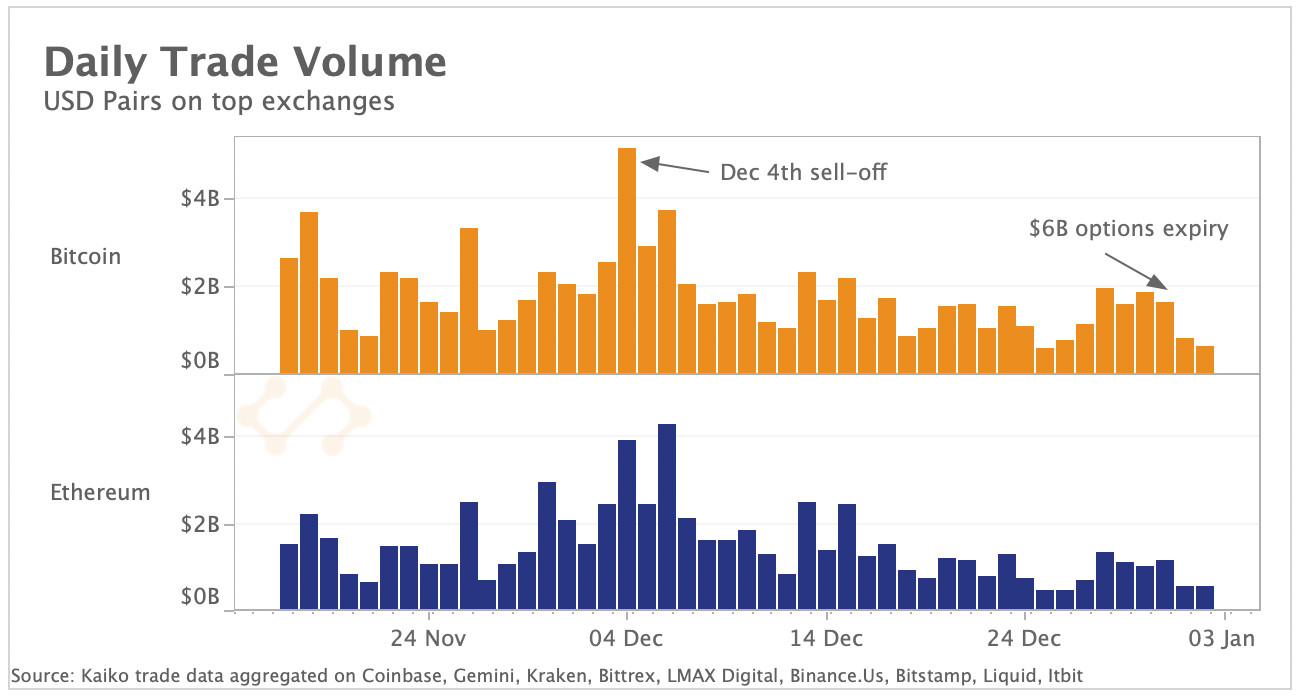
Traders for the most part took a vacation in the final weeks of December, with average Bitcoin and Ethereum volumes a lot lower than November's average. BTC-USD and ETH-USD volumes barely registered beyond $1.5B on the leading exchanges, coinciding with sharp dips for both assets. While volumes were overall relatively low, we noticed an abnormal spike in activity on Coinbase in the last week of December. Below, we chart the market share of volume for BTC-USD markets across exchanges, and can observe that trade volume on Coinbase surged from 45% on Dec 26 to 68% on Dec 30, its highest share in years.
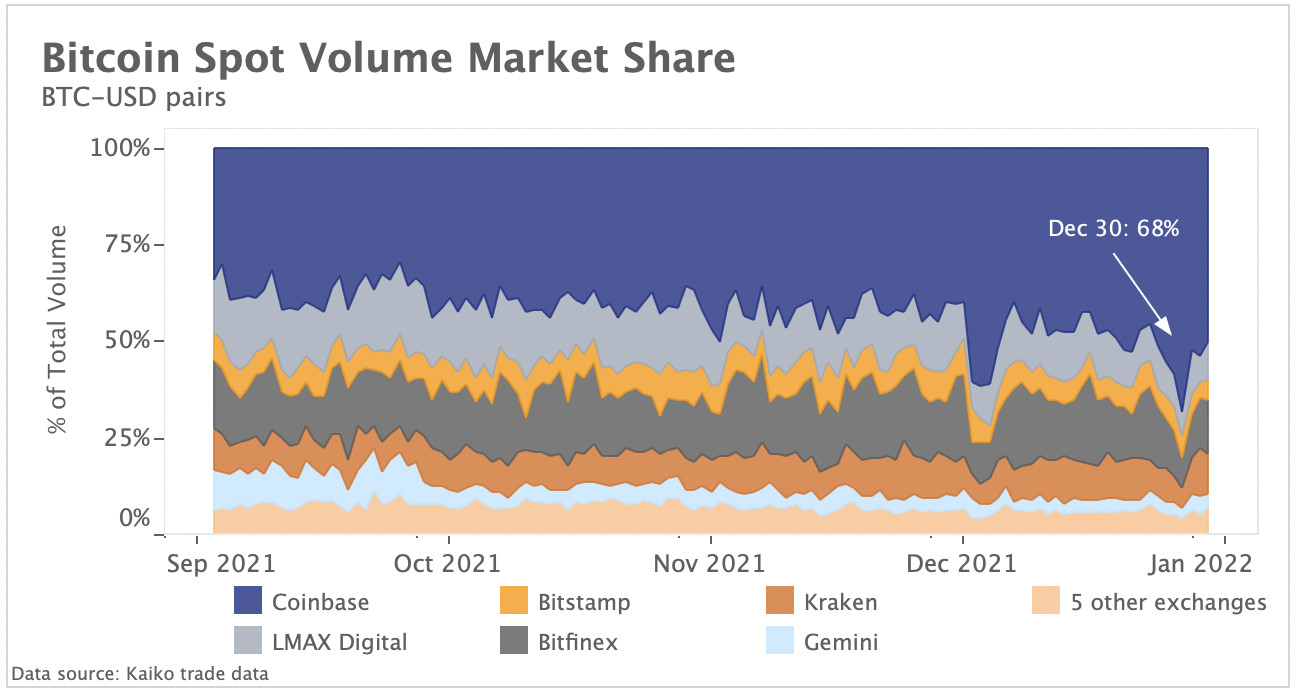
It's clear that a trader or handful of traders were abnormally active on Coinbase during this time. Below, we chart the second-by-second volume of buy vs. sell orders for all trades greater than 5 BTC to give an idea of how large traders (whales) were behaving. We can observe a large concentration of buy orders >5 BTC on December 30th, the day of the spike in market share. A cluster of large buy and sell orders were executed immediately before the 31st options expiry, and on the 1st of January, we can observe a sharp spike in sell orders >5 BTC.
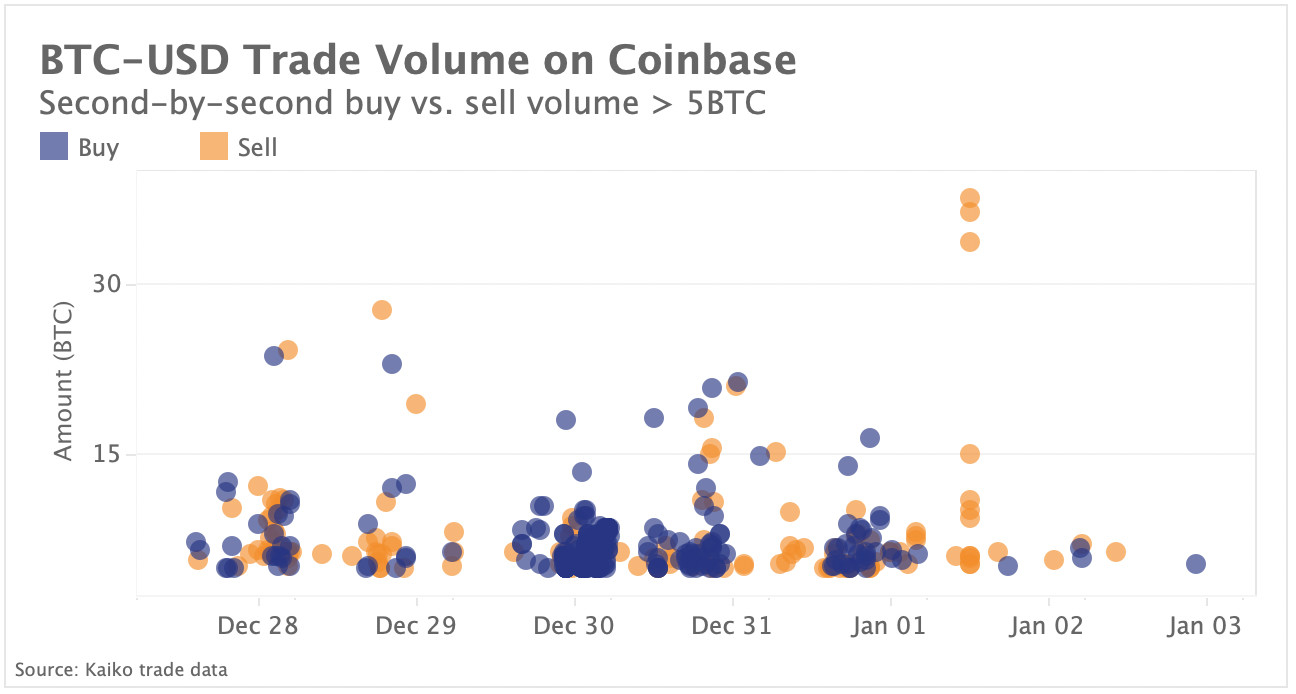
The average Bitcoin trade size on the exchange tripled between from $1K to $3K over the same period. Large trades are not always indicative of the extent of whale activity as traders tend to break larger orders into smaller chunks to avoid slippage. However, Coinbase has a highly liquid BTC-USD order book which can support large market orders, and when looking at the data we can see a high concentration of large price taker activity. To conclude, it seems likely that a whale executed a large buy order on Coinbase causing a spike in market share, and in the days that followed whales were mostly sellers.
Turkish Lira is highest volume fiat currency on Binance
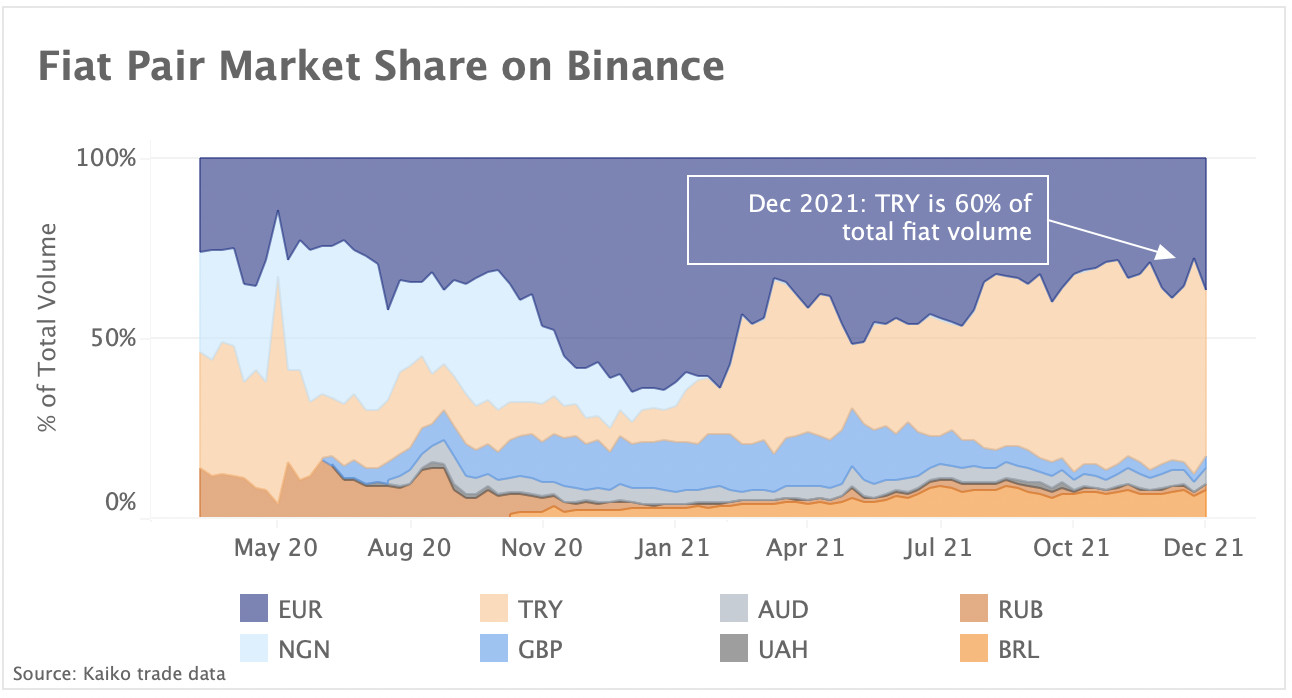
Crypto adoption in Turkey has soared over the past few months amid a record meltdown of the Turkish Lira (TRY). Today, Binance is one of the only major global exchanges that offers trading pairs denominated in TRY, and overall the exchange only lists a handful of fiat currencies due to regulatory restrictions. For years, the highest % of fiat pair volume was denominated in Euro, but that all changed in 2021. Above we chart the volume market share of major fiat currencies on Binance and observe that the share of Lira has soared from just 7% in January to 60% of all fiat volume in December. Over the same period, the Lira lost more than 40% of its value partly due to the country’s unconventional monetary policy focused on boosting growth and exports despite soaring inflation.
Turkey has made moves to regulate the cryptocurrency industry with a new crypto bill and a recent fine against Binance’s Turkish unit. Binance’s share of Euro (EUR) and British Pound (GBP) transaction volume has fallen sharply over the past year partly due to regional regulatory crackdowns.


Options volumes drop following $6b expiry
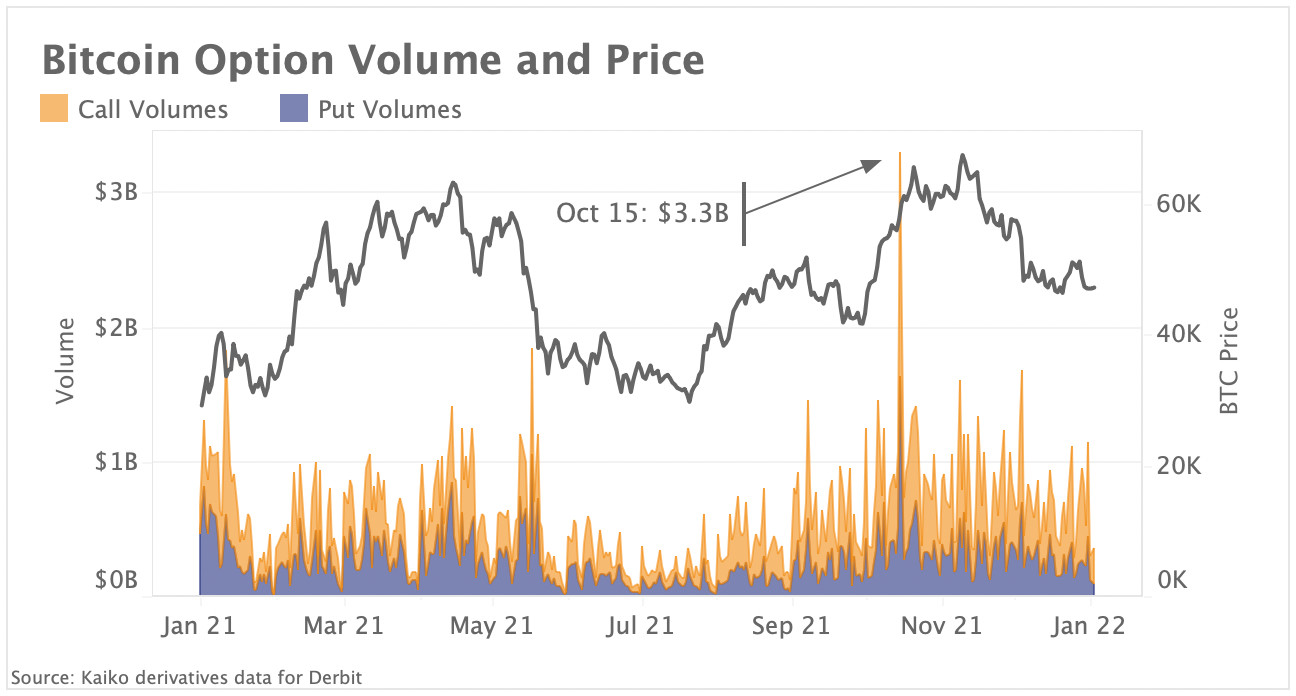
Bitcoin option volumes have decreased significantly after hitting a yearly high in October, with volumes preceding the December 31st expiry relatively low. Above, we chart the put and call trade volume on Deribit, the largest cryptocurrency options market, along with Bitcoin’s price. Options are a type of derivatives contract giving the right - but not the obligation - to purchase the underlying asset at a fixed price before or at the date of expiry. According to analysts, the large Dec. 31st expiry of mostly buy (call) option contracts has been among the drivers of Bitcoin's recent spot price turbulence as large traders attempted to push the spot price towards the maximum pain price. The max pain price is the strike price with the most open contracts and is estimated at $48K. With Bitcoin ending last week at around $47K, many call options holders were at a loss.
We observe that daily trade volume declined significantly after the expiry, from $1.1B on Dec 31 to $351mn in early January. Together with luckluster spot volumes and falling prices the trend suggests overall bearish sentiment and low interest from investors. Nevertheless, the market share of call options (bullish bets) has increased relative to puts (bearish bets) and is currently at around 66%.
Inflation expectations fall despite Omicron jitters
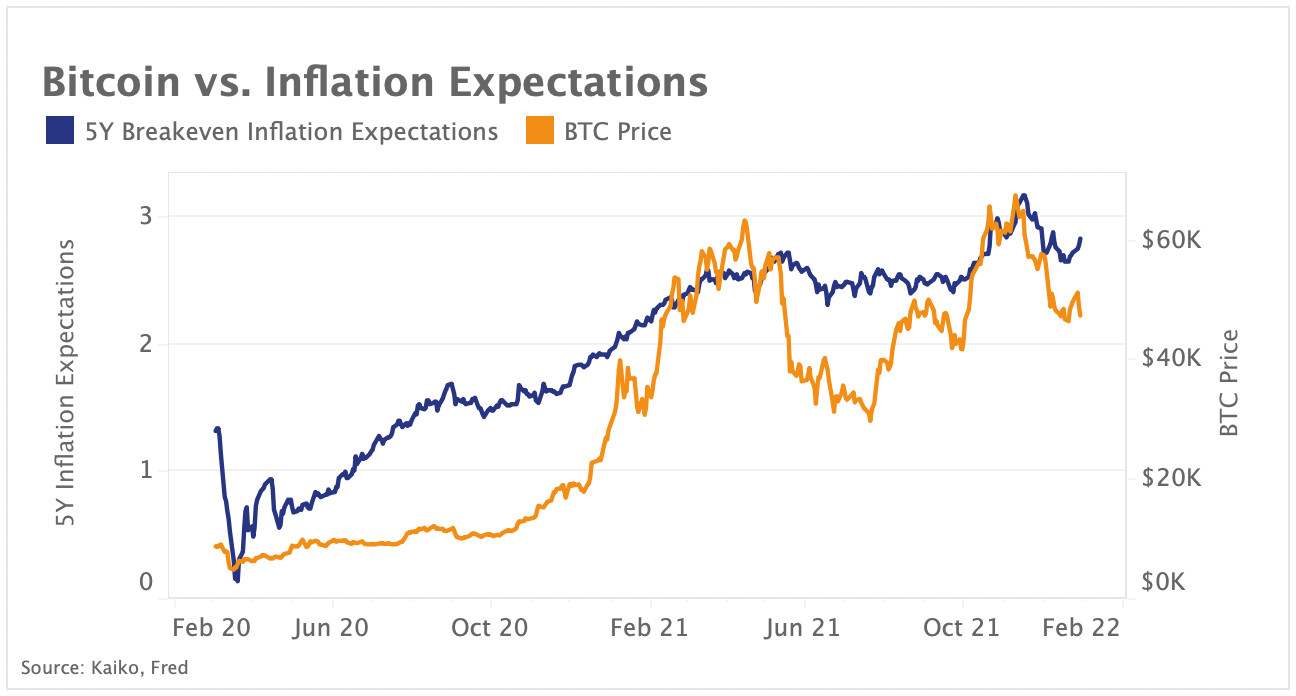
Breakeven inflation expectations - a market-based measure of expected inflation over the next 5 years - has declined after the U.S. Fed officially started tapering monthly asset purchases in November. Above, we chart inflation expectations along with the price of Bitcoin. We observe they have been moving in tandem over the past month despite diverging slightly at the end of December. Inflation expectations, which hit a multi-year high mid-November, have been on a downward trend, despite the emergence of the new Omicron covid strain which could worsen supply chain disruptions. The latter have been among the major drivers of rising prices throughout the past year. Bitcoin also fell after hitting an all-time high in November as investors de-risked their portfolio and remained cautious ahead of the end-year holiday season.