A summarizing review of what has been happening at the crypto markets of the past week. A look at trending sectors, liquidity, volatility, spreads and more. The weekly report in cooperation with market data provider Kaiko.
The last 7 days in cryptocurrency markets:
- Price Movements: Following the UK's Binance ban, Bitcoin pairs denominated in the British Pound have traded at a steep discount to the U.S. Dollar.
- Volume Dynamics: Average weekend trading volume has increased relative to weekday volumes over the past year.
- Order Book Liquidity: The bid-ask spread for BTC-USD pairs has widened on all exchanges analyzed throughout this recent sell-off.
- Macro Trends: Bitcoin's correlation with the S&P 500 turned negative for the first time in 2021.
Binance ban causes GBP discount
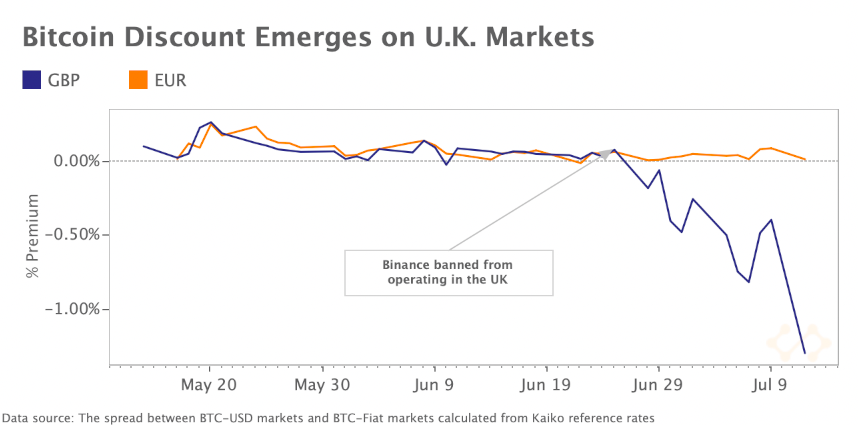
On June 28th, market regulators banned Binance from operating in the U.K. which instantly created a steep discount for BTC-GBP markets relative to BTC-USD. Bitcoin actively trades against the British Pound on 13 exchanges, of which Binance accounts for a significant portion of total volume. The ban likely spooked traders who sought to quickly cash out their Bitcoin, resulting in a discount relative to BTC-USD markets. Never before has such a steep drop been observed for the British Pound, which normally trades within maximum .1% of USD markets. We chart BTC-EUR for context, which today trades within .02% of USD markets. Following the ban, Barclays and Santander UK banned clients from transferring funds to the exchange. Binance also temporarily stopped payments from the EU's Sepa platform.
Average weekend volumes are growing
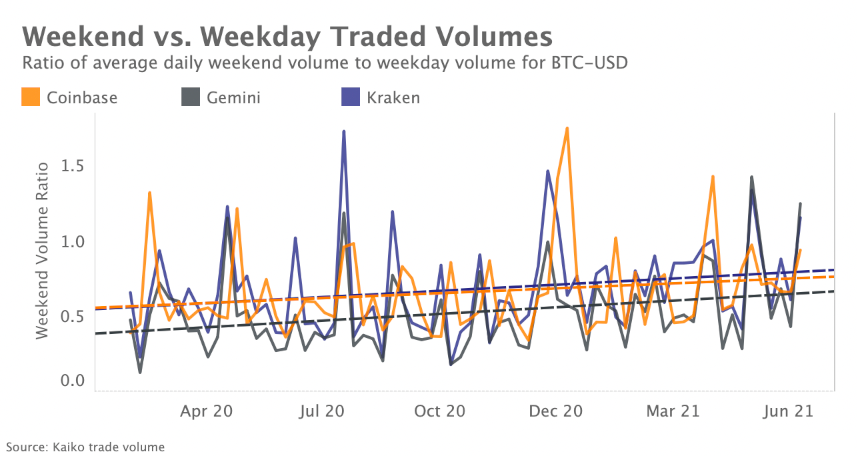
Sunday's volatility could be explained by trends in trading volume on the leading crypto-to-fiat exchanges. The average volume of Bitcoin traded over the weekend is growing relative to average weekday volumes. The ratio between weekend and weekly BTC-USD volumes has doubled since March 2020 on Coinbase, Kraken and Gemini. The ratio takes the average weekend volume divided by the average weekday volume, and when this ratio is above 1, the average weekend volume is greater than during the week. We can observe a clear trend over the past year, with average weekday volume still higher than weekend volumes, but weekend volumes quickly catching up.
This trend is interesting because it conflicts with Bitcoin's institutional narrative. Growing weekend volume suggests a higher retail presence relative to institutions, which we assume concentrate trading during the weekdays. However, the data could also suggests an increasing prevalence of bot trading, with high-volume traders breaking apart large orders to execute over the weekend.
Below, we chart the same ratio for BTC-USDT markets on the three major crypto-to-crypto exchanges: Binance, Okex, and Huobi.
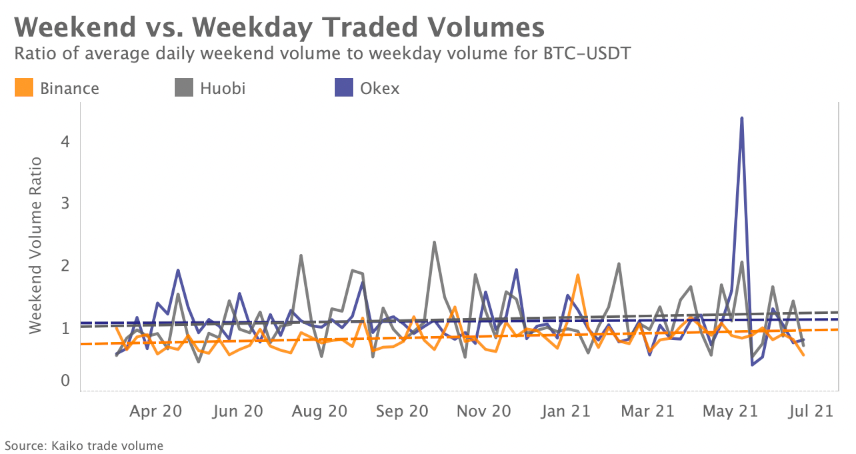
These exchanges have a more retail reputation, and the data confirms that average weekend volume is nearly equal to average weekday volume (1:1). There has been little change in the ratio on crypto-to-crypto exchanges over the past year. Overall, liquidity remains lower and is replenished more slowly outside of traditional trading hours, which could explain why growing weekend volumes has generated negative Sunday returns.
Bitcoin liquidity has worsened during sell-off
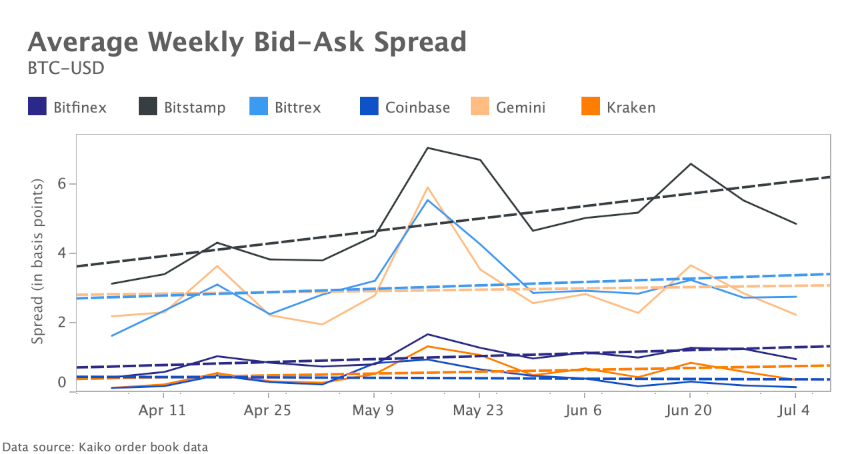
Over the past three months, the average bid-ask spread has increased ever-so slightly for BTC-USD pairs on the leading crypto-to-fiat exchanges. The increase has been most notable on Bitstamp, which has seen average spreads grow from 3 basis points to 4.8 basis points. Coinbase has experienced only a slight increase from .11 basis points to .14. Jitters over the previous month's sell-off could explain the trend, with market makers taking a step back waiting for markets to recalibrate.
Average price slippage, which measures the difference between the expected price of a trade and the price level required to fully execute an order, has also increased. Below, we chart average price slippage for a simulated 50'000 USD market sell order, averaged across the same six exchanges charted above.
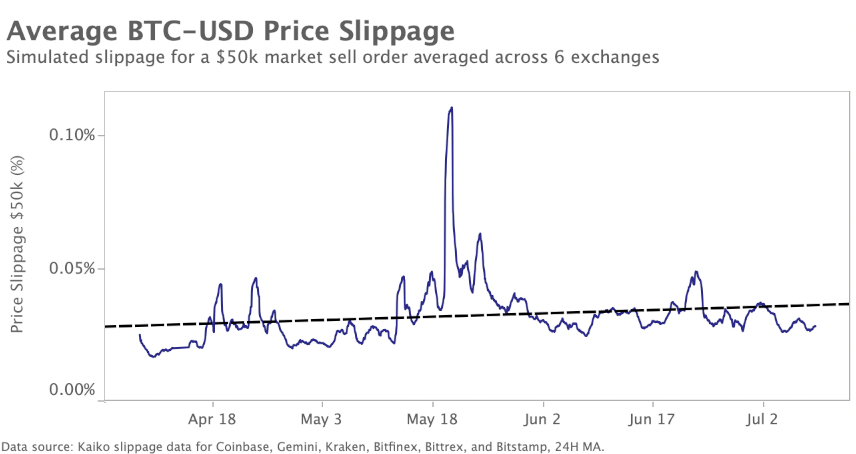
We can observe that slippage has grown slightly from the .02-.03% range to .03 -.04% over the past three months. Higher measures for price slippage mean it is costlier to trade large quantities of Bitcoin.
Bitcoin's correlation with S&P 500 shifts negative

For the first time this year, Bitcoin's correlation with the largest equity index has flipped negative, meaning the two financial instruments now have a slight negative correlation. For the first six months of 2021, Bitcoin and the S&P 500 were loosely correlated as both repeatedly broke all time highs amid a record-setting bull run. However, Bitcoin has since crashed while the S&P 500 continues to soar, resulting in a sharp divergence between the two. Bitcoin's correlation to Gold remains negative, but rose by 20% over the past month and is now slightly higher than the S&P 500, a first this year.