Close Menu
Crypto Valley Journal
    Facebook X (Twitter) Instagram
    Crypto Valley Journal
    • Hot Topics
      • News
      • Minds
    • Focus
      • Background
      • Blockchain
      • Legal & Compliance
      • Non-Fungible Token (NFTs)
    • Investing
      • Markets
      • Financial Products
      • Decentralized Finance (DeFi)
      • Exchange overview
    • Education
      • Basics
      • Glossary
      • Politicians on crypto
    • Statistics
      • Bitcoin-ETF-Flows
      • Ethereum-ETF-Flows
      • Crypto market data
      • On-chain data
    • Academy
      • Overview
      • Part 1: Blockchain
      • Part 2: Money
      • Part 3: Bitcoin
      • Part 4: Cryptocurrencies
      • Part 5: Decentralized Finance
      • Part 6: Investing
    • English
      • Deutsch
    Crypto Valley Journal
    You are at:Home » Focus » Background » McKinsey analysis: Real stablecoin payments reach USD 390 billion
    McKinsey analysis reveals only USD 390 billion of USD 35 trillion in stablecoin transactions are real payments. B2B segment grows by 733%.

    McKinsey analysis: Real stablecoin payments reach USD 390 billion

    By Editorial Office CVJ.CH on 26. January 2026 Background

    A joint study by McKinsey and Artemis Analytics provides the first differentiated view of the stablecoin payments market. The central finding is surprising: Of the USD 35 trillion that flowed through stablecoin networks in 2025, only around USD 390 billion went to actual payments.

    The rest consists of crypto trading, internal transfers, and protocol-related transactions. MKinsey's analysis is the first to systematically distinguish between transaction volume and real payment flows. The frequently cited comparisons with Visa or Mastercard are misleading: While stablecoins appear to process similar volumes at first glance, actual payments reach only 0.02 percent of global payment traffic of over USD 2 quadrillion annually.

    Subscribe to our newsletter

    The best articles of the week, directly delivered into your mailbox.

    Methodological distinction between volume and payments

    For the study, McKinsey combined bottom-up and top-down approaches. First, analysts tagged custody providers. Then they examined transaction patterns and filtered out trading activities and high-frequency operations. Excluded activities include: exchange liquidity pools, automated smart contract interactions, liquidity management, arbitrage, and protocol-related mechanisms.

    This distinction is relevant for companies and regulators. On one hand, it shows where stablecoins actually function as a means of payment. On the other hand, it reveals where they primarily serve crypto infrastructure. The methodology also makes clear that headlines about stablecoin volumes exceeding traditional payment networks miss the point.
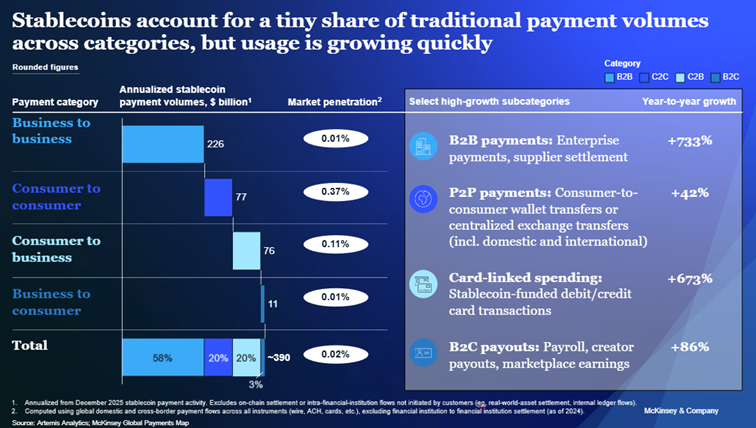
    Data on traditional payment processing with stablecoins / Source: McKinsey, Artemis

    B2B payments dominate with 733 percent growth

    The breakdown by use case shows a clear hierarchy. B2B payments stand out in particular: They reached USD 226 billion, accounting for 58 percent of total stablecoin payment volume. Year-over-year growth of 733 percent underscores the momentum in this segment. Companies are increasingly using stablecoins for cross-border supplier payments and international settlements.

    Global payroll and remittances totaled USD 90 billion. This corresponds to approximately one percent of the USD 1.2 trillion remittance segment. Capital market settlements reached USD 8 billion, while stablecoin card payments stood at USD 4.5 billion. The latter also recorded strong growth of 673 percent year-over-year.

    "The fact that real stablecoin payments are much lower than routine estimates does not diminish the long-term potential of stablecoins as payment infrastructure. Instead, it creates a clearer baseline for assessing where the market stands." - McKinsey and Artemis Analytics

    Ray Dalio advises 10 to 15% gold and a small Bitcoin position, because he expects a US debt crisis within about three years. Minds

    Star investor Ray Dalio considers Bitcoin inferior to gold

    Bitcoin overtakes gold in the US: per River's report, 49.6 million Americans own Bitcoin, while just 28.8 million still hold gold. Background

    Bitcoin overtakes gold among US investors for the first time

    The House of Satoshi Bitcoin ETP shifts its allocation between Bitcoin and cash each month via an AI model, with SIX trading starting in October. Financial Products

    House of Satoshi launches Bitcoin ETP with AI-driven allocation

    What separates Dogecoin from Bitcoin is its unlimited supply, and the 2013 satire coin now trades through its own US spot ETF. Basics

    What is Dogecoin? From satire project to ETF asset

    Ray Dalio advises 10 to 15% gold and a small Bitcoin position, because he expects a US debt crisis within about three years. Minds

    Star investor Ray Dalio considers Bitcoin inferior to gold

    Bitcoin overtakes gold in the US: per River's report, 49.6 million Americans own Bitcoin, while just 28.8 million still hold gold. Background

    Bitcoin overtakes gold among US investors for the first time

    Asia leads with 60 percent market share

    The geographic distribution shows clear concentration in the Asia-Pacific region. Singapore, Hong Kong, and Japan dominate with a combined stablecoin payment volume of USD 245 billion. North America follows with USD 95 billion, Europe with USD 50 billion. In contrast, Latin America and Africa remain marginal at under one billion USD each.

    This distribution reflects different regulatory frameworks and market structures. In Asia, established fintech ecosystems and high remittance volumes drive adoption. Still, the GENIUS Act passed in the US in July 2025 is likely to influence North American figures going forward. The law creates a comprehensive regulatory framework for stablecoin issuers for the first time and requires 100 percent reserve backing.

    Market capitalization and competition among issuers

    The circulating stablecoin supply exceeded USD 300 billion at the end of 2025. Shortly after, market capitalization reached an all-time high of over USD 311 billion in January 2026. Tether's USDT dominates with around USD 187 billion and a 60 percent market share. Circle's USDC follows with approximately USD 74 billion.

    Yet growth rates show a shift. USDC grew 73 percent in 2025, while USDT gained only 36 percent. For regulated B2B applications, companies increasingly prefer USDC. In contrast, USDT remains dominant in emerging markets on networks like Tron and Solana, particularly for peer-to-peer transfers.

    Outlook: Infrastructure on the verge of breakthrough

    The McKinsey analysis forecasts stablecoin market capitalization of USD 2 to 4 trillion by 2030. Integration by traditional payment providers like Visa and Stripe is accelerating. At the same time, crypto companies like Circle and Tether are positioning themselves as alternatives to slow and costly international wire transfers.

    The study establishes a sober baseline for future assessments. Stablecoins as a payment method are at the beginning, not the finish line. Actual adoption will be measured by real payment flows, not transaction volumes.


    Share. Facebook Twitter LinkedIn Email Telegram WhatsApp

    About the author

    Editorial Office CVJ.CH
    • Website
    • Twitter
    • LinkedIn

    Since 2018, the editorial team at Crypto Valley Journal has been reporting from Zug - the heart of Switzerland’s Crypto Valley - on Bitcoin, cryptocurrency, blockchain, and regulatory developments in digital assets. Behind the publication’s collective editorial voice is a team of writers with backgrounds in financial markets, law, and technology.

    Related Articles

    The OCC has conditionally approved a trust bank charter for World Liberty, allowing the Trump firm to issue the stablecoin USD1 itself in future.

    Regulator grants Trump firm World Liberty conditional bank charter

    The Tether KPMG audit ended with an unqualified opinion for the 2025 financial year and confirmed a reserve surplus of USD 6.814 billion.

    Tether completes first full audit with KPMG

    The Mastercard BVNK acquisition, worth up to USD 1.8 billion, expands the card network's stablecoin infrastructure for B2B payments and settlement.

    Mastercard closes BVNK acquisition worth up to USD 1.8 billion

    The anonymous GTA 6 leaker releases further stolen clips only once the Cyberleek memecoin reaches set market capitalization thresholds.
    24. August 2026

    Cyberleek memecoin unlocks new GTA 6 leaks

    The House of Satoshi Bitcoin ETP shifts its allocation between Bitcoin and cash each month via an AI model, with SIX trading starting in October.
    24. August 2026

    House of Satoshi launches Bitcoin ETP with AI-driven allocation

    Since mid-August 2026, PostFinance Ethereum staking runs without the twelve-week lock-up, and customers initiate unstaking themselves.
    24. August 2026

    PostFinance drops the fixed lock-up for Ethereum staking

    twitter image button instagram image button linkedin image button youtube image button

    About Crypto Valley Journal
    About Crypto Valley Journal

    On the pulse of the movement

    • Academy
    • Contact
    • Advertising
    • About us
    • Partner
    • Imprint
    • Privacy
    • Disclaimer
    Search

    Type above and press Enter to search. Press Esc to cancel.