Meta is developing a smartphone app called "Arena" under the direct supervision of Mark Zuckerberg, intended as an attack on Polymarket and Kalshi. This Meta prediction market venture initially forgoes real money and instead relies on a video-game-style points system.
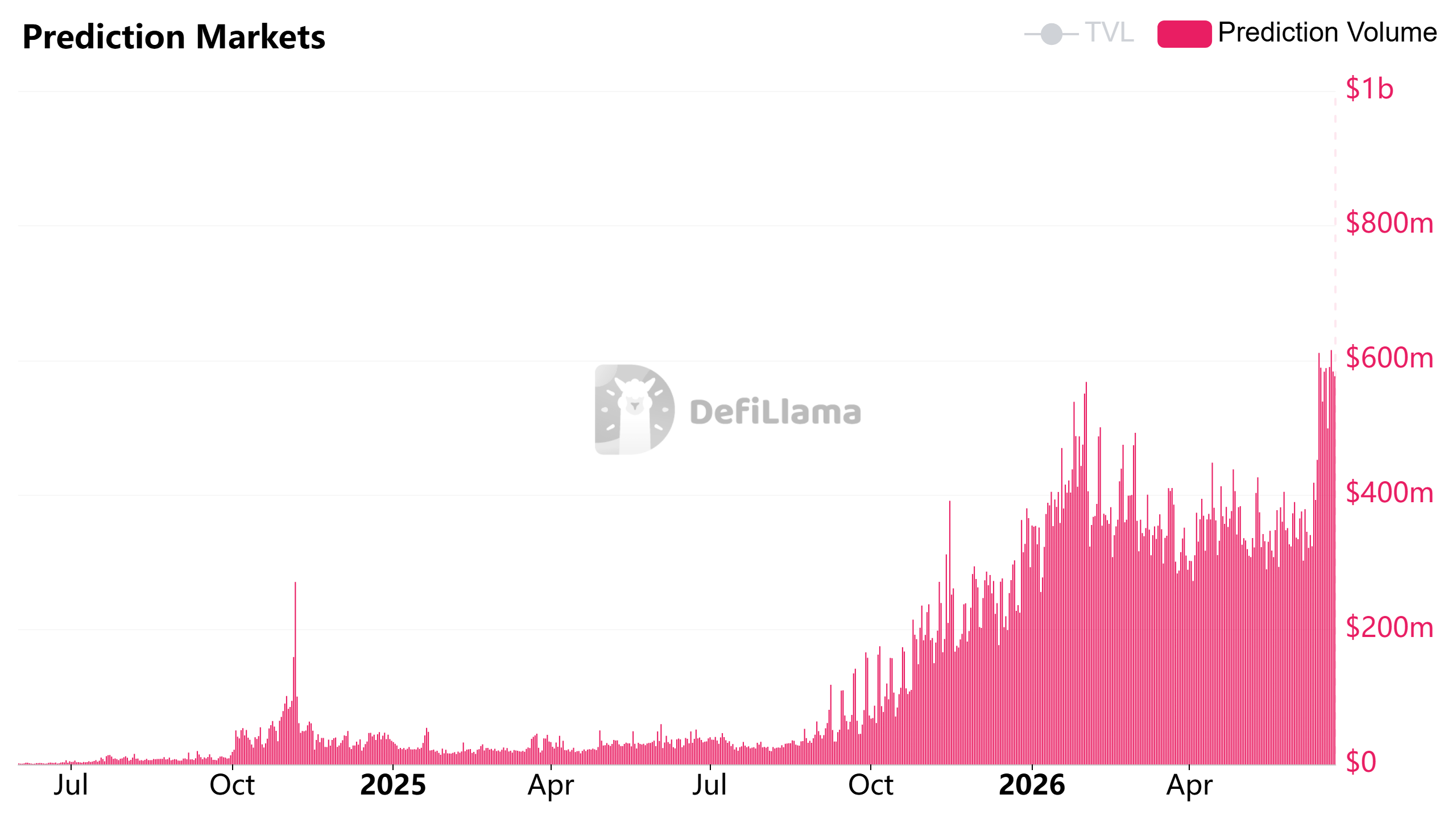
Prediction markets are platforms where users bet on the outcome of events, from elections to economic data to sports results. The traded market prices form collective probabilities for future events. The sector is growing rapidly: in 2025, Kalshi and Polymarket drew around 50 billion USD in trading volume, and by 2026 the market had already surpassed 130 billion USD. Following its Series F in May 2026, Kalshi is valued at 22 billion USD. Moreover, the research firm Bernstein forecasts annual trading volume of 1 trillion USD by the end of the decade.
Kalshi, Polymarket and a market on a growth trajectory
Kalshi sits at the center of institutional adoption. In May 2026, the company raised 1 billion USD in a Coatue-led Series F, lifting its valuation to 22 billion USD. Because the valuation had still stood at 11 billion USD in December 2025, the company's value thus doubled within just five months. Its investors include Sequoia, Andreessen Horowitz, Paradigm, Morgan Stanley and ARK Invest. Annualized trading volume stands at 178 billion USD, while annualized revenue exceeds 1.5 billion USD. The institutional demand is especially striking: within six months, institutional trading volume rose by 800 percent, as hedge funds, asset managers and prop trading firms discover event contracts as an asset class of their own.
Polymarket, however, pursues a structurally different approach. The platform runs on-chain on the Polygon blockchain, with settlement carried out in USDC via smart contracts. After a 2 billion USD investment by ICE, the parent company of the NYSE, the provider is valued at 9 billion USD. Meanwhile, the platform is seeking new investors at a valuation of 15 billion USD. In May 2026, Polymarket officially returned to the US market with its own iOS app. In addition, further players are pushing into the sector, including the gambling operators FanDuel and DraftKings, the crypto exchange Gemini and Trump Media & Technology Group.
The volume trajectory underscores the momentum. From around 50 billion USD in combined volume in 2025, the market climbed above 130 billion USD in 2026. The breakthrough came with the 2024 US presidential election, when Polymarket alone processed 3.3 billion USD in election markets. Bernstein sees this as merely the beginning and puts the potential at 1 trillion USD in annual trading volume by the end of the decade.
Arena as a cautious entry by Meta
Arena is the product of a small internal team that Zuckerberg commissioned directly. The app is meant to operate independently of Facebook, Instagram, WhatsApp and Messenger. Unlike its established competitors, it initially forgoes real money and uses a video-game-style points system instead, though a later switch to real money is not ruled out. Internally, the venture is regarded as "experimental but top priority" and forms part of a broader push through which Zuckerberg wants to create new app types based on changing social behavior. At the same time, the company is testing further standalone apps, including "Meta Photos" for AI-generated media types.
Strategically, Arena fits a familiar pattern. For years, Zuckerberg has pursued the tactic of copying rising competitors, for example with Stories as a response to Snap or Reels against TikTok. The success rate, however, is mixed. As early as 2020, the company released "Forecast," a prediction app with a points system, but discontinued it again in 2022. The "New Product Experimentation" team, founded in 2019, likewise produced few hits with standalone apps for podcasts, travel and music. Furthermore, the renewed effort falls in a delicate phase: in the first quarter of 2026, Meta recorded a quarterly decline in daily active users for the first time in its history, from an average of 3.56 billion in March.
A standalone app ecosystem could therefore build engagement outside the saturated core apps, especially since the company intends to deliberately steer its large social audiences toward Arena. Whether the app will appear at all, however, remains open, because it is still in development and may never be released. The information comes from two anonymous employees with direct knowledge of the plans, who spoke to the NYT; Meta declined to comment.


What Meta cannot replicate
The decisive difference lies in the architecture. Polymarket's trades do not run over central servers but over smart contracts on Polygon, a layer-2 blockchain on Ethereum. Settlement is carried out non-custodially in USDC, so users retain control over their funds at all times. Thus, the platform is technically more censorship-resistant than a centrally operated app. This is precisely where Meta hits a limit, because Arena would be a centrally controlled, regulated application without crypto settlement. What is a product feature at Polymarket cannot be reproduced in a conventional app.
The regulatory path differs as well. Polymarket was allowed to return to the US market only after a 1.4 million USD fine in 2022 and the purchase of the CFTC-licensed exchange QCX LLC, after the agency gave the green light in December 2025. As long as Arena launches without real money, Meta initially sidesteps this hurdle. A switch to real bets, however, would trigger the same licensing requirement with the Commodity Futures Trading Commission.
Regulation, insider trading and a fake-bet scandal
Despite its growth, the sector is under pressure. In April 2026, US federal prosecutors charged Gannon Ken Van Dyke, a Master Sergeant in the US Army Special Forces. The allegation is that he used classified information about Operation Absolute Resolve, the arrest of Nicolás Maduro in early 2026, to bet on Polymarket. With a single bet of 32,537 USD, he achieved a profit of 404,222 USD, equivalent to a return of 1,242 percent. In total, his gains added up to around 409,881 USD. It is the first insider trading case brought by the US Department of Justice on a prediction market; Van Dyke pleaded not guilty.
Shortly afterward, another scandal shook the industry. The Wall Street Journal reported that Polymarket had paid dozens of social media creators to film themselves placing fake bets. Of 1,105 analyzed TikTok videos, 778 showed clone websites instead of the real Polymarket page. In 118 videos, almost 900,000 USD in fabricated winnings were staged, while the same bets would in reality have led to losses of over 166,000 USD. The creators reportedly received 2,000 to 3,000 USD per month, coupled with instructions not to disclose their payment. The provider subsequently announced an internal review.