The digital assets sector has become a billion-dollar market and is visibly penetrating the traditional financial world. Titled "The Future of Digital Assets," an event on the topic was held in Zurich last week, as more and more institutional investors have started to invest in crypto assets.
Crypto assets, or digital assets, are experiencing tremendous growth. More and more institutional investors are investing in this new asset class, and a number of established financial institutions now recognize crypto assets as a promising investment area. In the meantime, a broad ecosystem with corresponding products and services has developed around the emerging asset class.
"The Future of Digital Assets" - Crypto assets in the traditional financial world
The total market capitalization of all cryptocurrencies is approaching an all-time high of $2.5 trillion with an estimated 200 million users worldwide. However, with the emergence of crypto assets, the second internet revolution is still in its infancy and, analogous to the first in the late '90s, is elusive. Accordingly, there is a perceptible uncertainty among investors, especially since many myths surround the topic.
With the aim of providing more insight into current developments, the event "The Future of Digital Assets" organized by CVJ.CH and 10x10, took place for the first time in Zurich. Proven experts from the field explained how crypto-assets can be used sensibly within a portfolio context and what opportunities and risks the new asset class brings with it. The current infrastructure in Switzerland around digital assets was also highlighted. More than 100 participants, mainly from the institutional finance sector, attended the event physically or virtually and underlined a growing interest in digital assets.
Switzerland is falling behind as a location for innovation
In his introduction, 10x10 founder Rino Borini points to the attractive positioning of American financial service providers in the field. Fintech companies such as Paypal or Square, but also the major Wall Street banks now offer services related to digital assets. However, the Swiss financial centre seems to be losing importance as a pioneer and home of the "Crypto Valley". The major domestic banks are widely opposed and some voices in politics are even calling for a complete ban - despite the exemplary early regulation of the sector. In Switzerland, the role of Wall Street banks has been taken over by innovative private banks as well as companies with banking licenses specializing in crypto assets.
Cryptocurrencies in a portfolio context
The now $2.5 trillion cryptocurrency market is finding more and more institutional investors considering digital assets in their portfolio allocations. But what is the impact of Bitcoin & Co. on a traditional investment portfolio? OpenMetrics CTO Tobias Setz analyzed the price development of the most popular cryptocurrencies and their impact on performance and risk parameters. The primary factors considered were return, volatility and maximum price loss.
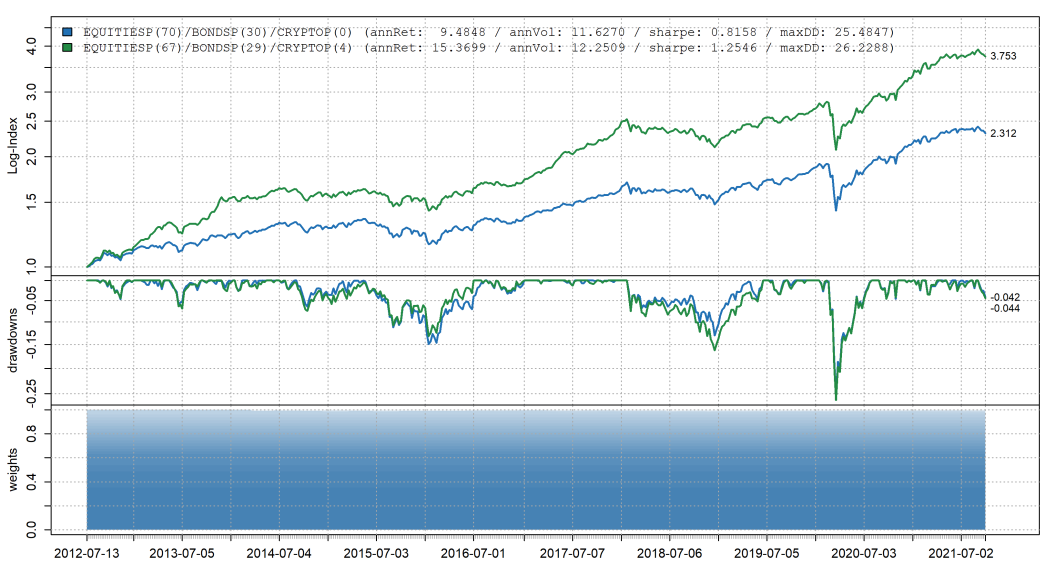
Even a small portfolio allocation to cryptocurrencies can significantly increase returns. According to the calculations, in relation to the risk taken, it makes even more sense to include the digital asset class in a portfolio. Diversification, as is often the case, is the buzzword of the day.
Emerging crypto trends and traditional investment opportunities
The sheer number of different digital currencies can overwhelm many investors. According to the analytics site CoinMarketCap, there are currently over 12,500 different cryptocurrencies. Sina Meier and Adrian Fritz of 21Shares provided information on the sectors and streamlined their focus on the most important ones. With the presentation of five cryptocurrencies, the visitors got an insight into a world that goes beyond Bitcoin and Ethereum. Also highlighted were the Solana smart contract platform, the Polygon scaling solution, and the dYdX DeFi application. In quite a few cryptocurrencies, 21 Shares offers exchange-traded products (ETPs) on various exchanges. This makes it possible for investors to participate in the price action of the corresponding cryptocurrencies in the usual infrastructure.




Infrastructure for asset managers is in place
Despite seeing an uptick in client demand for digital assets, there is often a lack of knowledge about the infrastructure and regulatory environment for the new asset class. Many an asset manager waves off overwhelmed client inquiries about crypto assets. According to expert Roger Darin, who has developed a turnkey solution for digital assets with Incore Bank, this does not have to be the case. With the CRYSP platform, innovative investment products can already be offered in bankable form, allowing for a proprietary investment strategy and compliant positioning in the new market.