
A summarizing review of what has been happening at the crypto markets of the past week. A look at trending sectors, liquidity, volatility, spreads and more. The weekly report in cooperation with market data provider Kaiko.
The last 7 days in cryptocurrency markets:
- Price Movements: Bitcoin now trades at a steep discount vs. the Russian Ruble.
- Volume Dynamics: Bitcoin volume dominance has climbed over the past month as traders rotate out of altcoins.
- Order Book Liquidity: BTC-RUB and BTC-UAH spreads remains volatile, matching global forex markets.
- Derivatives: The put-call ratio for BTC and ETH options has stabilised.
- Macro Trends: Commodities prices are surging as U.S. inflation hit a 4-decade high.
Volatility persists in global financial markets
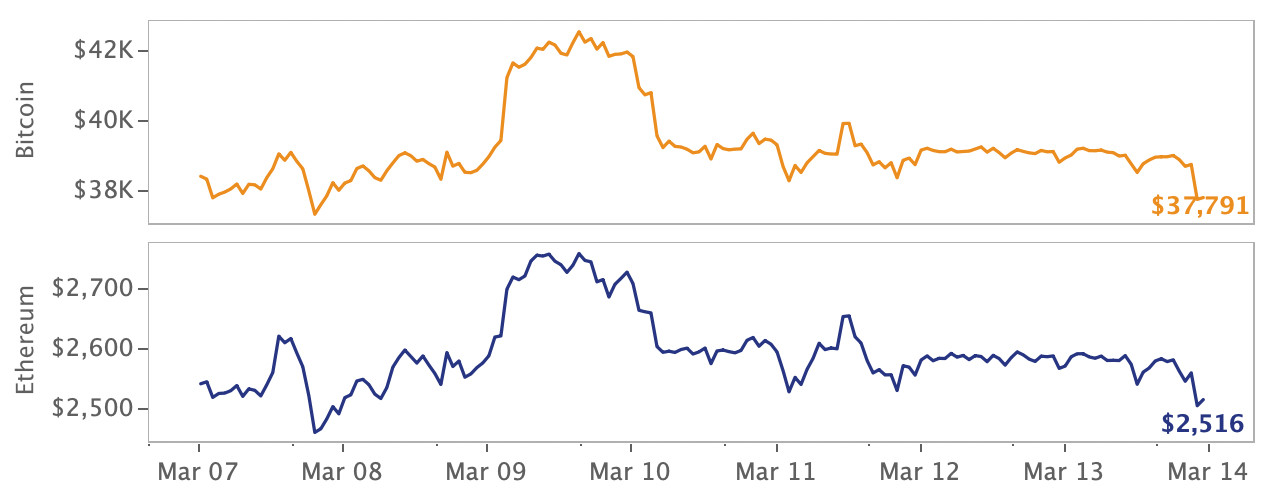
Investors continued de-risking their portfolios with both Bitcoin and Ethereum closing the week in the red, while the tech-focused Nasdaq 100 entered its first bear market since the pandemic (down 20% from its recent peak). Commodities markets remain in full price discovery mode, exhibiting strong volatility as traders struggle to price the fallout of the current geopolitical crisis. Despite growing stagflation worries (defined as a period of slowing growth and high inflation), most major central banks are continuing to pursue a hawkish monetary policy. Markets ramped up bets for a Fed rate hike this week as U.S. inflation hit another multi-decade high in February.
In crypto industry news, President Biden released a long-awaited executive order on cryptocurrencies, FTX is expanding into Europe, and Binance is launching its own fiat-to-crypto payment processing company.
DeFi tokens suffer following prolific developer departure
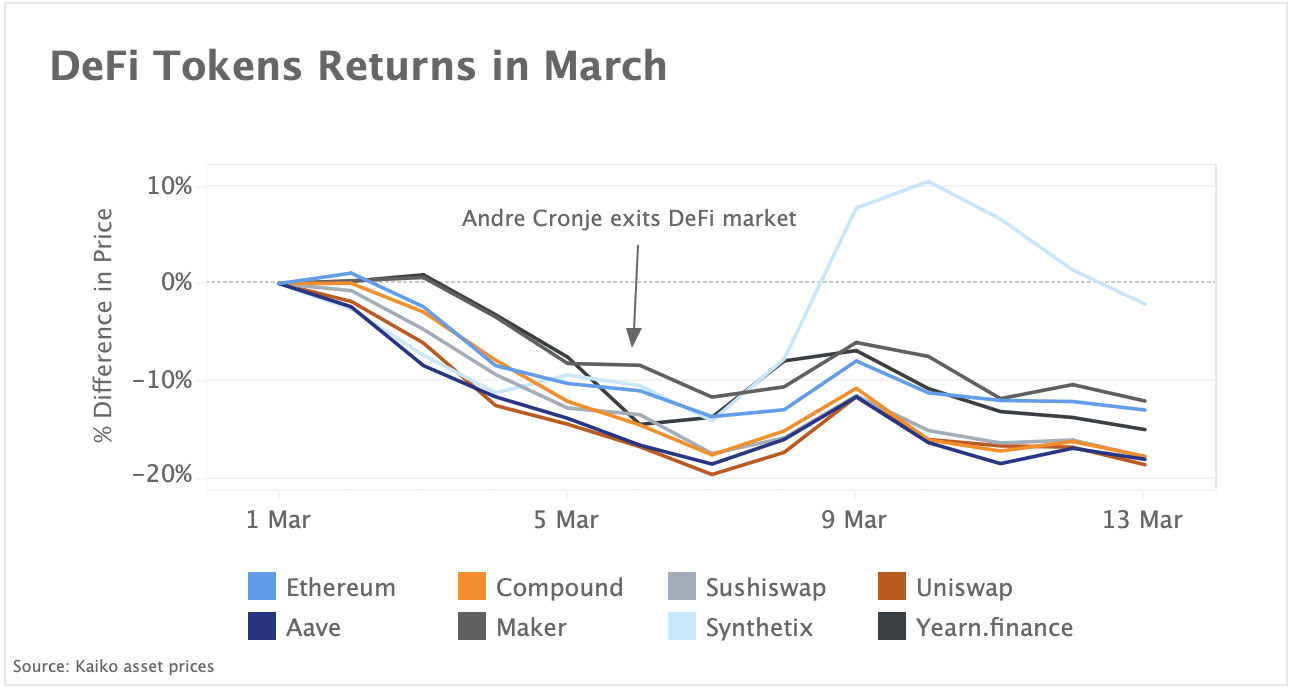
DeFi tokens continued their downtrend last week following the announcement that prolific developer Andre Cronje is permanently exiting the industry. Cronje has contributed to around 25 projects in the space, including Yearn Finance, Fantom, Keep3r, and Solidly. Yearn Finance’s YFI took a big hit following the news, plummeting 7% between March 5-7. Fantom - a high throughput blockchain network rivaling Ethereum – saw its Total Value Locked (TVL) plummet -20%.
Overall, most DeFi tokens have been underperforming Ethereum in March with the notable exception of Synthetix protocol’s native token - SNX. SNX, which was among the worst performing DeFi tokens in 2021, saw a strong rebound last week on several upcoming network upgrades and increased demand for staking. Despite the spike, the token remains more than 80% below its all-time high. The recent decline in Ethereum gas fees and total value locked on Ethereum-based DeFi Protocols suggests investors’ interest in the sector is sluggish.
Bitcoin trades at steep discount vs. Russian Ruble
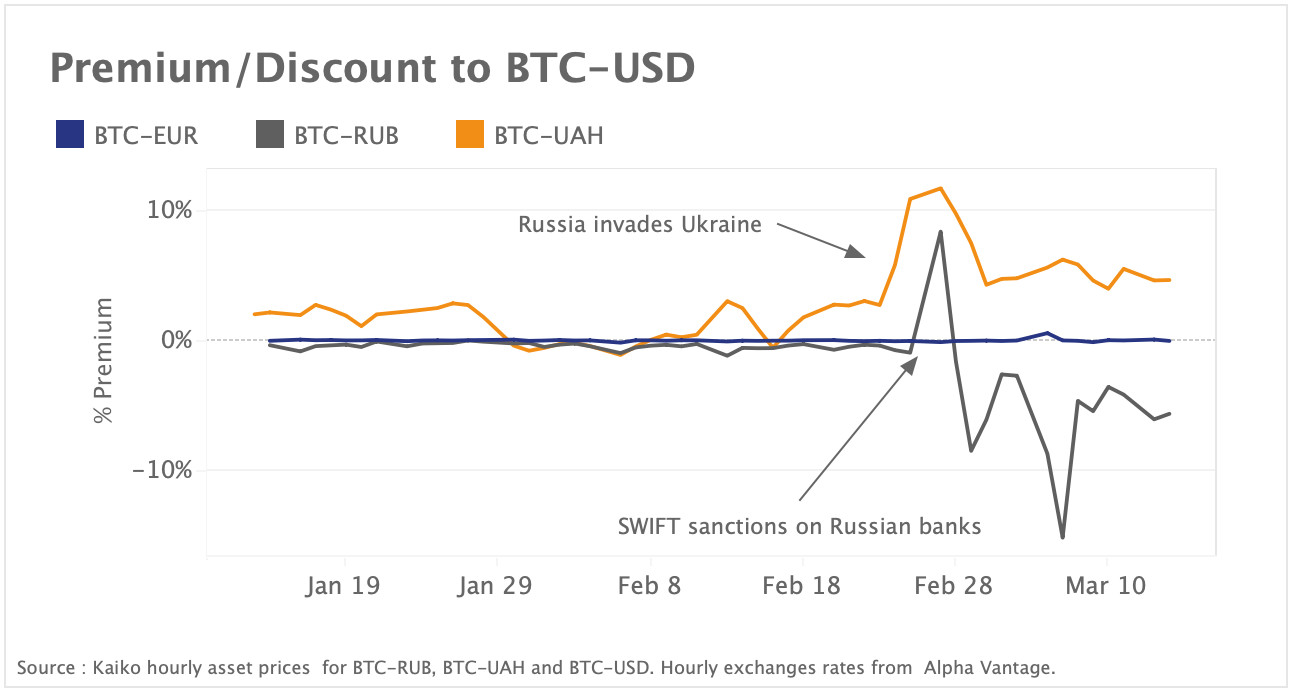
Bitcoin continues to trade at a premium on Ukrainian hryvnia (UAH) markets while a steep discount has emerged on Russian ruble (RUB) markets. The premium (or discount) for purchasing Bitcoin with a fiat currency is calculated by taking the difference between the BTC price trading on local markets (converted into U.S. Dollars using fiat exchange rates) and the price of Bitcoin on USD markets. The steep discount observed on Russian markets could be the result of strong selling pressure as Russians seek to liquidate their crypto at risk of sanctions. Centralized crypto exchanges have thus far complied with official sanctions against Russia, halting payments from sanctioned Russian banks and restricting accounts.
It is interesting to note that despite the huge discount, Bitcoin is trading at all time highs versus the Ruble, highlighting the extent of market inefficiencies. This suggests the discount could also be due to a heavily disrupted price discovery process and uncertainty about the Ruble’s value relative to other currencies amid low liquidity, foreign currency restrictions, and market adjustment delays. It is also interesting to note that the discount mirrors oil markets where traders shunned Russia’s flagship Urals crude oil, causing it to trade at a 24% discount relative to Brent crude oil in early March.
Ruble and Hyrvnia trade activity diverges
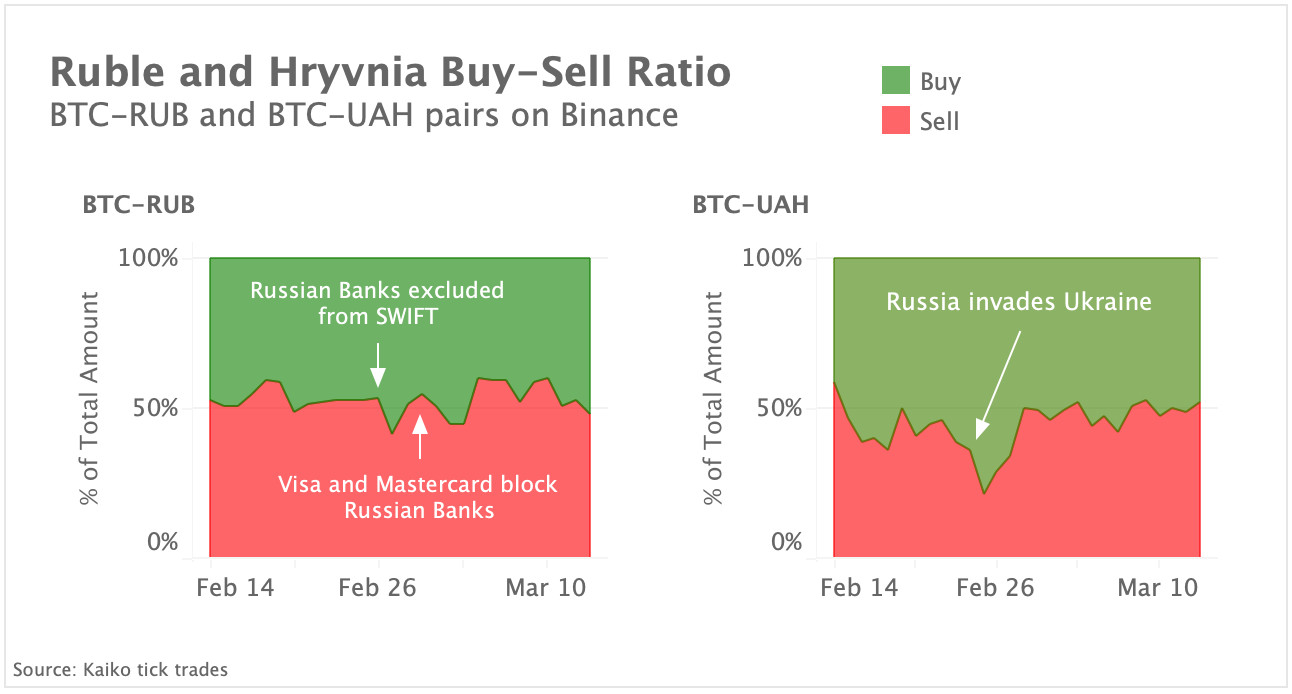
The most straightforward way to understand trader sentiment is by looking at the buy-sell ratio, computed using Kaiko's tick-level trade data. We notice several interesting trends when exploring this metric for Ukrainian Hryvnia and Russian Ruble-denominated Bitcoin markets. In the immediate aftermath of the invasion, buy volume for Binance's BTC-UAH markets surged to 79%, which suggests that traders really were flocking to crypto amid massive financial uncertainty. The trend is much more muted on Russian markets where buy volumes only briefly exceed sell volumes.
For Ruble-denominated markets, we can observe a slight increase in sell-volume since the imposition of sanctions, even as the Ruble experiences a 60% loss in value. Crypto exchanges must comply with sanctions, however there has yet to be a blanket ban on Russian crypto trading. Instead, the bans have affected underlying payment systems allowing Russians to trade crypto, including SWIFT, Visa and Mastercard. On March 9th, Binance announced that Visa and Mastercard credit cards issued in Russia would be unavailable to transact on Binance. After this date, we can observe a sharp drop in Ruble-denominated trade volume, which reached all time highs on March 7th.
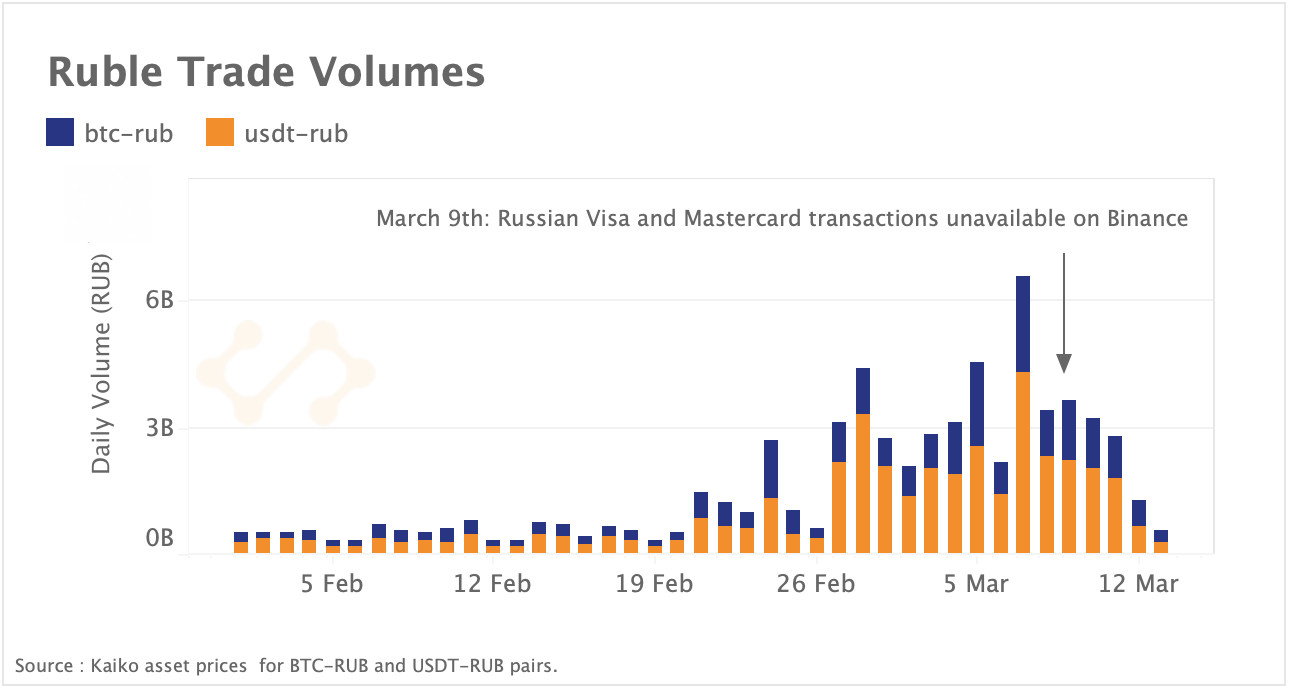
Trade volumes are now at levels they were before the invasion. The same is not the case for Hyrvnia-denominated crypto volume, which remains at elevated levels. This suggests that sanctions have impacted trading activity on Binance. However, as Binance's CEO points out, there are many ways to access crypto beyond global exchanges, including OTC desks, regional platforms, and directly interacting with the technology (as opposed to going through a third party).
Bitcoin dominance increases amid market downtrend
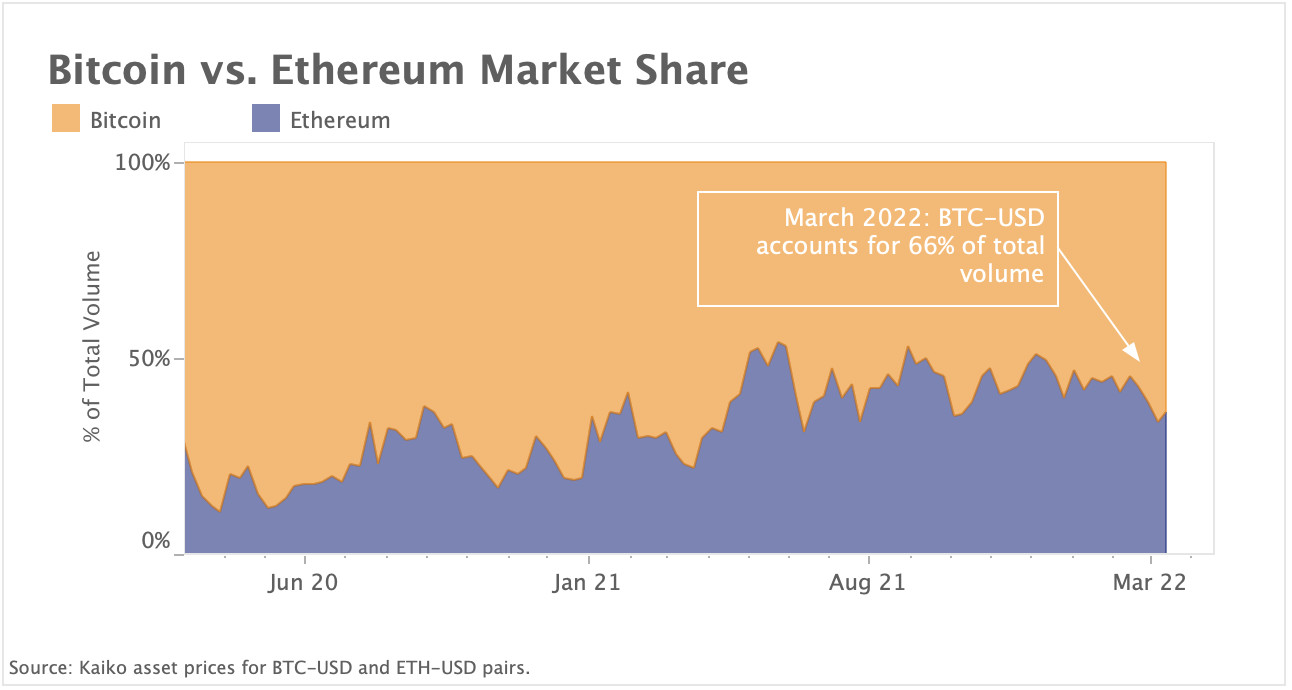
A popular metric for understanding market structure is to look at Bitcoin's dominance vs. Ethereum. The idea is that in bull markets, Ethereum's market share increases relative to Bitcoin as traders invest in altcoins and alternative networks. In times of uncertainty, traders rotate funds back into Bitcoin, considered a crypto "safe haven." Since 2020, trade volume for Ethereum has surged relative to Bitcoin amid the biggest bull market in crypto history. Yet over the past month, the % of total Bitcoin volume has surged to 66%, its highest level in nearly a year.
The trend suggests Bitcoin has been more resilient than Ethereum to geopolitical tensions and global risk-off sentiment. BTC is down 20% since the start of the year while Ethereum has lost 32% of its value. Overall, Ethereum’s market share remains significantly above its 2020 average suggesting the market structure has shifted over the past two years.
Privacy token volume spike

Last week, privacy tokens - cryptocurrencies with anonymity-boosting features - saw double digits returns and a surge in trade volumes as traders anticipated a rise in demand after the U.S. ramped up its crypto regulation efforts. The three largest privacy tokens by market cap - Monero (XMR), Zcash (ZEC) and Oasis Network’s ROSE token - saw trade volume jump three-fold on Binance, to $245m, its highest level since January. The surge came after the U.S. President signed a long-awaited executive order requiring U.S. agencies to assess the benefits and risks of digital assets. ZEC and XRM have gained 51% and 42% respectively since Russia invaded Ukraine. However, it remains unlikely that these tokens will be used to evade sanctions, and the surge is likely fueled by speculation.



U.S. Dollar strengthens with growing demand for cash

Global demand for dollar liquidity remains strong after the most recent Russia-Ukraine peace talks made very little progress. The U.S. Dollar Index (DXY) - measuring the greenback’s performance relative to a basket of foreign currencies - strengthened for the third week in a row. Hot U.S. inflation data for February also provided support for the Dollar, confirming markets’ expectations that the Fed will lift rates at its meeting this week despite rising concerns around the global growth outlook. Above, we chart the DXY alongside Bitcoin’s price, and can observe that they have followed different trends since the start of the year, with BTC trading in a tight range while the DXY surges.
Surging commodities boost inflation expectations

U.S. inflation expectations hit their highest level since 2003 last week, boosted by soaring commodities prices. Above we chart the 10-year U.S. inflation expectations alongside the iShares S&P GSCI Commodity-Index Trust (GSG). The GSG tracks a broad array of commodities futures, including energy, precious metals and agricultural markets. We observe that commodities have risen sharply after the start of the war between Russia and Ukraine - both major commodities exporters - on growing supply disruption fears coupled with low global inventories. Volatility has also increased with margin calls roiling commodities markets as traders struggled to price the fallouts of the conflict. Last week, the London Metal Exchange (LME) halted nickel trading after the price of the industrial metal jumped by over 250% in two days, following a massive short squeeze.