A summarizing review of what has been happening at the crypto markets of the past week. A look at trending sectors, liquidity, volatility, spreads and more. The weekly report in cooperation with market data provider Kaiko.
A whole bunch happened on the regulatory front last week as BTC dipped below $30k: SEC chair Gary Gensler gave a marathon defense of the crypto crackdown, the SEC filed a lawsuit against Bittrex, and the landmark MiCA European crypto framework became law. Today we explore:
- Coinbase's steady drop in market share and new offshore plans.
- Tether's persistent premium since the banking crisis.
- BTC's outperformance relative to gold.
Coinbase targets offshore as market share suffers
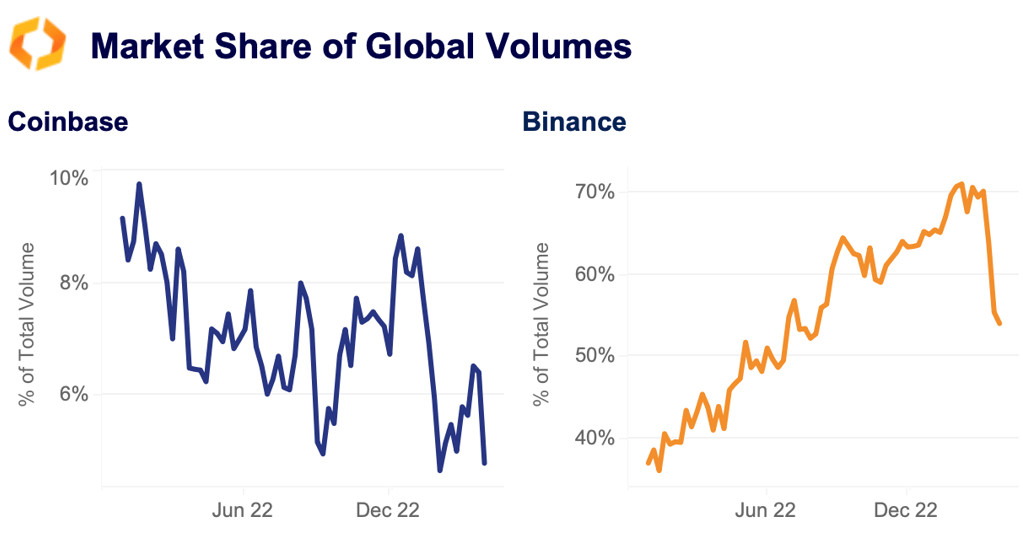
Last week, Coinbase received approval to operate an offshore derivatives exchange, based in Bermuda. This move makes a lot of sense, particularly when looking at Coinbase’s share of total spot volumes.
Since the start of 2022, Coinbase’s share of volumes has almost halved, falling from 10% to 5% while Binance gained as much as 30% market share over the same time period, before losing some in the last couple of weeks with their reintroduction of fees. As with most U.S crypto exchanges, Coinbase has been the target of significant attention from the SEC, threatening their growth prospects. Overseas exchanges, on the other hand, are facing a lot less regulatory uncertainty, making them more competitive against their U.S counterparts.

Binance benefitted the most from FTX’s collapse in terms of derivatives market share, gaining virtually all of the 11% share FTX had, with Binance rising from 52% share of volumes in 2022 to 62% in 2023. Gemini also look to be entering the race for perpetual futures market share, announcing they were making the same move as Coinbase last week in an effort to become more competitive. With Coinbase and Gemini entering the market, it is very possible they can command significant market share in the space, particularly with less regulatory concerns to worry about offshore.
Tether continues to trade at a slight premium
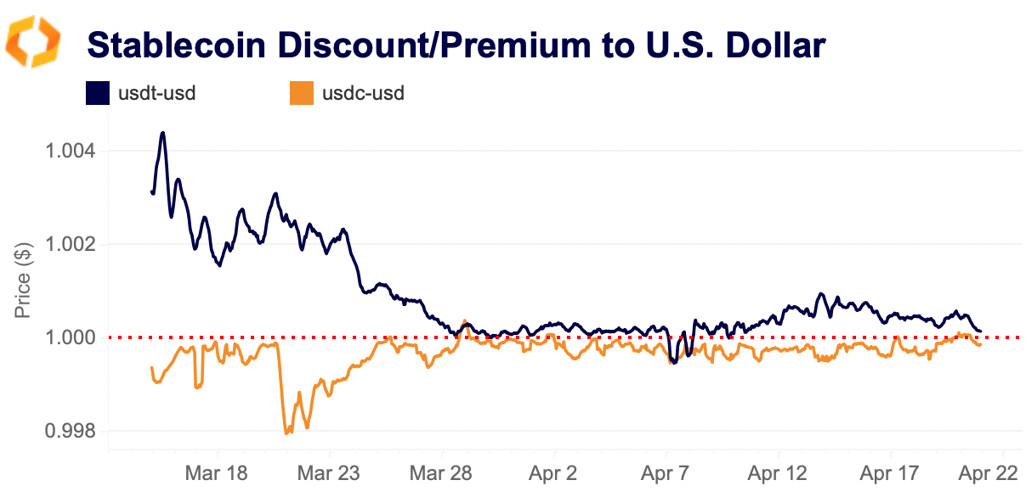
USDT has been trading at a premium on centralized exchanges ever since the March banking crisis, which saw traders rotate funds out of USDC amid fears surrounding Circle's reserves. The trend mirrors a solid increase in USDT’s market capitalization which recently exceeded $81bn - its highest level since the collapse of Terra. In contrast, USDC has been trading at a discount, and its market cap has declined significantly from $12 billion to around $31 billion.
Overall, the market cap of USDC and BUSD has fallen steadily over the past year. U.S. regulators forced Paxos to halt issuance of BUSD back in February, and investors are still uneasy about USDC a month after the banking crisis.
Regulatory crackdown impacts crypto liquidity

Just three weeks after Seattle-based crypto exchange Bittrex announced it would end U.S. operations, the SEC charged the company and its cofounder with operating as an unregistered securities exchange, broker-dealer, and clearing agency. Most notably, the complaint also claimed the cryptocurrencies ALGO, DASH, and OMG to be securities. While Bittrex no longer plays a big role in crypto market structure, the SEC complaint had an instant rollover effect on the most liquid ALGO pair in crypto, ALGO-USD on Coinbase, which saw 1% market depth almost halved. Perhaps unsurprisingly, this effect was not present on international exchanges like Kucoin and Binance.
As shown above, regulatory statements targeting crypto assets can have a real impact on liquidity, much like the ongoing cut-off from U.S. banking services and payment rails. Last month, the sister exchange of OKX serving U.S customers, OKCoin, announced it was “temporarily” pausing USD deposits after it struggled to find a banking partner to facilitate payments. Liquidity on the exchange's BTC-USD has plummeted as a result, down over 80%.
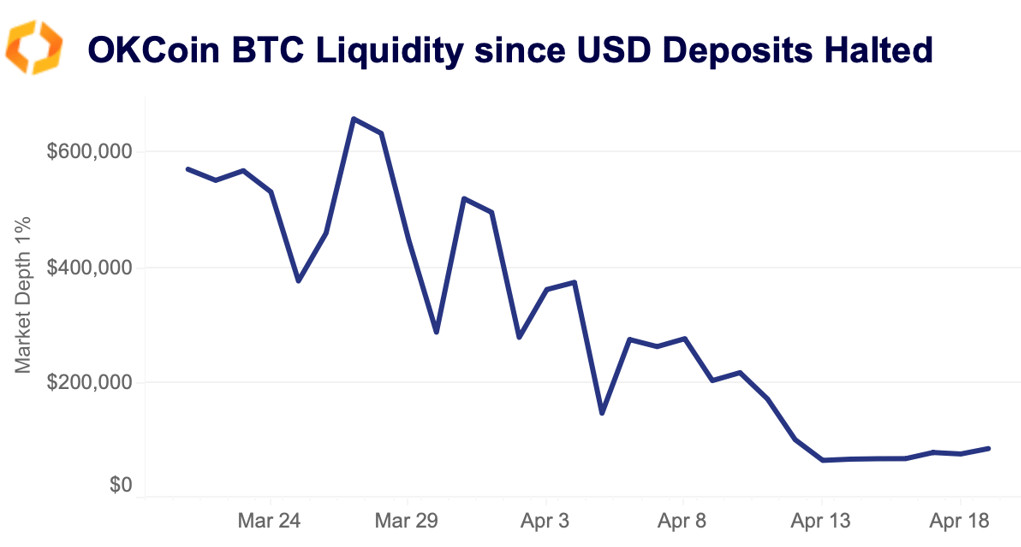
That temporary pause is still in place as the exchange seemingly can’t get banked, a trend which we predicted may impact many smaller crypto firms. Binance and Bybit were also forced to halt USD deposits earlier this year.
Binance BTC liquidity plummets as prices tumble
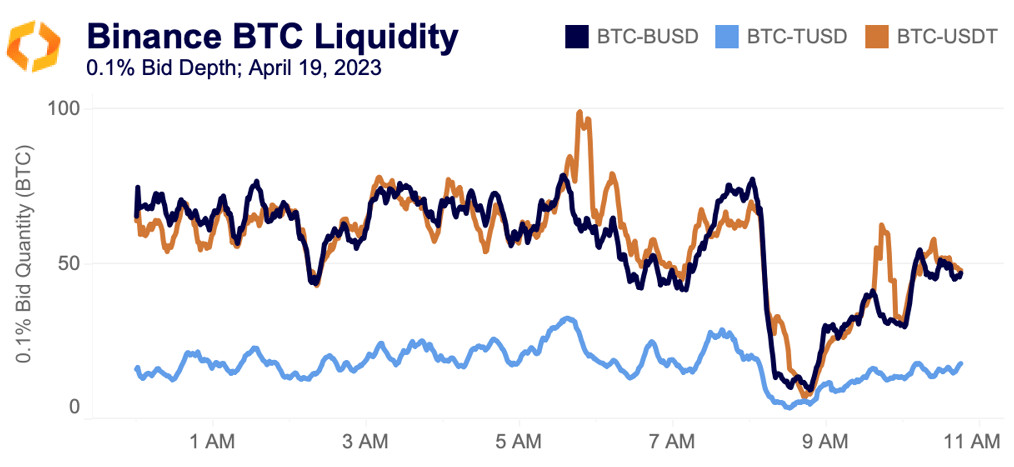
BTC quickly dipped below the $30k mark last week, driven by strong spot selling, primarily on Binance’s USDT and TUSD pairs. As price fell, bid depth within 0.1% of the mid price quickly dropped from over 50 BTC for the USDT and BUSD pairs to less than 10 BTC for each. Meanwhile, the BTC-TUSD pair, which has recently come to rival the USDT pair in volumes because of Binance’s zero-fee promotion, dropped from just 20 BTC to less than 4 BTC. Unlike other sharp price dips, this did not appear to be driven by derivatives, highlighting both how derivatives open interest has been muted in the last few days and how illiquidity in spot markets is increasing volatility.
When looking at the market orders executed on April 19th, the day of the sell-off, we can observe a series of huge BTC sell orders (orange) executed after the initial price dip, which likely prevented a price recovery.
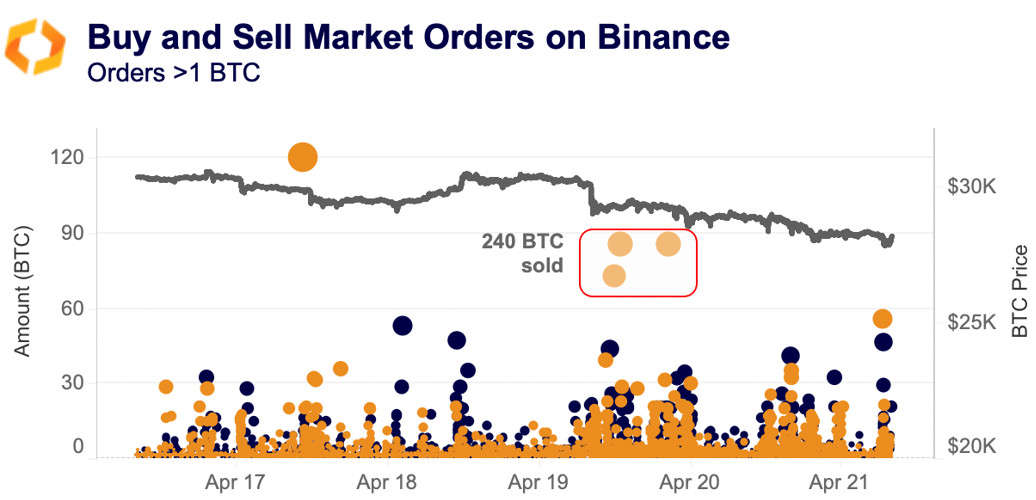
On April 17th, when BTC first dipped below $30k, a massive sell order of 120 BTC was executed just one hour before. Overall, 17.2k sell orders greater than 1 BTC were executed from April 17th-21st compared with just 15.1k buy orders. The data suggests this could be a whale-led sell off.




cbETH liquidity surges on Coinbase after upgrade
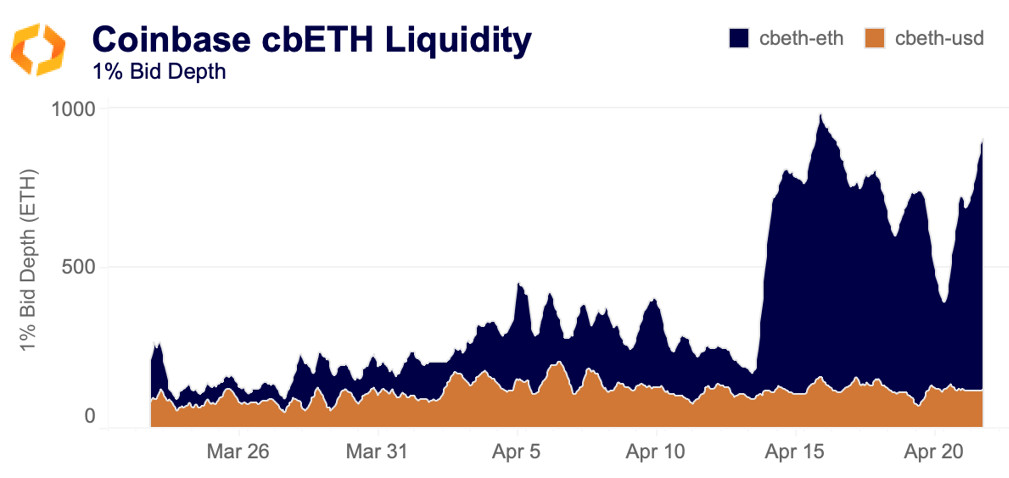
Coinbase’s cbETH-ETH 1% bid depth nearly 10x’ed in just a few days following Ethereum’s successful Shapella upgrade. Meanwhile, cbETH-USD volume has remained essentially flat for the past month. This is an indication that there are willing buyers should cbETH’s price dip relative to ETH’s. This is yet another sign that the upgrade has boosted confidence in Ethereum’s staking model as well as liquid staking derivatives. Currently, cbETH volume is split roughly evenly between Coinbase and decentralized exchanges, primarily Uniswap V3, while nearly all Lido Staked ETH (stETH) volume is on Curve.
BTC continues to outperform gold
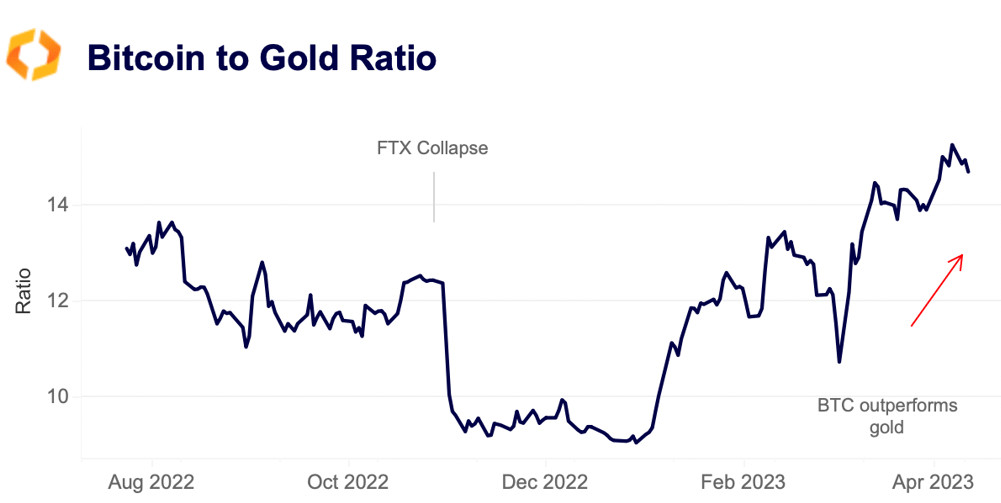
Despite the recent sell-off, the BTC to gold ratio continued trending upwards last week with one BTC equalling 14.7 ozs of gold in early April, up from 9 ozs in the beginning of the year. A rising ratio means that BTC is outperforming safe-haven gold despite the ongoing macro uncertainty and is a bullish signal. The ratio - which has been mostly declining after it hit an all-time high of 36.8 in November 2021 - fell to its lowest level since the start of the crypto bull run after the collapse of FTX.