A summarizing review of what has been happening at the crypto markets of the past week. A look at trending sectors, liquidity, volatility, spreads and more. The weekly report in cooperation with market data provider Kaiko.
The last 7 days in cryptocurrency markets:
- Price Movements: Bitcoin traded at a 6% premium vs. the Ukrainian hryvnia immediately following the invasion.
- Volume Dynamics: Bitcoin and stablecoin volume surged for both Russian and Ukrainian markets.
- Order Book Liquidity: Spreads and slippage deteriorated for global BTC-USD markets amid high volatility.
- Derivatives: Open interest for perpetual futures is at 5-month lows.
- Macro Trends: Gold prices have benefitted strongly from growing geopolitical uncertainty.
Invasion triggers global volatility
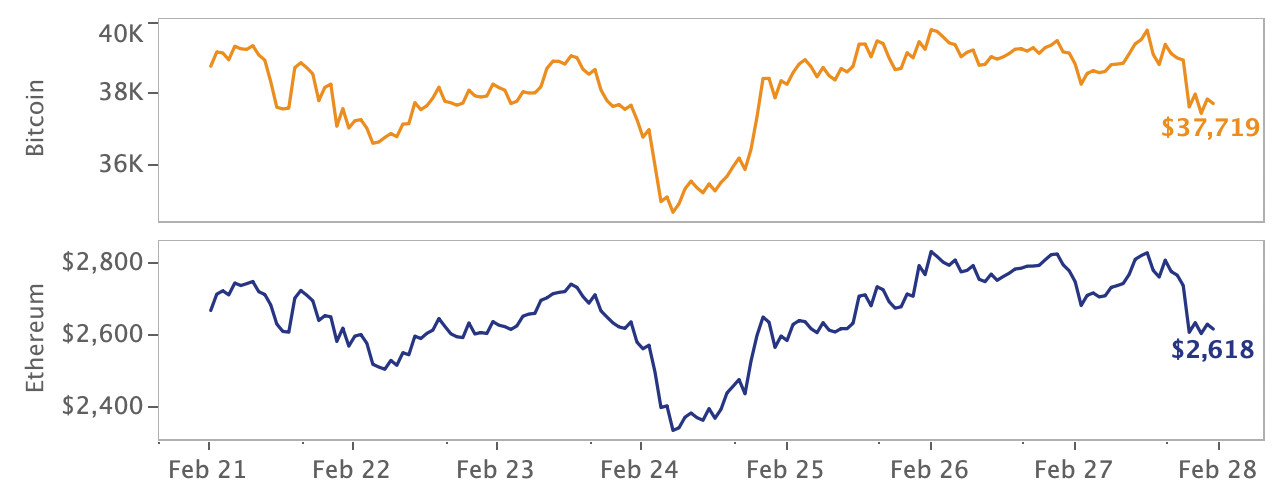
The sharp escalation of the Russia-Ukraine conflict into a full-out invasion spurred a dramatic sell-off across global financial markets. Cryptocurrencies plunged, the S&P 500 entered a technical correction, and commodities prices soared on fears of supply disruptions. Markets recovered by Friday with Bitcoin closing Sunday night down just 2.7%, although volatility is likely to continue throughout the week.
In this week’s newsletter, we take a closer look at how the invasion has influenced global financial markets. The Washington Post dubbed the conflict “the world’s first crypto war,” as both sides find advantages in borderless, decentralized currencies. Looking at the data, we are already seeing a surge in both Russian ruble and Ukrainian hryvnia cryptocurrency transactions on centralized exchanges, which could consequently be the first crypto companies targeted with sanctions. Ultimately, Russia’s invasion of Ukraine places the cryptocurrency industry in a unique and precarious position, needing to balance sanctions enforcement while lacking the power to restrict transactions on decentralized networks.
Bitcoin trades at 6% premium versus Ukrainian hryvnia
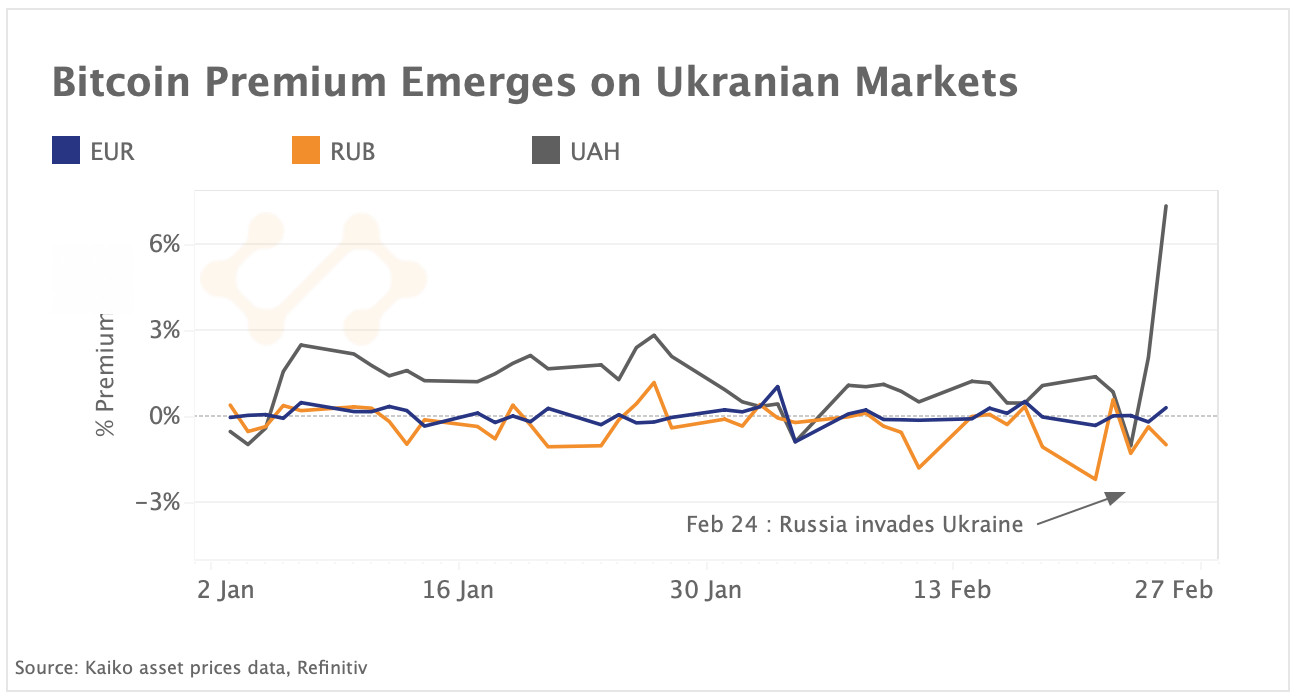
Bitcoin traded at a 6% premium on Binance’s Ukrainian hryvnia (UAH) market as demand for cryptocurrencies soared immediately following Russia’s invasion. Demand surged on Binance as local Ukrainian currency markets faced significant disruptions, with the Ukrainian central bank temporarily halting foreign currency withdrawals and the Ukrainian hryvnia falling to all time lows versus the U.S. Dollar. The premium measures the difference between the price of Bitcoin on UAH markets versus USD markets. The BTC-RUB and BTC-EUR premiums are also charted for comparison. Bitcoin continued trading at a slight discount on Russian markets despite the Russian ruble (RUB) tumbling to an all-time low versus the USD, forcing the Russian central bank to hike its key interest rates on Monday.
Tether premium spikes to 4-month high and remains volatile
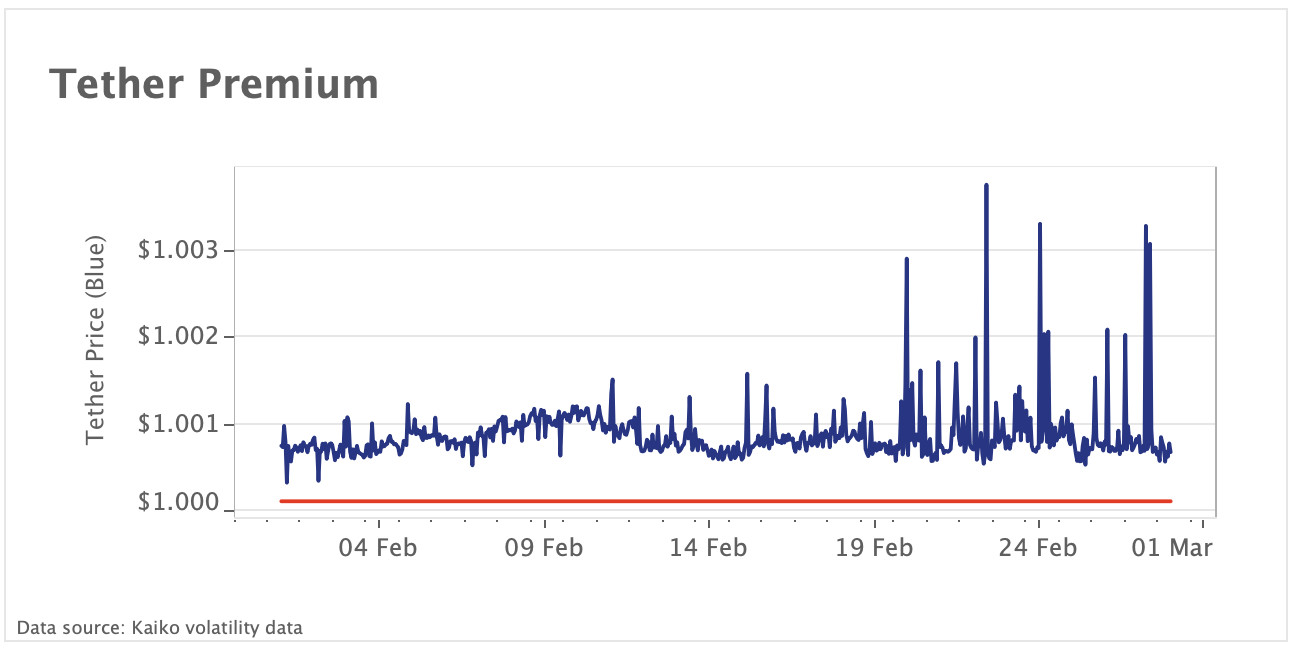
The largest stablecoin by market cap, Tether (USDT), diverged from its one-to-one peg to the U.S. Dollar during the past week's market volatility. USDT traded above $1.003 on Feb 23-24, its highest level since November 2021. Stablecoins often diverge from their peg in times of volatility as traders rotate funds out of crypto assets and into safe havens. The price of Tether is calculated using real USDT-USD trading pairs trading on 10 exchanges.
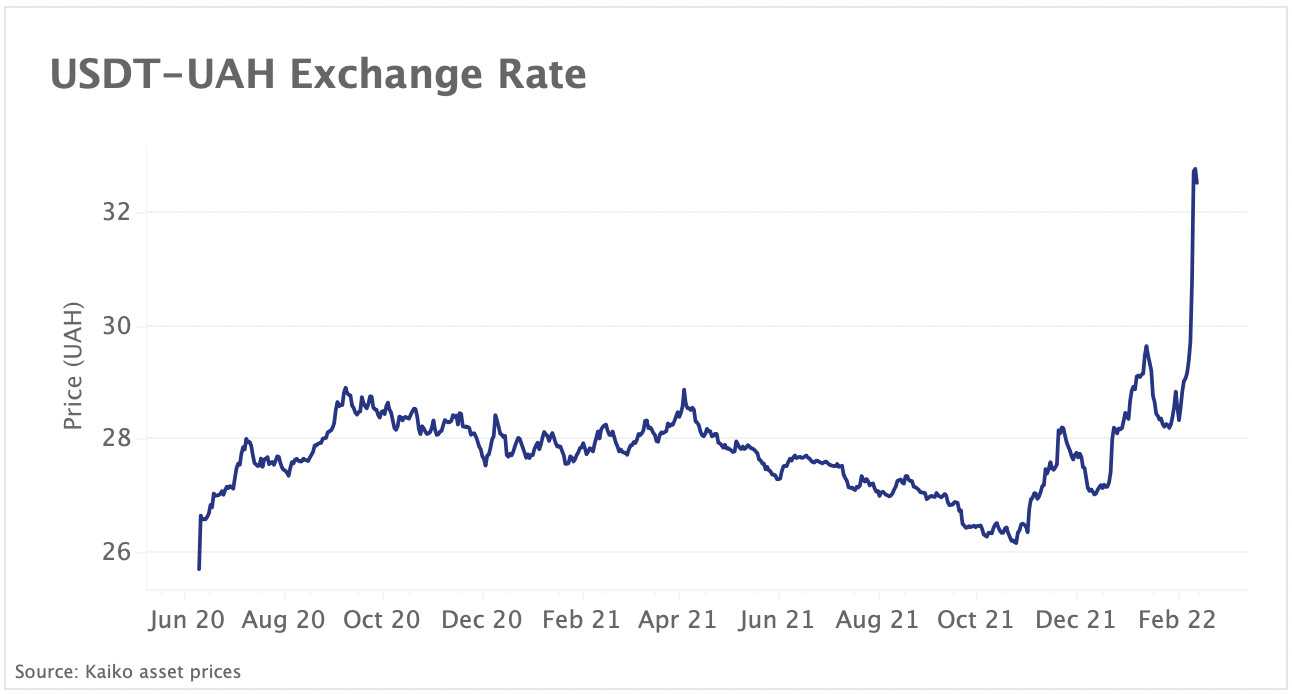
USDT also spiked to its highest level ever versus the Ukranian hryvnia as the fiat currency sank to all time lows versus the dollar. As of Monday morning, 1 USDT was trading for more than 32 UAH as demand soared for stablecoins. USDT is also trading at record highs versus the Russian ruble as the currency sinks to lows versus the dollar. As traders rush to exchange volatile fiat currency into stablecoins, issuers could face significant pressure to monitor addresses to avoid violating international sanctions.


Ukrainian and Russian crypto transaction volume soars
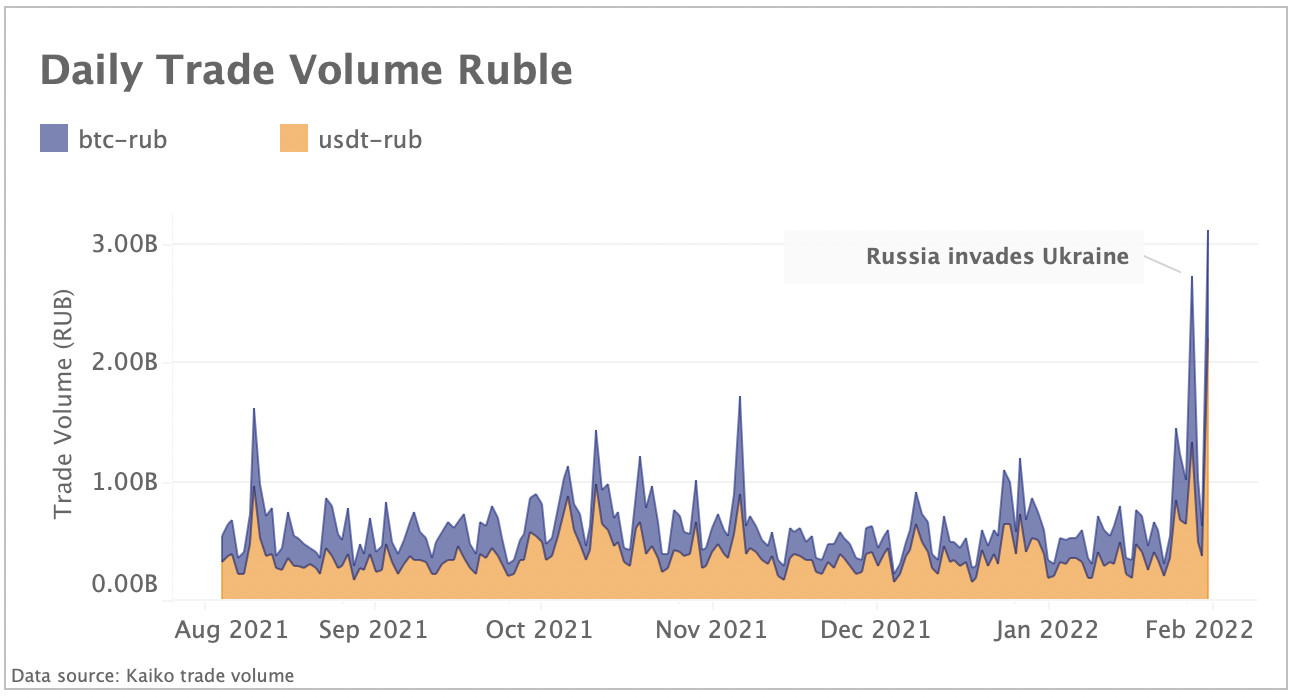
Both ruble and hryvnia trade volumes surged to their highest levels in months almost immediately after the Russian invasion, highlighting the complexities of the cryptocurrency industry’s role in the conflict. Volume for both RUB and UAH trading pairs increased far more quickly than volume for other pairs, such as BTC-USD, which suggests the crisis is directly influencing trading behavior. Ruble and hryvnia markets only trade on a handful of global exchanges in Kaiko's coverage, of which Binance dominates. Local exchanges not covered also show similar trends, with lower volumes.
A plummeting Ruble and reduced access to the U.S. Dollar amid waves of sanctions could particularly heighten the appeal of USD-pegged stablecoins. USDT-RUB trade volumes spiked to 10 month highs and accounted for higher volumes than BTC-RUB markets (charted above). Meanwhile, as Ukraine’s currency plummets and ongoing access to banking services remains uncertain, cryptocurrency trade volumes have undergone a similar surge (charted below).
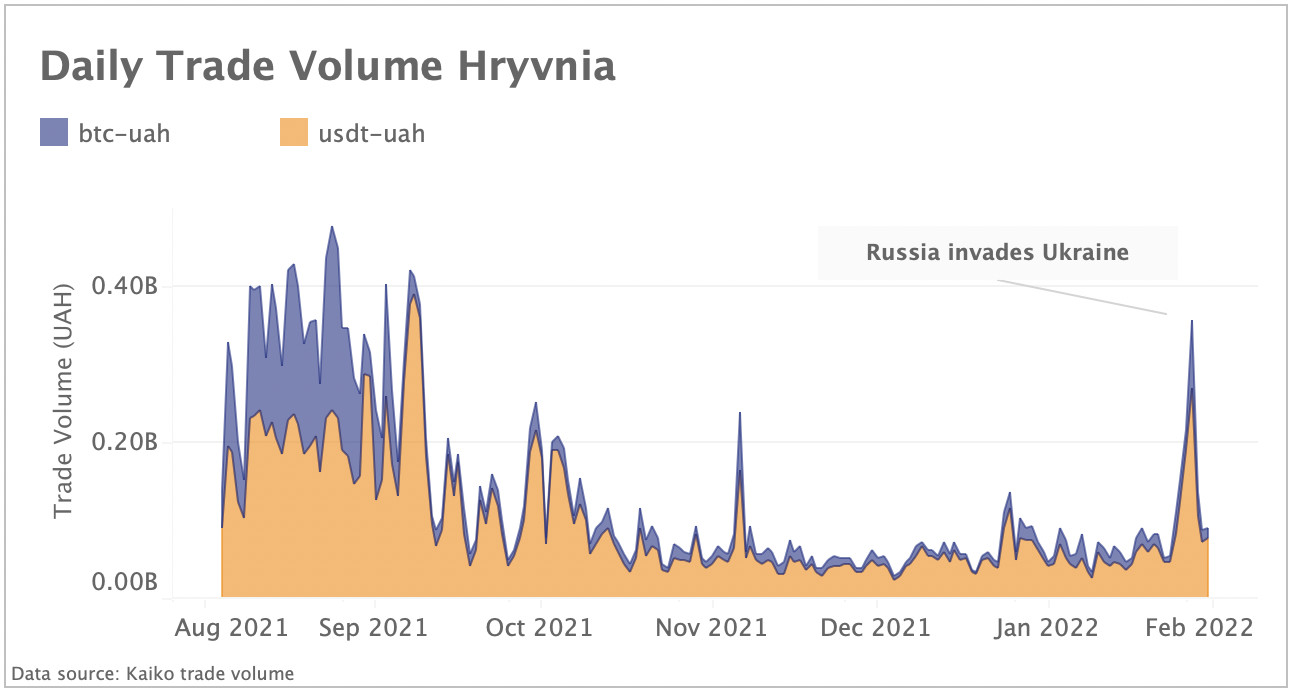
UAH volumes soared to 5 month highs and Ukraine’s official twitter account even posted several requests for cryptocurrency donations over the weekend. The veracity of the messages is still being determined amid the strong possibility of Russian cyberattacks, although millions of dollars worth of Bitcoin and Ethereum have accumulated in the addresses listed. Today, the majority of RUB and UAH cryptocurrency volume takes place on Binance, a centralized exchange, and it will be interesting to see how sanctions on global payment systems affect the ability to trade on centralized markets.
Open interest sinks to five month lows
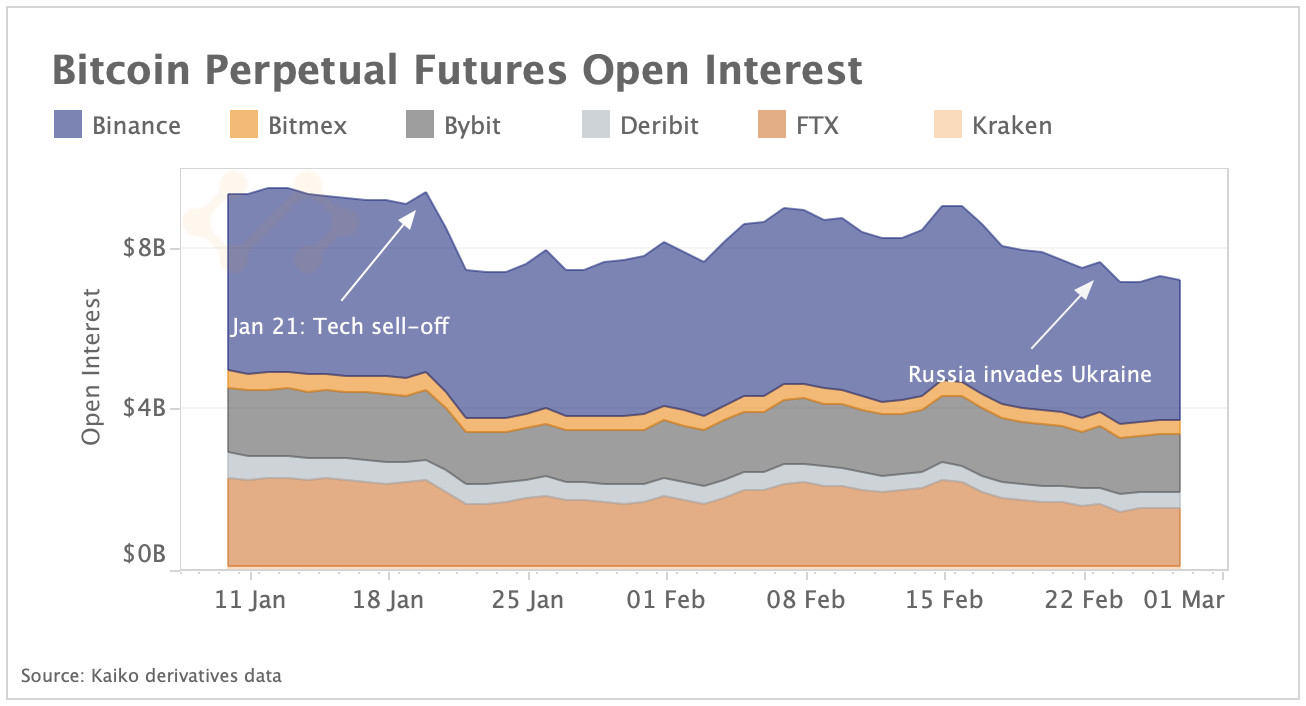
Bitcoin perpetual futures open interest declined by 10% to around $7B, its lowest level in 5 months. The drop happened as Bitcoin spot prices plummeted 5% on Feb 24 before bouncing back to $39k over the weekend. The move triggered another round of long and short liquidations across derivatives markets. The drop was much more gradual than during the January sell-off which could be explained by lower amounts of leverage. Overall, the steady downward trend in the amount of open contracts suggests capital inflows remain weak.
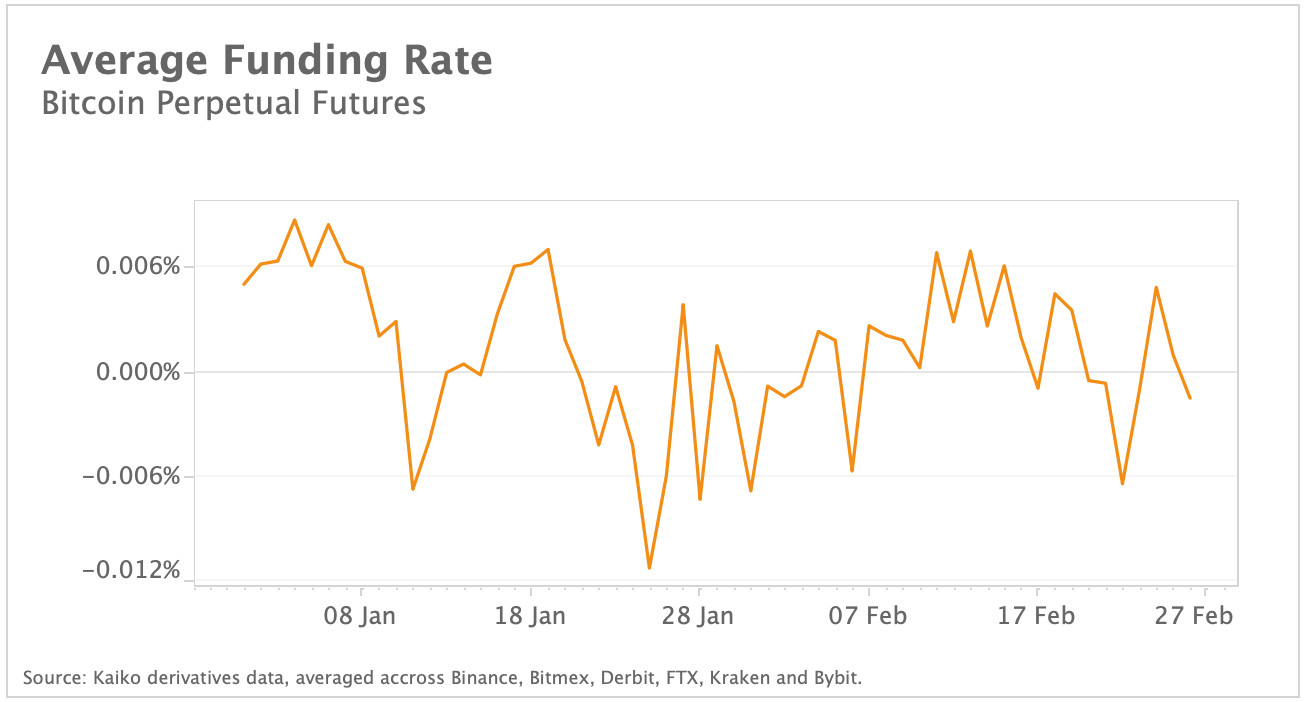
Average Bitcoin perpetual futures funding rates have also been neutral throughout February, dipping negative in times of volatility before reverting to the mean. Funding rates are the cost of holding a long position and a gauge of market sentiment, and tend to be positive during bull runs, and neutral/negative during bear markets.
Gold benefits from global uncertainty
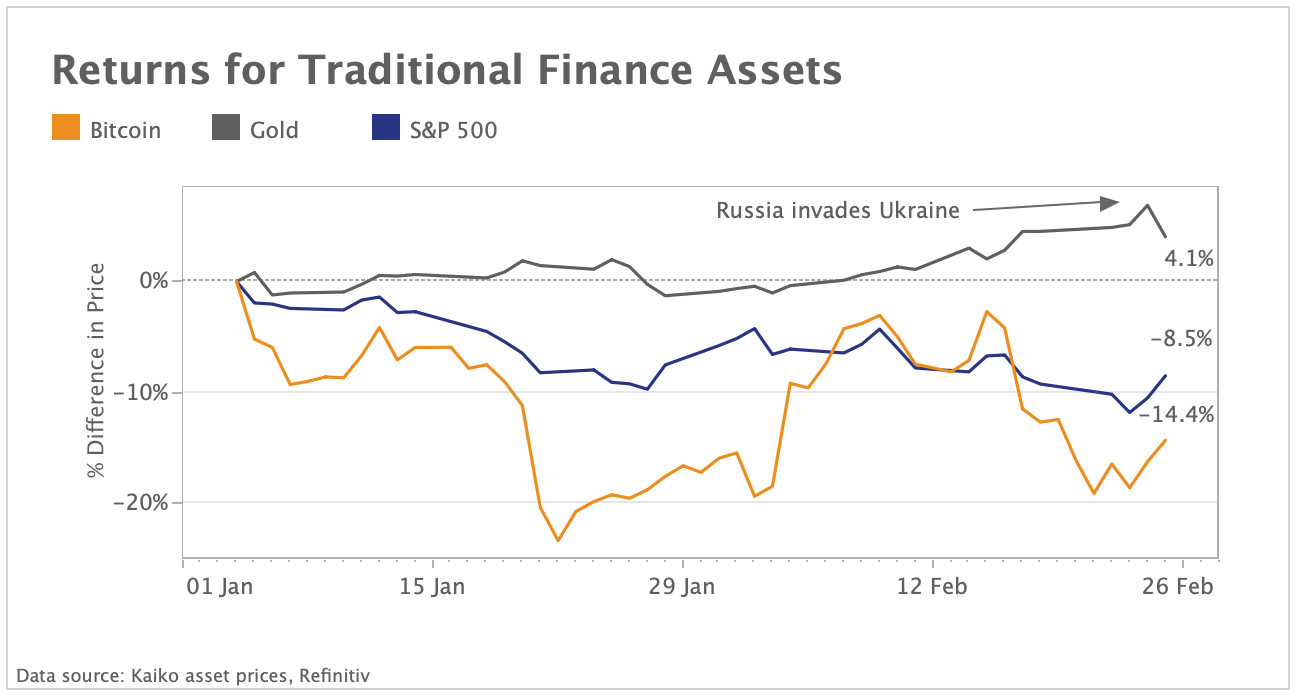
Gold has benefitted strongly from February's geopolitical uncertainty and is currently one of the few traditional financial assets that are up since the start of 2022. As the Russia-Ukraine crisis played out, Gold soared to yearly highs, before dipping slightly as equities recovered. Bitcoin’s correlation with Gold has been mostly negative since October while its correlation with equities has climbed, which suggests investors are treating the cryptocurrency more like a risk asset instead of a safe haven.
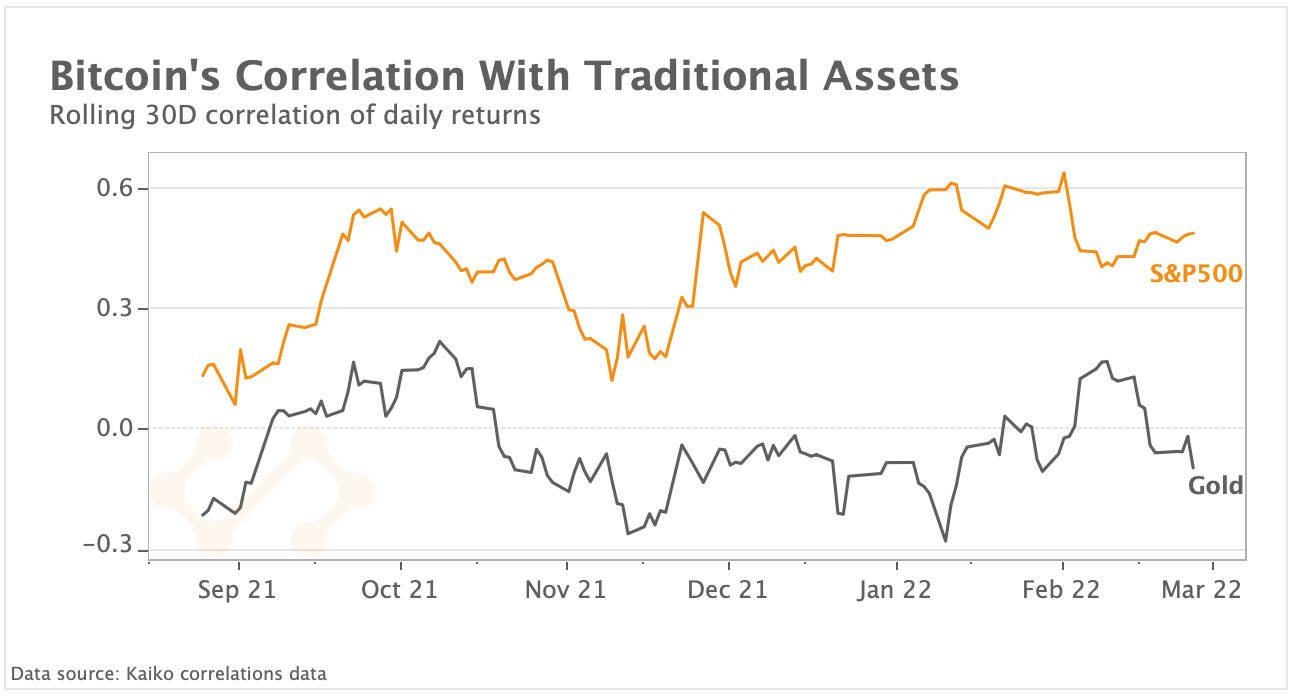
Bitcoin has been mostly declining since the U.S. Fed took a hawkish shift in November, sending tech stocks and other risk assets down. Gold, on the other hand, has outperformed most other assets including U.S. Treasuries and safe-haven currencies as a geopolitical hedge over the past few weeks. However, Bitcoin could also benefit from rising demand as a safe-haven, especially considering the data demonstrating high demand from traders of the Ukrainian hyvrnia.