
Close Menu
Crypto Valley Journal
    Facebook X (Twitter) Instagram
    Crypto Valley Journal
    • Hot Topics
      • News
      • Minds
    • Focus
      • Background
      • Blockchain
      • Legal & Compliance
      • Non-Fungible Token (NFTs)
    • Investing
      • Markets
      • Financial Products
      • Decentralized Finance (DeFi)
      • Exchange overview
    • Education
      • Basics
      • Glossary
      • Politicians on crypto
    • Statistics
      • Bitcoin-ETF-Flows
      • Ethereum-ETF-Flows
      • Crypto market data
      • On-chain data
    • Academy
      • Overview
      • Part 1: Blockchain
      • Part 2: Money
      • Part 3: Bitcoin
      • Part 4: Cryptocurrencies
      • Part 5: Decentralized Finance
      • Part 6: Investing
    • English
      • Deutsch
    Crypto Valley Journal
    You are at:Home » Focus » Blockchain » CBDC adoption in Africa: do risks and high costs outweigh the benefits?
    CBDC adoption in Africa: do risks and high costs outweigh the benefits?

    CBDC adoption in Africa: do risks and high costs outweigh the benefits?

    By CVJ.CH Content Partner BeInCrypto on 28. November 2022 Blockchain

    A recent survey on the topic of central bank digital currency (CBDC) development in Africa gives some fresh insight into their evolution and regulators’ motivations and concerns. Nonetheless, analysts worldwide are raising questions about CBDC implementation, be it in Africa, China, or the U.S.

    Central bank digital currencies, popularly known as CBDCs, have been touted as the next step toward financial inclusion. They have the potential to transform the financial system specific to a region. So much potential that government bodies are collaborating with regulatory bodies to solidify their control over their respective payment systems.

    From central banking and tech-driven institutions to politicians - many have their fingers on the pulse of this latest payment innovation. Places like China and Russia have already launched pilot programs, while others, such as the US, are in the research phase. But another critical area for CBDC development is in Africa. Severe cracks have emerged in CBDC operations in this region, which arguably, could see the most benefits.

    African CBDCs: The what and why

    CBDCs are envisioned as a tool to bolster the monetary system with the central bank at the core to support safe, low-cost, and inclusive payments while promoting innovation. The digital currencies could bring financial services to people who previously didn’t have bank accounts, especially if designed for offline use. In remote areas without internet access, digital transactions can be made at little or no cost using simple feature phones. This has to potential to further foster cross-border transfers and payments.
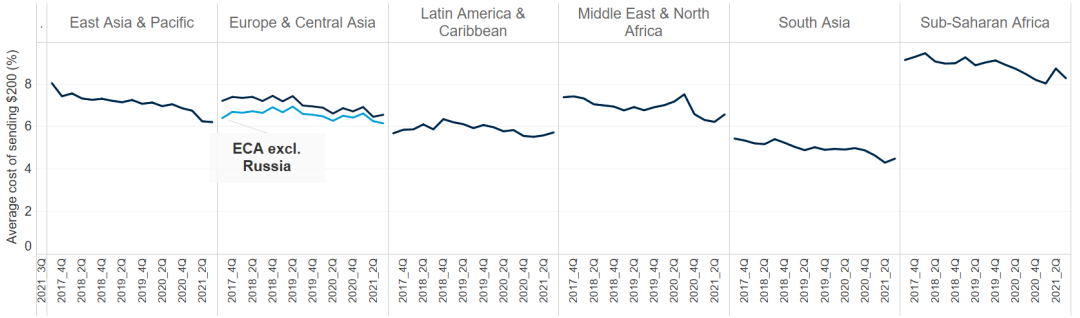
    Average cost of sending $200 by region of the world / Source: World Bank

    Sub-Saharan Africa remains the most expensive region to send and receive money, with an average cost of just under 8% of the transfer amount. CBDCs could ideally help counter this setback and promote financial inclusion within the African region, especially compared to other EMEs (emerging market economies). While many regions across the African continent are exploring CBDC implementation, Nigeria and Ghana are leading the pack.

    Status report on CBDCs in Africa

    The interest of African central banks in CBDCs has recently shot up. While all those surveyed are analyzing CBDCs, only a few have projects at advanced stages (pilot or live).
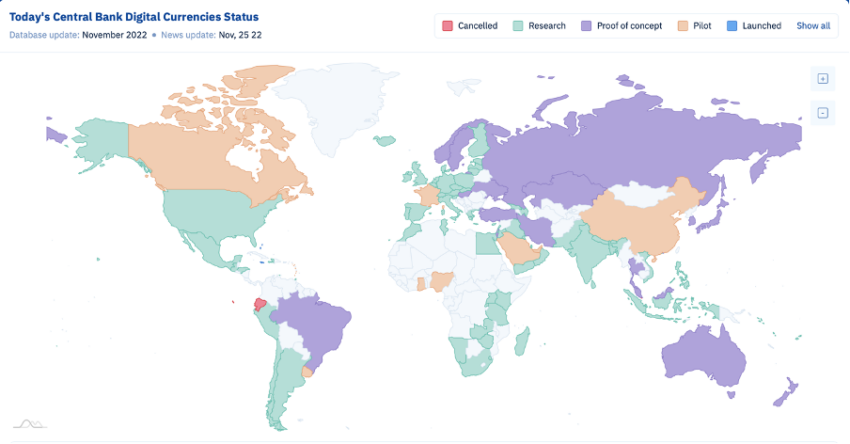
    Status of CBDC projects all over the world / Source: CBDC Tracker

    Several sub-Saharan African central banks are either researching or are in the pilot phase of a digital currency following Nigeria’s introduction of the e-Naira and Ghana’s e-cedi. There are still many risks and challenges, including data privacy, cyber-attacks, and public access to digital infrastructure.


    Ray Dalio’s Bridgewater Associates Minds

    Star investor Ray Dalio considers Bitcoin inferior to gold

    Tokenization opens up new ways for companies to engage investors flexibly and structure financing efficiently. Background

    Tokenized equity shares: a tax-efficient alternative to traditional equity?

    VanEck lists VBNB, the first US spot BNB ETF on Nasdaq. Sponsor fee 0.39%, custody at Anchorage Digital, no staking at launch. Financial Products

    VanEck launches first US BNB ETF (VBNB) on Nasdaq

    Digital finance transparency relies on Proof of Reserves, Merkle trees, MPC custody and 24/7 monitoring to verify solvency and user assets. Basics

    Transparency as the foundation of security in digital finance

    Ray Dalio’s Bridgewater Associates Minds

    Star investor Ray Dalio considers Bitcoin inferior to gold

    Tokenization opens up new ways for companies to engage investors flexibly and structure financing efficiently. Background

    Tokenized equity shares: a tax-efficient alternative to traditional equity?

    Visible cracks in the infrastructure

    A recent report highlighted some key differences and varying motivations in the African CBDC movement. The Bank for International Settlements (BIS) surveyed 19 African central banks that served as the report’s base. A direct threat to freedom that a CBDC might pose is closely related to its threat to privacy. Per the report, the main operational challenge noted is cyber risk, even more in Africa than elsewhere.

    A new survey with 19 African central banks shows that the main concern regarding #CBDCs is cybersecurity, even more than elsewhere. High operational burden for the central bank is also a bigger concern than in other regions https://t.co/FzkCq5POOD pic.twitter.com/XqYHjRwyRv

    — Bank for International Settlements (@BIS_org) November 24, 2022

    A successful cyberattack on a CBDC could cause severe and widespread damage and erode the basis of an entire region’s economy. Attacks on credit card systems and databases containing consumer credit profiles already offer a glimpse of the potential threats involved. Another significant challenge is the operational burden of maintaining a CBDC. The BIS survey notes:

    “Here African central banks highlight aspects very similar to other EMEs: network resilience, the cost, availability, and combinability of technologies, and their scalability and functionalities. The operational cost of such a complex system is high.” - BIS central bank survey

    Meanwhile, the risk of low adoption and bank disintegration also ranked among the top concerns. Nigeria's central bank digital currency has been adopted by just 0.50% of the country’s population. Following this, different analysts proclaimed that “the eNaira has been a massive failure.”


    Share. Facebook Twitter LinkedIn Email Telegram WhatsApp

    About the author

    CVJ.CH Content Partner BeInCrypto
    • Website

    BeInCrypto is a news website founded in August 2018 that specializes in cryptographic technology, privacy, fintech, and the Internet — among other related topics. The primary goal is to inject transparency into an industry rife with disingenuous reporting, unlabeled sponsored articles, and paid news masquerading as honest journalism.

    Related Articles

    BIS and more than 40 banks present the Project Agorá prototype: cross-border payments tokenized and now in the real-money testing phase.

    Project Agorá: BIS and banks tokenize cross-border payments

    Crypto Finance, AMINA Bank and Incore Bank process live transactions on Google Cloud Universal Ledger with real-time AML screening.

    Crypto Finance, AMINA and Incore Bank process live transactions on Google Cloud Universal Ledger

    Seven Swiss banks - including UBS, ZKB, PostFinance, and Raiffeisen - are launching a Swiss franc stablecoin sandbox for 2026.

    Heavyweights of the Swiss banking center launch a CHF stablecoin sandbox

    Jamie Dimon attacks Coinbase CEO Armstrong and fights for the banks' stablecoin yield rule in the CLARITY Act lobbying battle.
    31. May 2026

    Jamie Dimon vs. Coinbase: JPMorgan escalates CLARITY Act dispute

    cvj-weekly-review
    30. May 2026

    Weekly review: Raiffeisen enters the crypto business

    Raiffeisen crypto trading and custody arrive in 2027, with Sygnum as external partner. The group confirmed the move to CVJ.CH
    29. May 2026

    Exclusive: Raiffeisen to offer crypto trading and custody from 2027

    twitter image button instagram image button linkedin image button youtube image button

    About Crypto Valley Journal
    About Crypto Valley Journal

    On the pulse of the movement

    • Academy
    • Contact
    • Advertising
    • About us
    • Partner
    • Imprint
    • Privacy
    • Disclaimer
    Search

    Type above and press Enter to search. Press Esc to cancel.