ESG or ethical investment is a form of investment in which attention is paid to various factors. Not only economic but also socio-economic and sustainable principles play a major role. Can Bitcoin & Co. fulfill common ESG standards?
These three components form ESG – Environmental, Social (inclusion), and Governance. ESG investing has gained traction in the last few years and the question of whether cryptocurrency is compatible with it has been raised many times. In this article we adress this topic and conclude that many cryptocurrencies are aligned with the ESG standards and can be included in a well-diversified portfolio.
Proof-of-Work and Bitcoin’s energy problem
The first issue with cryptocurrencies is often related to energy consumption. As Bitcoin (BTC) is the most famous cryptocurrency of all, it is often believed that what is true with bitcoin is valid for all cryptocurrencies. This is a huge misconception. According to Bloomberg, Bitcoin’s energy consumption is estimated to have increased from 6.6 terawatt-hours in 2017 to 138 terawatt-hours in early 2022. Its annual power consumption is greater than that of the whole country of Norway. Bitcoin’s carbon footprint is around 114 million tons of carbon dioxide of annualized emissions. (Comparable to that of Belgium.)
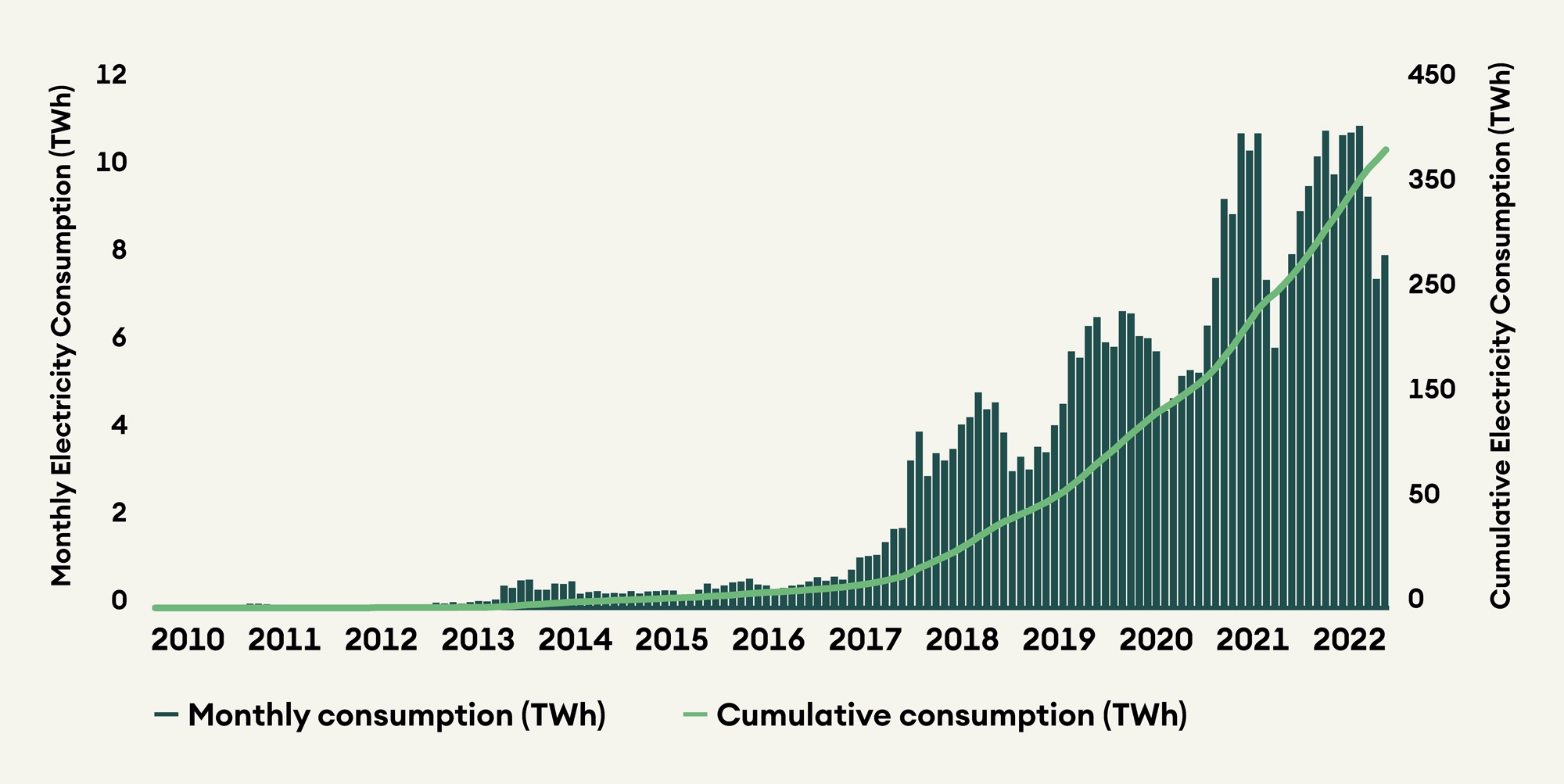
Bitcoins intensive energy use comes directly from the consensus mechanism and the way blocks are produced. Bitcoin uses a Proof-of-Work (PoW) mechanism. This mechanism is designed in a way that miners compete to mine the next block and get the rewards paid in Bitcoin. As the fastest miners get the rewards, mining has become an industry where thousands of mining racks run parallel to solve the cryptographic puzzle that unlocks the reward. Notice that the energy spent is used to secure the bitcoin network and create a decentralized, open network that everyone can use worldwide. The energy is thus not wasted.
The source of energy used to mine bitcoin has changed over time. According to the consulting firm Roland Berger, 57% of mining comes from renewable energy. The crypto community is aware of the energy issue. It has come out with its solution, called the Crypto Climate Accord.
Crypto Climate Accord
The Crypto Climate Accord (CCA) is a private sector-led initiative for the entire crypto community focused on decarbonizing the cryptocurrency industry. A consortium of private players announced it in April 2021. It wants to transition all blockchains to renewable energy by 2030 and reach net-zero greenhouse gas emissions by 2040. The initiative is led by three non-profit companies — the Rocky Mountain Institute, the Energy Web Foundation, and the Alliance for Innovative Regulation.
The first two are non-profits focused on sustainability and transition to low-carbon footprints. At the same time, the Alliance for Innovative Regulation is an international advocacy group that speaks for implementing fair financial systems. The accord currently has two objectives:
- Achieve net-zero emissions from electricity consumption for CCA Signatories by 2030
- Develop standards, tools, and technologies with CCA Supporters to accelerate the adoption of and verify progress toward 100% renewably-powered blockchains by the 2025 UNFCCC COP30 conference
Financial inclusion
According to the World Bank, 76% of the world’s population has a bank account. Economic development, access to financial services, and poverty are all interconnected. Critics argue that cryptocurrencies only claim to bring financial inclusion but do not do so. Maybe yes, cryptocurrencies cannot solve the problem of poverty. However, cryptocurrencies lower the barriers to entry into the financial system. There is no minimum amount to open a wallet, no KYC requirement, no maintenance fees, but only transaction costs.
To access cryptocurrency services, the minimum requirement is to have a smartphone and an internet connection. By 2023, 85% of the global population is expected to have a smartphone, making cryptocurrencies very attractive for individuals from developing countries regarding financial operations. Again, the percentage of smartphone ownership in developing countries is low and will see exponential growth with time.
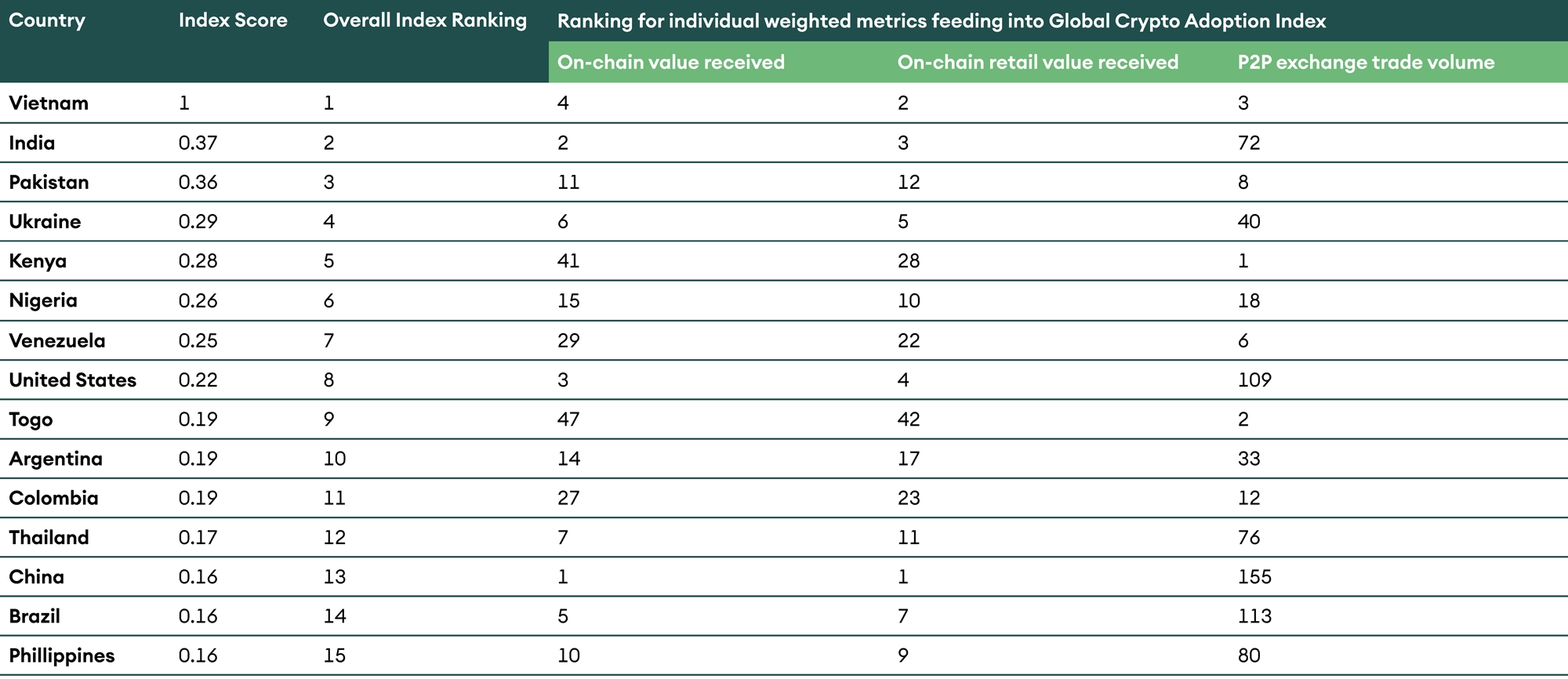
According to a 2021 Chainalysis Report, emerging economies rank the highest in cryptocurrency adoption, with Vietnam, India, and Pakistan being the top three. More than 80% of the top 15 users of cryptocurrency are from developing countries, as shown in the table below. This suggests that cryptocurrencies offer services these people cannot access otherwise.
Cross-border transaction time has been an issue for entities and individuals who frequently send and receive money from other countries. According to the SWIFT payment network, wire transfers typically take several days as cash flows via several banks. Cryptocurrencies offer a convenient alternative. Settlement times for cryptocurrency payments are significantly lower than for traditional currency payments. For example, Bitcoin and Ethereum provide average transaction times between 12 seconds and 60 minutes. By comparison, wire transfers might take between four hours and five days, and credit/debit card transactions could take up to 9 days, according to a Morgan Stanley Report.
Cryptocurrency transaction costs are also lower than traditional payment methods. According to Morgan Stanley, Bitcoin and Ethereum offer average transaction fees between USD 2-4, whereas a cheque transfer fee is USD 15-20 and wire transaction fee is USD 25-50. Moreover, transactions in newer PoS blockchains are quasi-instantaneous (sub-second finality), and transaction costs are as low as USD 0.3 in case of Avalanche, USD 0.1 in Polygon, and USD 0.00025 in Solana.




Illicit activities
According to a 2022 Chainalysis Report, cryptocurrency-based crime hit an all-time high in 2021, with over USD 14 billion of funds moved into illicit wallets. However, when comparing the USD 14 billion to the total cryptocurrency transaction volume, the share is only 0.15%. and has declined from previous years.
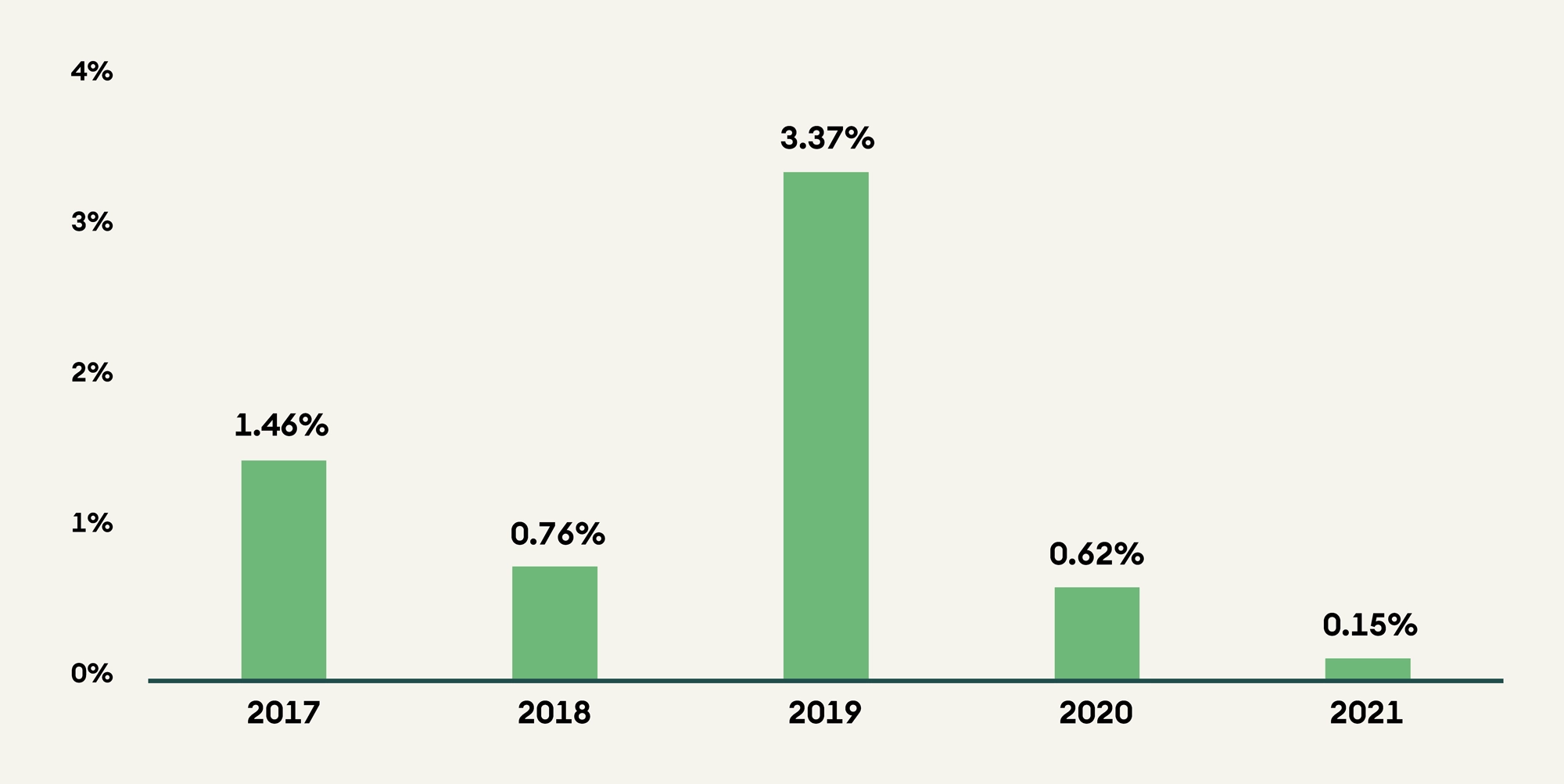
This puts the percentage of identified illicit activity among all cryptocurrencies lower than the broader economy, which is 2-4% of global GDP (according to the United Nations). This puts global corruption at USD 2 trillion (going by World Bank’s estimates), a figure significantly higher than that for cryptocurrencies.
The decline in the share of illicit activities financed with cryptocurrencies results from the increasing global regulation affecting digital exchanges. Notice also that blockchain is an open technology. All transactions are directly observable on the chain, making the traceability of money flows easy.
Governance
Blockchain protocols are software, and those who can change the software code have the power to make and break the network. Governance plays a vital role as a small group of developers often have the right to change the code. As they say, with great power comes great responsibility.
Protocol changes are not decided by a single party or a fixed group of “shareholders”, as with traditional companies. There is greater fluidity regarding protocol management, as everyone has the right to make proposals. This approach’s benefit is broadening the decision base to include more stakeholders. There is greater fluidity regarding protocol management, as everyone has the right to make proposals. This approach’s benefit is broadening the decision base to include more stakeholders. However, the difficulty is ensuring that decisions taken ensure the longevity and prosperity of the protocol.
As far as protocol management is concerned, governance is either off-chain or on-chain. The old blockchains, such as Bitcoin and Ethereum, have off-chain governance. It means it is unnecessary to hold the protocol coin to have the right to change it. You can imagine it as a company where non-shareholders have the right to participate in the general assembly and to make proposals.
In the case of Ethereum, the various entities involved in Ethereum governance are:
- Ether holders
- Users who have interacted with Ethereum applications
- Application and tooling developers
- Ethereum node operators
- EIP Authors (the individual who proposes the EIP on the governance forum)
- Miners/Validators of the network
- Protocol Developers a.k.a. “Core Developers”
Use of EIP/BIP
To propose a protocol change called EIP for Ethereum Improvement Proposals, there are clear rules. More importantly, all the EIPs are listed publicly and reviewed by all the participants wanting to have their say.The way it works is as follows.
A member usually proposes an EIP on the governance forum. It includes an in-depth description of the technological changes being proposed and the reasoning behind the proposal. The community then provides feedback, which is shared with the core developers, usually over the “AllCoreDevs call”. It is then decided whether to go ahead with it, shelf it for the time being, or reject it. Suppose it passes this stage and is considered. In that case, the EIP is iterated towards a final proposal incorporating the feedback gathered from the relevant members. It is then tested on test nets before it is scheduled for deployment on the Ethereum Mainnet.
In the Bitcoin Network’s case, proposals are referred to as Bitcoin Improvement Proposals (BIPs). BIPs are informal proposals and ideas usually generated in community chats or through social media engagement. Before becoming a “BIP”, the recommendation is shared via email or other communication channels where the community provides initial feedback. Once the proposal receives significant support, the author can progress it to the next stage and turn it into a BIP.
Once a BIP is submitted as a draft to the BIP GitHub, the proposal is reviewed and worked on transparently by the developer community so everyone can view its progress and consequent testing outcomes. As the Bitcoin blockchain is based on code, protocol changes will immediately reflect. Because of the severe implications, some changes might inflict a cost to miners. Hence, a change in the code requires the acceptance of around 95% of miners unless the author gives a reasonable motive for a lower threshold.
Similar concepts in DeFi
The process is similar for Dapps (decentralized applications) built on top of these base layers, except that the network’s core developers are not involved in that process. Almost all Dapps have a governance token for this process (usually either airdropped to the app’s early users or can also be bought off exchanges at market price). There is an on-chain voting process generally using a tool like snapshot.org. The weighted average of the votes (weighted corresponding to each voter’s respective holding of the governance token) decides what happens to the proposed implementation for the Dapp.
A form of on-chain governance is through DAOs (Decentralized Autonomous Organizations). Voting in DAOs is like on-chain voting for protocols. Here, the token holders need to “stake” their tokens to be able to participate in governance. The greater the number of tokens the voter holds, the higher the weightage given to the vote. These tokens will remain staked until voting closes. For more on DAOs, read our previous article here.
Conclusion
In this publication, we have covered some aspects of ESG investing. We have focused on carbon emissions, financial and social inclusions, illicit activities, and governance. The ESG standards have broader coverage than the one we discussed here. Whether cryptocurrencies are aligned with ESG standards cannot be answered definitively in this publication. In our view, many of them are and the general trend is towards more ESG-friendly protocols.
With the notable exception of Bitcoin, energy-intensive PoW protocols are slowly losing traction. Energy-efficient PoS protocols are replacing them. Regarding Bitcoin, the energy mix has improved, as 57% of it is renewable. Cryptocurrencies alone cannot solve poverty. However, data suggests that cryptocurrencies are broadly used in developing countries where the financial infrastructure is not as developed as in the Western world, leading to some financial inclusion.
The share of illicit activities is declining as the cryptoverse is preparing for coming regulation. Diversity is still low, but groups are working on it. Finally, innovation in governance is taking place and offers a level of transparency rarely seen in the traditional world.