

The Swiss Blockchain Federation (SBF) ranks Switzerland sixth out of 15 financial centers in its first global SBF benchmark, with 75.62 out of 100 points. As a result, the association is calling for faster FINMA procedures and a workable framework for CHF stablecoins.
The SBF represents the interests of the Swiss blockchain industry toward policymakers and authorities. It describes itself as a public-private initiative of business, government, academia and civil society. Its benchmark measures which locations are best positioned in regulated infrastructure for tokenized securities, bonds and funds. Originally launched in December 2017 as the Blockchain Taskforce, the association formed as the SBF in 2018. Its president is Heinz Tännler. The SBF produced the new report "Infrastructure First" with support from AMINA Bank and the law and tax firm MME. The following figures come from the SBF's press release and media kit. In total, the report compares 15 locations across eleven dimensions. The US, Singapore, the United Kingdom, Germany and Japan rank ahead of Switzerland, while Luxembourg follows just behind.
Sixth place hinges on 0.12 points
The US tops the ranking with 85.00 points. Singapore follows with 83.25 and the United Kingdom with 80.00 points. After that, the field tightens. Germany scores 76.88, Japan 76.38 and Switzerland 75.62 points. Luxembourg trails by just 0.12 points at 75.50. France follows in eighth place with 74.12. Thus, fewer than three points separate fourth and eighth place. Finally, Liechtenstein at 64.25 and the Cayman Islands at 50.25 points sit at the bottom of the list.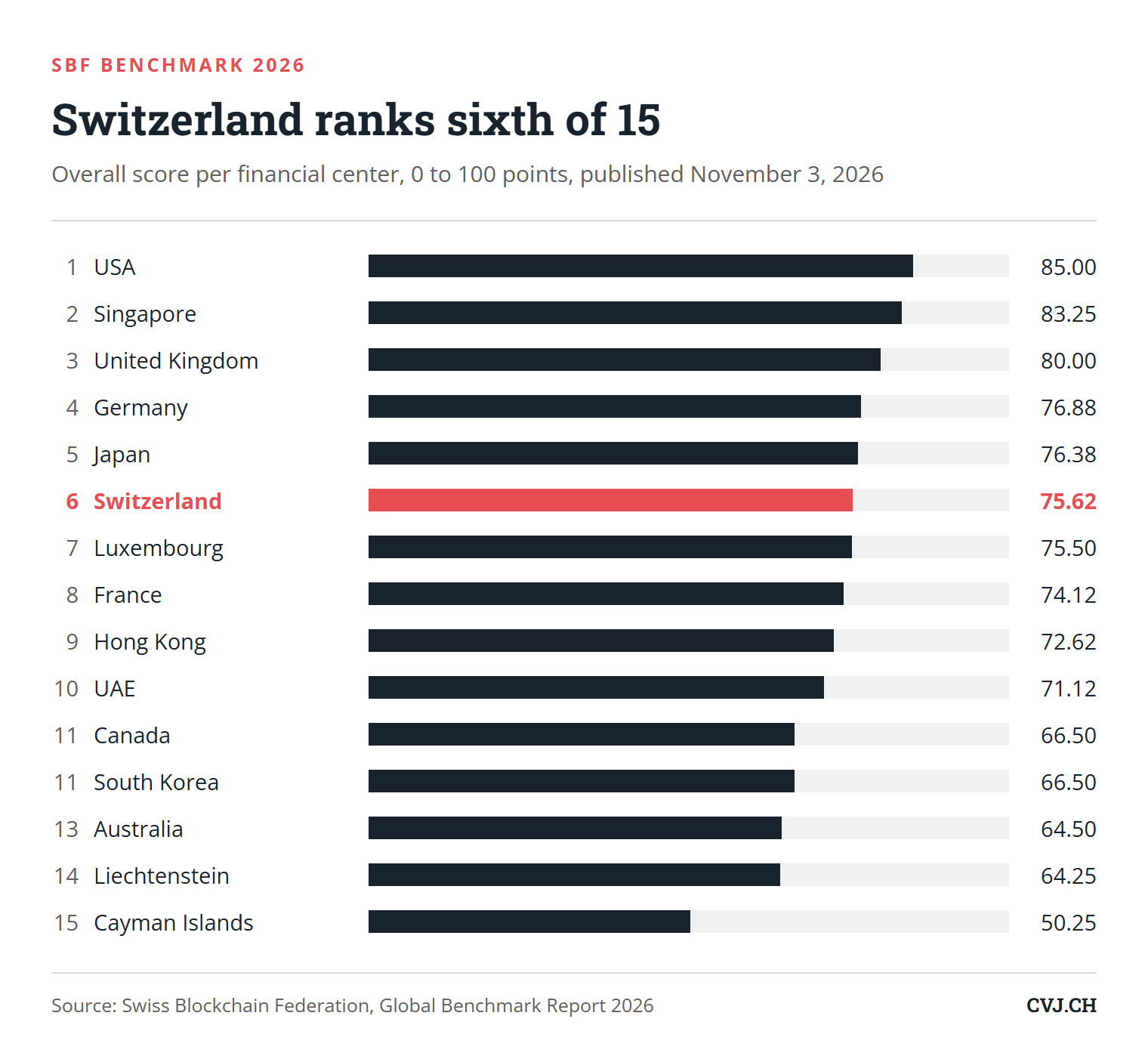
Additionally, Switzerland sits on a category boundary. The report sorts the locations into three groups. "Leading" starts at 82 points, "Advanced" covers 76 to 82 and "Developing" lies below 76. With 75.62, Switzerland therefore falls just short of the "Advanced" threshold. It trails fifth-placed Japan by 0.76 points, but the leader by 9.38. In the midfield, fractions of a point decide the order.
Top scores in law and infrastructure, lagging on speed
In three of the eleven dimensions, Switzerland achieves the highest score of all 15 locations. It receives 9.5 out of 10 points for DLT infrastructure and 9.0 each for Regulatory Certainty and Legal Finality. In addition, it ties with the best for Banking & Custody and anti-money laundering at 8.5. It also matches the top score for geopolitical stability at 9.0. The SBF attributes this strength to an early legal framework. The DLT Act has been fully in force since August 2021. Before that, the regulator had already granted the first FINMA licenses for digital assets in 2019.
On implementation speed, called "Implementation Momentum" in the report, however, Switzerland scores only 6.0 points. The US reaches 9.0 here. Only Australia at 5.5 and the Cayman Islands at 5.0 rank lower than Switzerland. The gap is even wider in market size and liquidity, where Switzerland's 5.0 points compare with 10.0 for the US. Only Liechtenstein and the Cayman Islands perform worse there. By comparison, second-placed Singapore achieves relatively high scores, with 8.5 for speed and 8.0 for market size. In AI x Blockchain and Talent, Switzerland scores 7.8 points, while the US again reaches 9.0.
The weighting decides the overall result. Speed, market size and AI x Blockchain each count for 15%, so together they make up 45% of the total. By contrast, Switzerland's three top disciplines together account for 25%: DLT infrastructure, Regulatory Certainty and Legal Finality. The report thus puts the emphasis on implementation and market impact. Combining the published Swiss individual scores with these weights yields around 75.7 points. Apart from rounding, this matches the overall score. In the quadrant of regulatory maturity and implementation speed, Switzerland stands alone in the "Mature but Deliberate" field. Its position there is around 9.2 to 6.0 points. Singapore and Luxembourg count as "Systematic Leaders". The US, the United Kingdom, Germany, Japan, France and the UAE fall under "Fast Movers".



Five demands on FINMA and policymakers
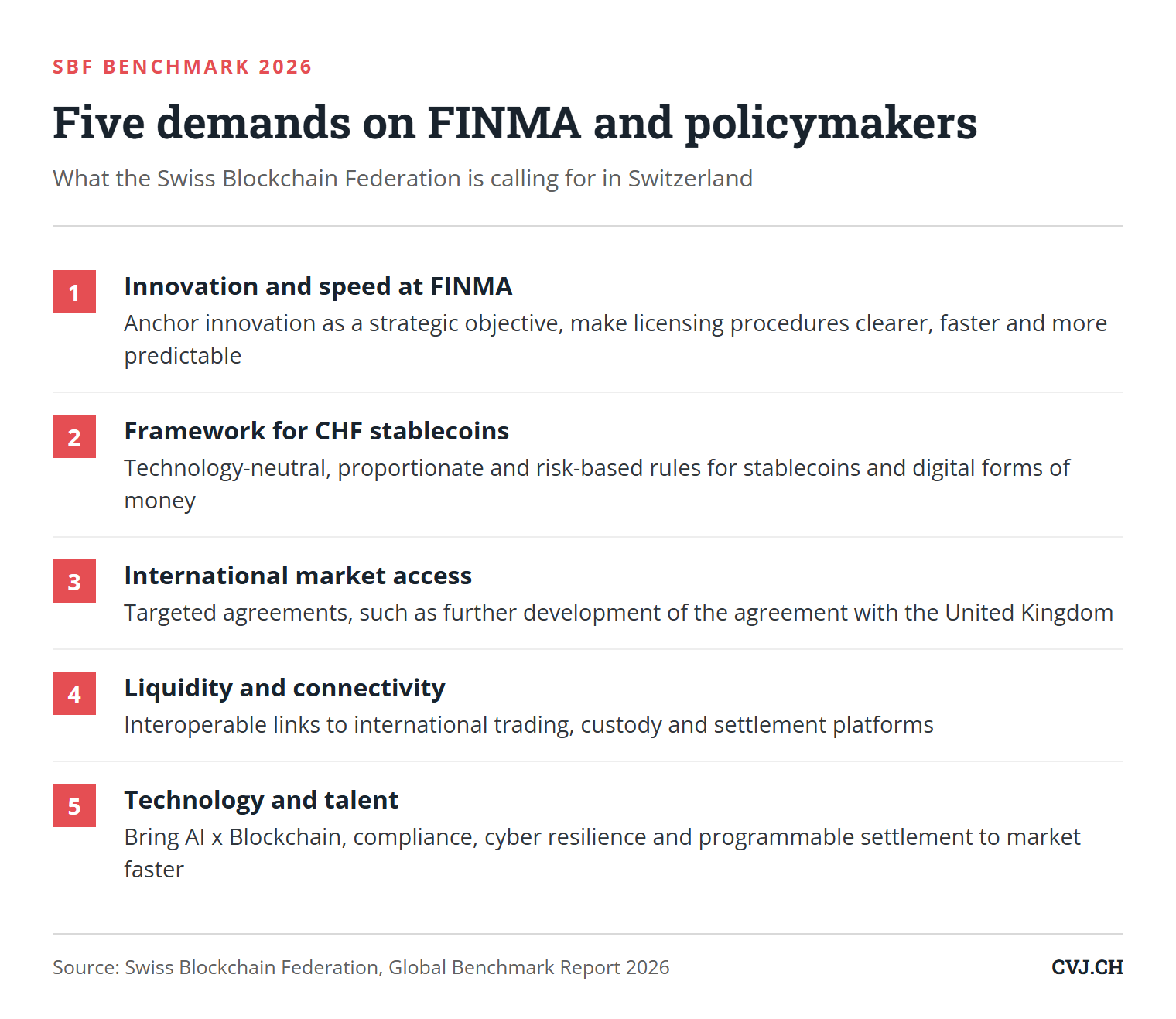
The SBF identifies three gaps. One is implementation speed, another shallow market depth combined with weak international connectivity. The third concerns the path from AI x Blockchain and talent to scalable applications. From these, the association derives five demands. First, FINMA should anchor innovation as a strategic goal and make its licensing procedures clearer, faster and more predictable. For CHF stablecoins and digital forms of money, the SBF also calls for a technology-neutral, proportionate and risk-based framework. The remaining points target the market. The association wants to improve international access. For example, this could happen by further developing the agreement with the United Kingdom on digital financial services. Moreover, it seeks interoperable links to international trading, custody and settlement platforms. It also wants faster market entry for technology and talent. Nevertheless, the SBF stresses that it is not seeking weaker supervision.
Meanwhile, the demands meet ongoing legislation. With the revision of the Financial Institutions Act (FinIA), the Federal Council wants to create two new license categories. These are the payment instrument institution and the crypto institution. Under the plan, only payment instrument institutions may issue a particular type of stablecoin in the future. Furthermore, the new category would replace the existing fintech license. The consultation on the bill ran from October 2025 to February 2026. According to the SBF's policy overview, the bills are still with the Federal Council. This applies to FinIA and to the Financial Market Infrastructure Act (FinMIA). The association expects the dispatches in the first half of 2027. A joint debate in parliament could follow in the same year. The SBF's demands therefore come at a stage that sets the course for the next round of regulation.
Strategically, the SBF advises against copying New York, London or Singapore. Instead, Switzerland should position itself as a neutral and internationally connected location for institutional digital assets. This covers tokenized bonds, funds, collateral and private market assets, plus custody and programmable cross-border settlement.
What comes next after the SBF benchmark
The recommendations build on earlier positions of the association. The SBF's 12-point program from May 2025 already called for FINMA licenses within six months. It also sought innovation as a supervisory objective and technology-neutral regulation of stablecoins. The benchmark now places these concerns in an international comparison.
Things get concrete in the coming weeks. First, the State Secretariat for International Finance (SIF) holds a hearing on November 17, 2026. Its topic is "optimizing financial market regulation". The dispatches on FinIA and FinMIA follow after that. The SBF offers the full report, with country profiles and international case studies, via its website.
"Switzerland has a strong foundation. But we must not assume that legal quality and trust alone are enough. We must once again translate both more quickly into international relevance, concrete applications and lasting value creation." - Heinz Tännler, President, Swiss Blockchain Federation