
A summarizing review of what has been happening at the crypto markets of the past week. A look at trending sectors, liquidity, volatility, spreads and more. The weekly report in cooperation with market data provider Kaiko.
The last 7 days in cryptocurrency markets:
- Price Movements: Ethereum gained 13% over the past week as the network successfully moved one step closer to ETH 2.0.
- Volume Dynamics: Tether remains the dominant stablecoin on centralized exchanges.
- Order Book Liquidity: Spreads for Coinbase and Binance have diverged over the past month.
- Derivatives: Traders increasingly prefer linear contracts amid a growing risk-off environment.
- Macro Trends: Gold is up nearly 7% YTD while equities have suffered.
Relief rally following Fed rate hike announcement

Last week, the U.S. Fed finally hiked interest rates by a quarter point, putting an end to two years of pandemic monetary policy and initiating a hiking cycle set to last through 2023. The widely-expected move could have a strong impact on risk assets in the near term, which have benefited heavily from the era of easy money. Yet, both crypto assets and equities underwent a relief rally following the announcement, with Bitcoin (BTC) closing the week up 9% and ETH up 13%.
In other industry news, Ethereum edged one step closer to proof-of-stake, the EU rejected a controversial proposal that would have limited proof-of-work, and the popular NFT collection Bored Apes Yacht Club launched a governance token.
Airdrops prove volatile

Last week, the company behind Bored Ape Yacht Club (BAYC) launched a governance and utility token - ApeCoin (APE) - via an airdrop. An airdrop is a mechanism designed to reward early protocol adopters and attract new users and has proven to be a very effective tool for building community and momentum around a project. However, airdrops are not without their risks, as highlighted by BAYC’s, which suffered a flash loan attack, price volatility, and controversies around the distribution of tokens. Although APE is governed by a decentralized autonomous organization - Apecoin DAO - around one third of the total 1bn of APE tokens created will be attributed to Yuga Labs (the development team) and launch contributors.
Above, we chart the price of some of the biggest aidrops over the past few years. We can observe that all four airdropped tokens experienced an initial price pop followed by a steady drop in prices as traders took profit. In the long run, tokens often re-gain momentum, and it will be interesting to see how BAYC evolves as its community grows.
Ethereum-Bitcoin ratio sees reversal
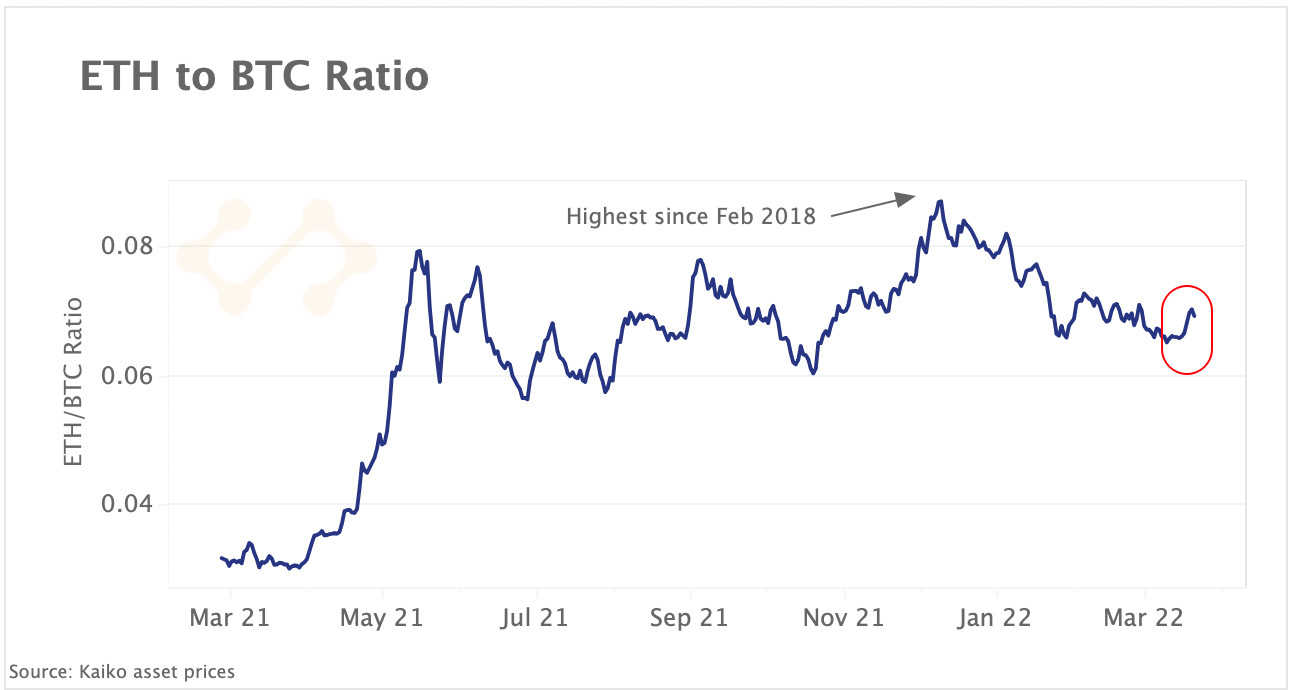
Ethereum has underperformed Bitcoin since the start of the year following a prolonged period of deteriorating global risk sentiment, which has spilled into altcoin markets. While Ethereum is down 25% YTD, Bitcoin has lost just 13%. Yet, we can observe a slight reversal in this trend over the past week when looking at the Ethereum-to-Bitcoin price ratio, which can be used as an indicator of Bitcoin’s dominance relative to altcoin markets and has historically served as a gauge for investor sentiment. The reversal came after Ethereum moved one step closer to a transition to proof-of-stake, which should be completed sometime in Q2. More than 10 million ETH have now been staked in Ethereum 2.0 and investor confidence in the network is likely to increase in the run-up to the transition.
Tether remains the dominant stablecoin on centralized exchanges (CEXs)
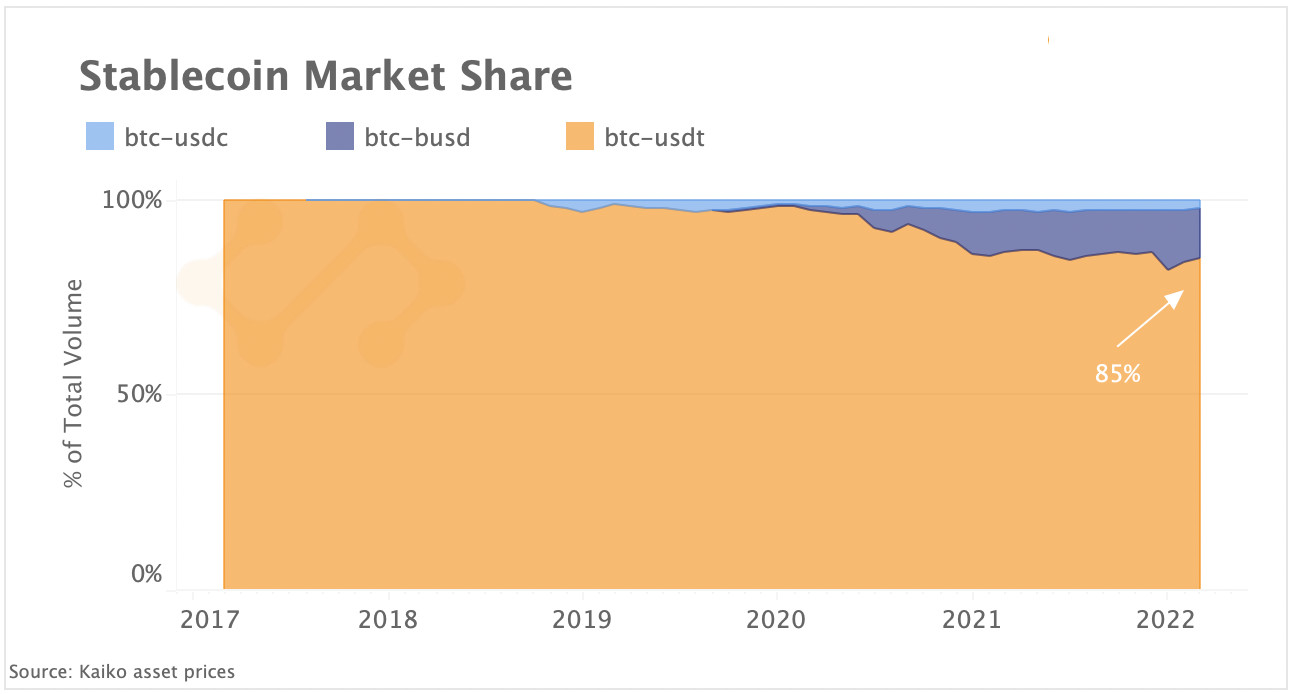
Tether’s USDT remains by far the most popular stablecoin on centralized exchanges. Above, we chart the market share of Bitcoin transactions executed against the three largest stablecoins by market cap - Tether USDT (market cap of $80bn), Circle’s USD Coin ($52bn) and Binance USD ($18bn). 84% of all Bitcoin-stablecoin transactions are executed against USDT. However, Binance USD, issued by Binance in partnership with Paxos, has grown significantly over the past two years, now accounting for around 13% of total stablecoin volume. By contrast, the second largest stablecoin by market cap, USDC, has not gained market share over the past five years on centralized exchanges. However, USDC and other smaller cap stablecoins such as DAI (market cap of $10bn) are widely used on decentralized exchanges (DEXs), which explains their recent surge in market cap.
The past few weeks have demonstrated the utility of stablecoins amid market volatility and fiat currency devaluation. Local Russian and Ukrainian markets have both seen a strong increase in USDT trade volumes over the past few weeks. Yet, with soaring use, comes a renewed round of speculation around the composition of reserves for issuers, with some hedge funds taking an interest in shorting Tether.
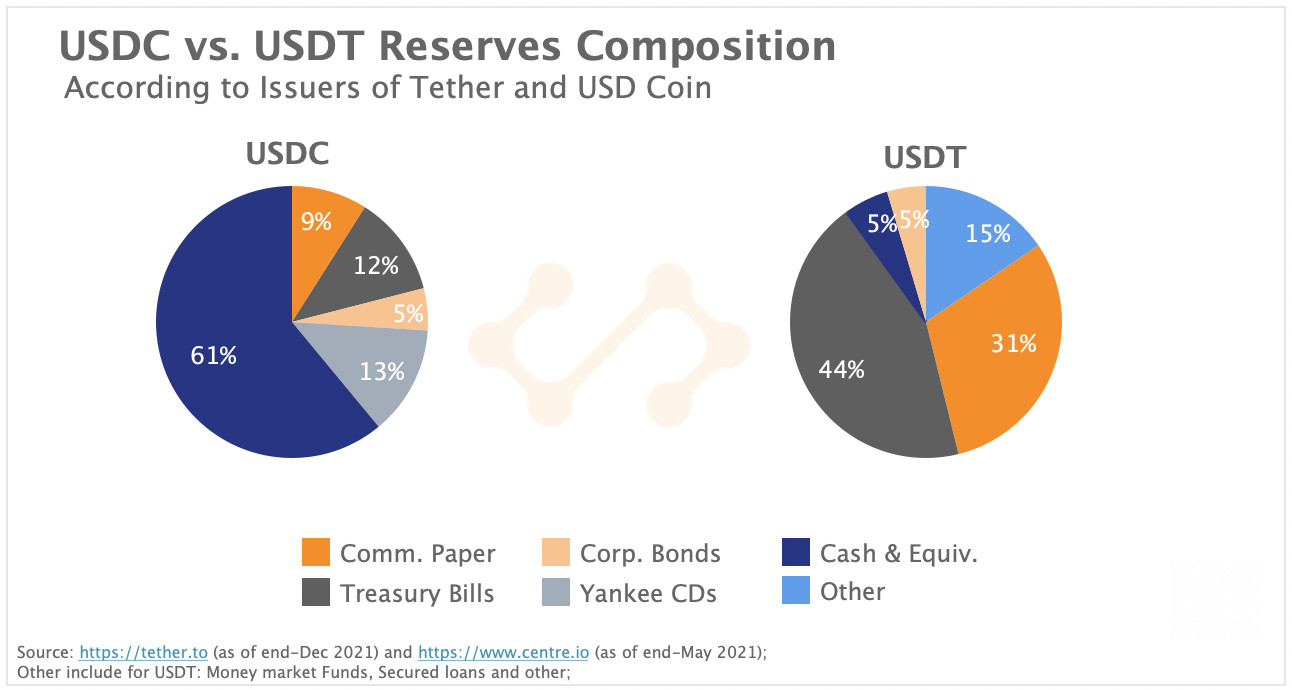
In December, Tether published a renewed composition of reserves, revealing it has increased its exposure to U.S. government debt instruments and reduced the share of unsecured short-term commercial debt (from 50% in June to 30% in Dec). We can observe that the composition of Tether and Circle’s reserves differ significantly, with Tether investing primarily in treasury bills and riskier commercial paper while Circle holds the majority of its reserves in cash and equivalents. This makes Tether more exposed to global commercial debt volatility, a particularly potent risk following severe financial restrictions against Russia and rising policy uncertainty.



Linear contracts grow in popularity as bearish sentiment persists

With Bitcoin down nearly 40% from its November all-time high, traders are increasingly preferring linear contracts, as opposed to inverse. Inverse contracts are margined and settled in the base currency and the value of the margin varies with the asset’s price movements. This makes inverse contracts more vulnerable to liquidations when the underlying’s price (in this case Bitcoin) declines. By contrast, they are more profitable when Bitcoin’s price is rising.
Linear contracts are margined with USD or stablecoins, thus the value of collateral does not shift with price volatility. Above, we chart the market share of trade volume for Bitcoin inverse vs. linear perpetual futures contracts and can observe that the market share of inverse contracts has declined from 35% to 20% of total trade volume since September. The trend suggests that traders are more cautious amid rising macro volatility, and prefer a linear (thus more predictable) PNL.
Fed starts hiking cycle amid growth scare
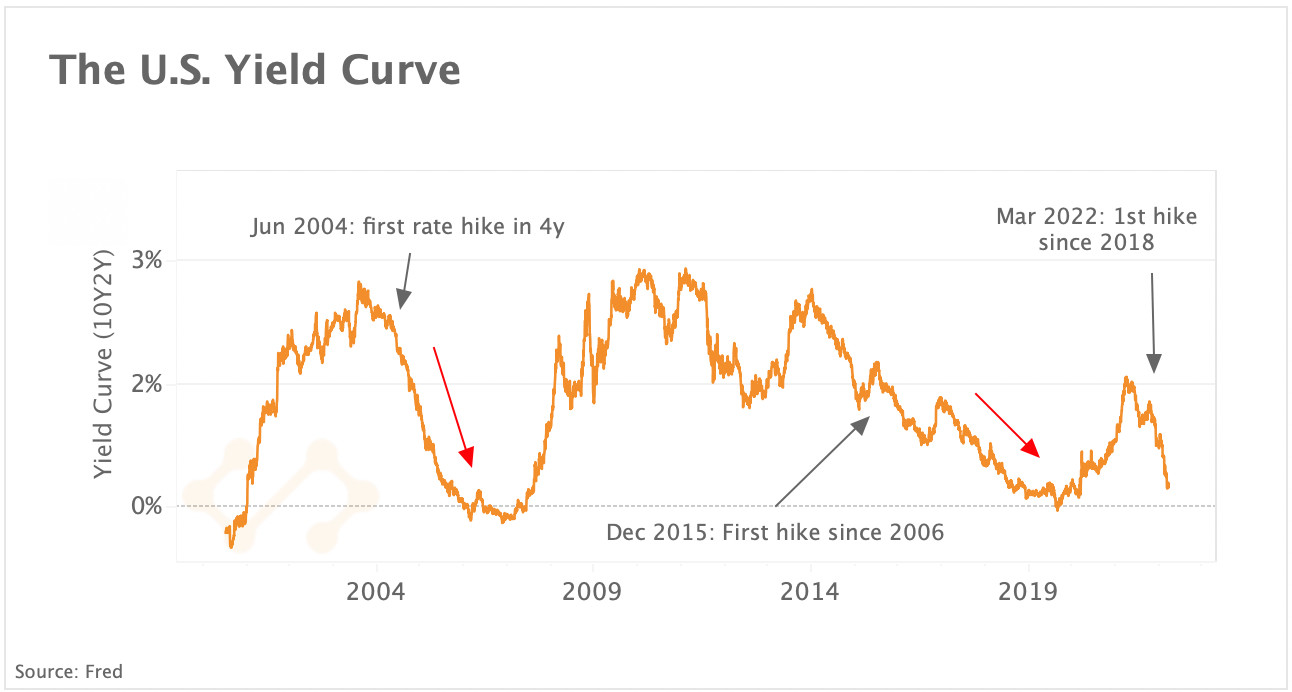
The U.S. central bank officially started its hiking cycle last week, following an unprecedented period of monetary policy accommodation, in an attempt to curb the highest inflation in forty years. The Fed lifted its key policy rate by a quarter percentage point and signaled it will start reducing its $9tn balance sheet “at a coming meeting”. Despite fallouts from the Russia-Ukraine war, the central bank announced it is ready to lift rates faster and higher than previously expected. It now projects seven rate hikes this year, up from only three at its previous FOMC meeting in December. However, markets remain skeptical as to whether the Fed could engineer soft lending by allowing inflationary pressures to cool down without pushing the economy into a recession and needing to cut rates again.
Above we chart the gap between 2 – and 10-year U.S. Treasury yields - known as the yield curve. Typically, the curve tends to flatten when investors expect a slowdown in growth or a recession. We observe that the current tightening cycle starts with the yield curve remarkably flat - just 25bps away from inversion, leaving the Fed in a very tight spot.
The upcoming quantitative tightening- i.e. reduction of the Fed’s massive bond holdings - will likely push long-term yields higher and help steepen the curve. However risks remain tilted to the downside as it is reasonable to expect that quantitative tightening will have the reverse effect on markets than quantitative easing and a direct negative impact on risk assets valuations. All eyes are now on the release of the minutes of the Fed’s FOMC meeting in three weeks which will provide more details on how the Fed will manage the QT process.
Gold rallies while equities suffer
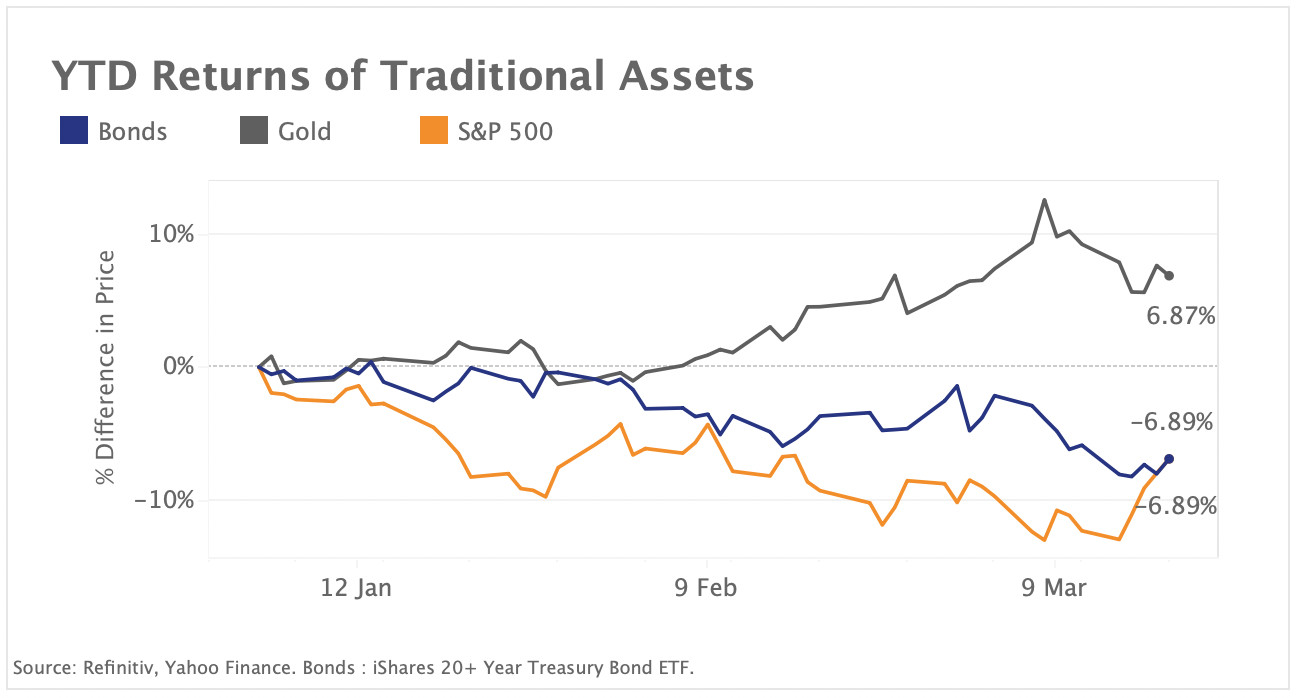
Traditional assets have had a tough start to they year, making diversification amid rising volatility extremely challenging. Above we chart the YTD returns of gold, the broad - based S&P 500 and the iShares 20+ Year Treasury Bond ETF. We observe that both equities and bonds have had one of the worst starts of the year on record and are down 7% YTD. While gold’s price barely moved last year, despite inflation hitting multi-decade highs, it has gained traction. Gold outperformed bonds and equities, gaining nearly 8% since the start of the year.