
A summarizing review of what has been happening at the crypto markets of the past week. A look at trending sectors, liquidity, volatility, spreads and more. The weekly report in cooperation with market data provider Kaiko.
The last 7 days in cryptocurrency markets:
- Price Movements: DEX and CEX tokens are down double digits as trade volume on both types of exchange stagnates.
- Trade Volume: DOGE trading activity surged following the announcement that Elon Musk would acquire Twitter.
- Order Book Liquidity: FTX.US and Binance.US remain less liquid than their global affiliates, as measured by slippage.
- Derivatives: BTC-denominated open interest reached its highest level in more than a year, although USD-denominated OI remains flat.
- Macro Trends: The biggest BTC-exposed tech companies, including Block, Tesla and Microstrategy, are all underperforming the crypto asset.
Crypto and equities suffer poor April performance

April has come to a close, and with it one of the poorest showings for risk assets since the start of the pandemic. While Bitcoin (BTC) closed the month down more than 18%, equities didn't fare much better, with Nasdaq experiencing its worst monthly close since 2008, down more than 13%. Despite the bearish pullback, April was yet another blockbuster month for VC investment and institutional activity. To close out the month, Goldman Sachs made its first Bitcoin-backed loan, Fidelity announced they will let clients invest in Bitcoin for their 401k, and Stripe will let users make payments using the stablecoin USDC.
DEX and CEX tokens underperform as trade volume stagnates

Both centralized and decentralized exchanges earn the majority of their revenues from transaction fees. Thus, it is no surprise that tokens issued by exchanges are faring poorly as trade volumes stagnate and prices turn bearish. We charted a simulated DEX and CEX portfolio of assets and can observe that since the start of the year, both are down double digits, with DEX tokens underperforming CEX tokens. Although Coinbase does not have its own token, its stock price recently dropped to all time lows in part because of "notably" lower volumes, which affect earnings. While tokens issued by exchanges are not directly tied to earnings (they are not securities), they can be viewed as a type of bet on the success of an exchange, and price movements have historically been heavily correlated to broader crypto market activity.
USDT continues to dominate on centralized exchanges

Decentralized stablecoins have recently surged in popularity, with Terra UST surpassing Binance's BUSD as the third largest stablecoin by market cap. Decentralized stablecoins are mostly used in DeFi protocols, with one of the most popular use cases being earning yield in lending protocols. For example, UST holders can earn up to 17.92% APY through Anchor Protocol, contributing to the stablecoin's immense growth.
Yet, the majority of crypto activity today is dominated by centralized exchanges, with Tether remaining the largest global stablecoin, despite a more limited role in DeFi. Above, we chart the number of active stablecoin-denominated pairs across all CEXs. We can observe that USDT is the quote asset for nearly 3,500 pairs, while the next closest, BUSD is the quote asset for fewer than 350. However, USDT's top competitor, USDC, and other decentralized stablecoins such as DAI and UST have a much stronger foothold in DeFi, highlighting the growing divergence in use cases.
Japanese crypto activity drops amid FX volatility
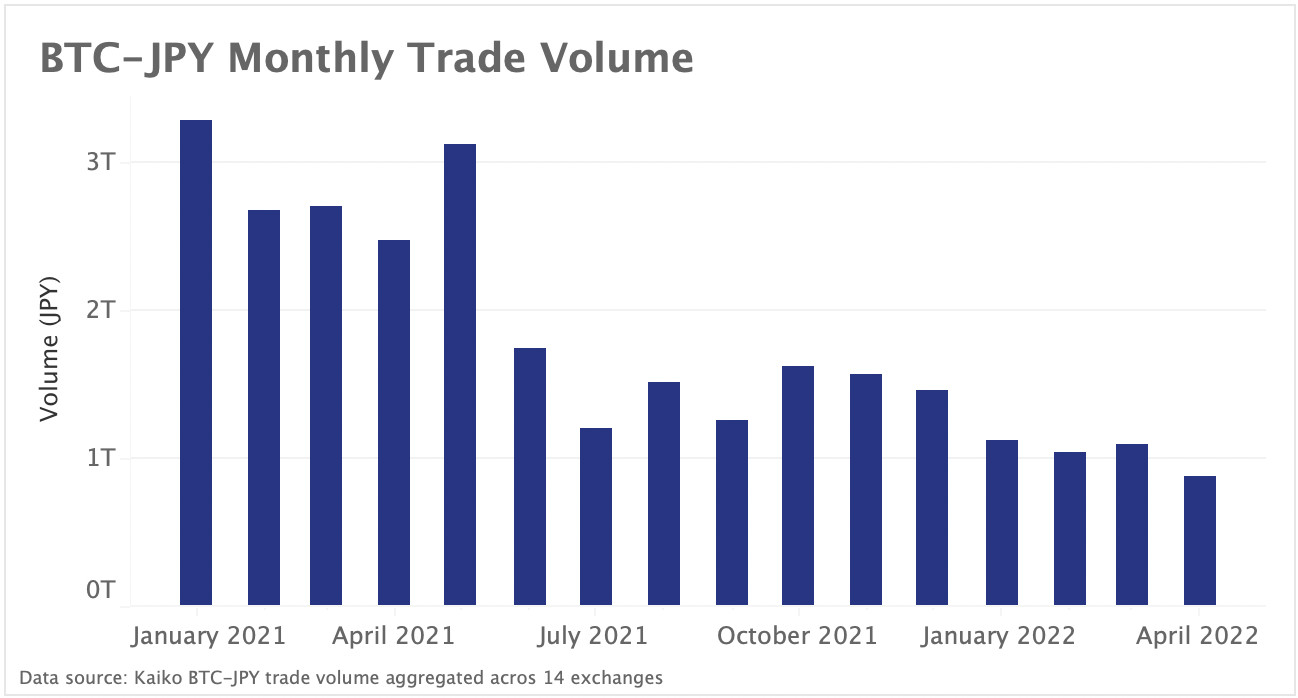
With rising FX volatility for the Japanese Yen, trading activity for the BTC-JPY pair has dropped to its lowest level since 2020. The Yen has depreciated 10% versus the USD over the past 7 weeks, and today 1 USD trades for about 130 Yen. Throughout April, Bitcoin traded at a slight premium on JPY markets compared with USD markets, although trade volumes have reverted to 2020 levels. In April, the equivalent of about $7.5 billion was traded across 14 exchanges that offer a BTC-JPY pair, which is still relatively high compared with other regional fiat crypto activity. However, this is a significant drop-off from all time highs of more than $20 billion. During the 2017-18 bull run, Japan had some of the largest crypto markets and retail activity in the world.
DOGE gains ground in battle of the meme coins

Dogecoin (DOGE) price and volumes surged to multi month highs last week after Tesla CEO Elon Musk reached a $44bn deal to take over social media platform Twitter. The acquisition boosted speculation for an increase in the meme coin’s use cases as Musk has openly expressed his support for DOGE over the past year. Above, we chart Dogecoin’s market share relative to its main competitor Shiba Inu (SHIB). We observe that both coins are strongly driven by shifts in risk sentiment and exhibit significant volatility in trade volumes. However, SHIB has been mostly dominating the market following its listing on Coinbase in September 2021. Despite the recent surge, DOGE’s price and volumes remain well below their all-time high reached in May 2021.
FTX.US and Binance.US remain less liquid than global counterparts
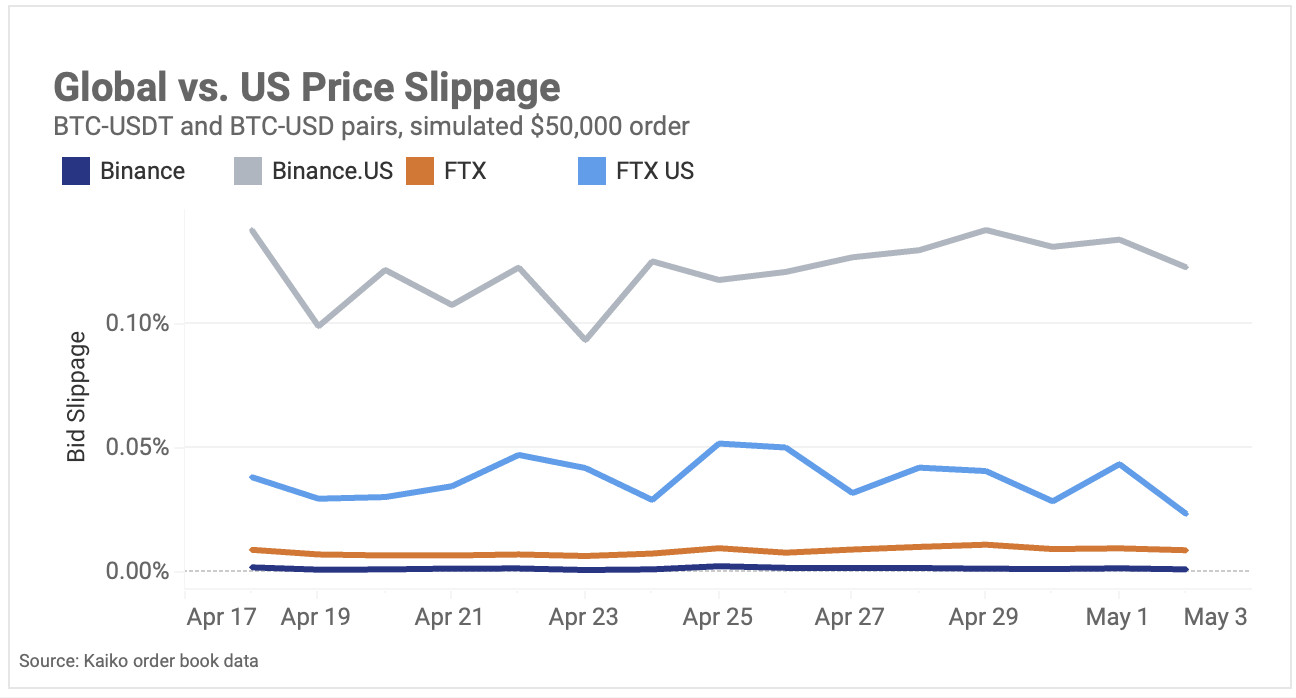
Slippage for BTC pairs on U.S. exchanges has remained consistently higher than their more frequently used international versions, with the largest gap present between Binance and Binance.US. Slippage for BTC-USD pairs on FTX.US and Binance.US average around 0.05% and 0.1%, respectively, while slippage on the global exchanges are usually under 0.01%. This is despite large marketing pushes from both exchanges, as well as large fundraising rounds; FTX US raised $400mn at an $8bn valuation this January while Binance.US raised $200mn at a $4.5bn valuation in April. Notably, there has been confusion around FTX’s marketing, as its most visible advertisements (Super Bowl, FTX Arena) have seemingly advertised the international exchange rather than the domestic version.



Volatility gap between Nasdaq and BTC at lowest level since 2020
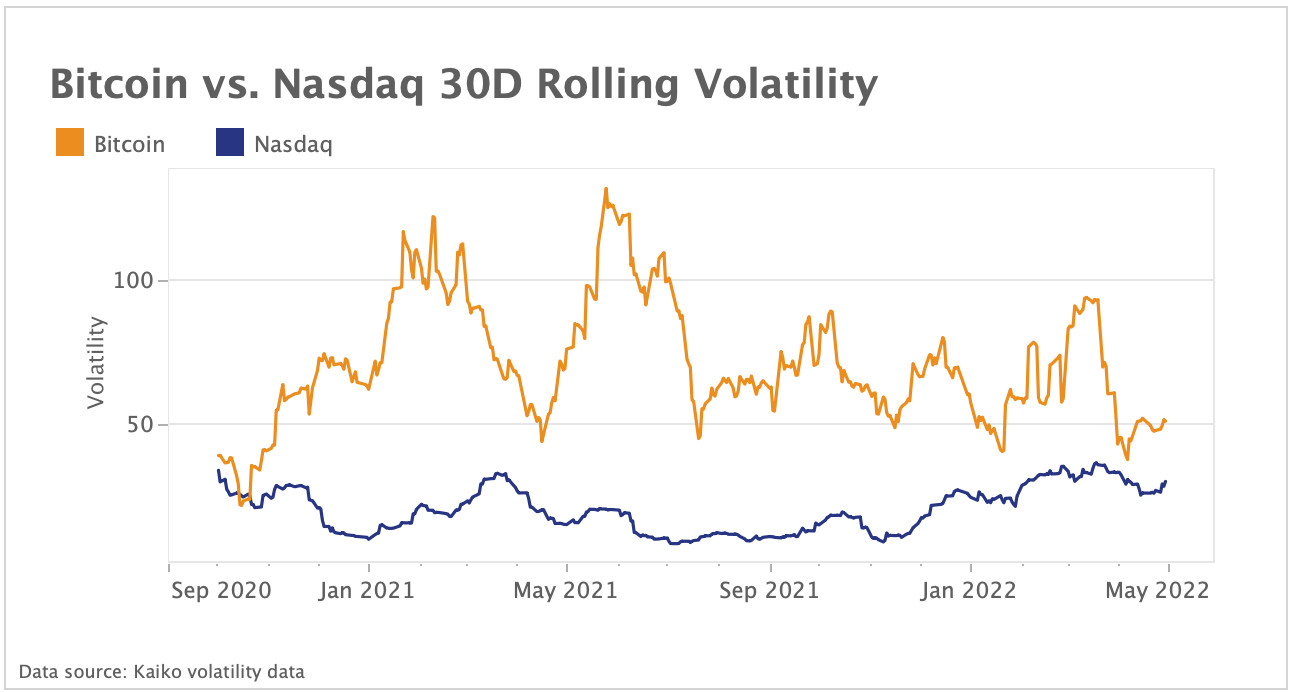
Nasdaq’s 30-day rolling volatility has continued to tick higher since December 2021, while Bitcoin’s has declined precipitously since March. This has brought the two measures closer than they have been since September 2020, when equity markets registered their first significant downturn following five months of blistering growth following the COVID-19 market crash; Bitcoin was still under $10,000 at this time. The recent convergence in volatility has been marked by a poor earnings season and a relatively stable crypto market, though volatility reemerged over the weekend.
BTC-exposed tech companies underperform Bitcoin

Despite Bitcoin’s correlation with tech equities hitting a multi-year high of 0.8, it has outperformed other risk assets since the start of the year, suggesting that capital flows into the sector have remained relatively more resilient. Above, we chart Bitcoin YTD price returns alongside the returns of the largest Bitcoin-exposed companies (all have purchased the crypto asset for their balance sheets). While Bitcoin lost 17% of its value YTD, all four companies are registering far worse returns. The largest U.S. based crypto exchange Coinbase is the worst performer, with its stock price down 50% YTD after crypto trade volumes - its major source of revenue - stagnated and its operations in India failed to take off.
FX volatility spills into crypto
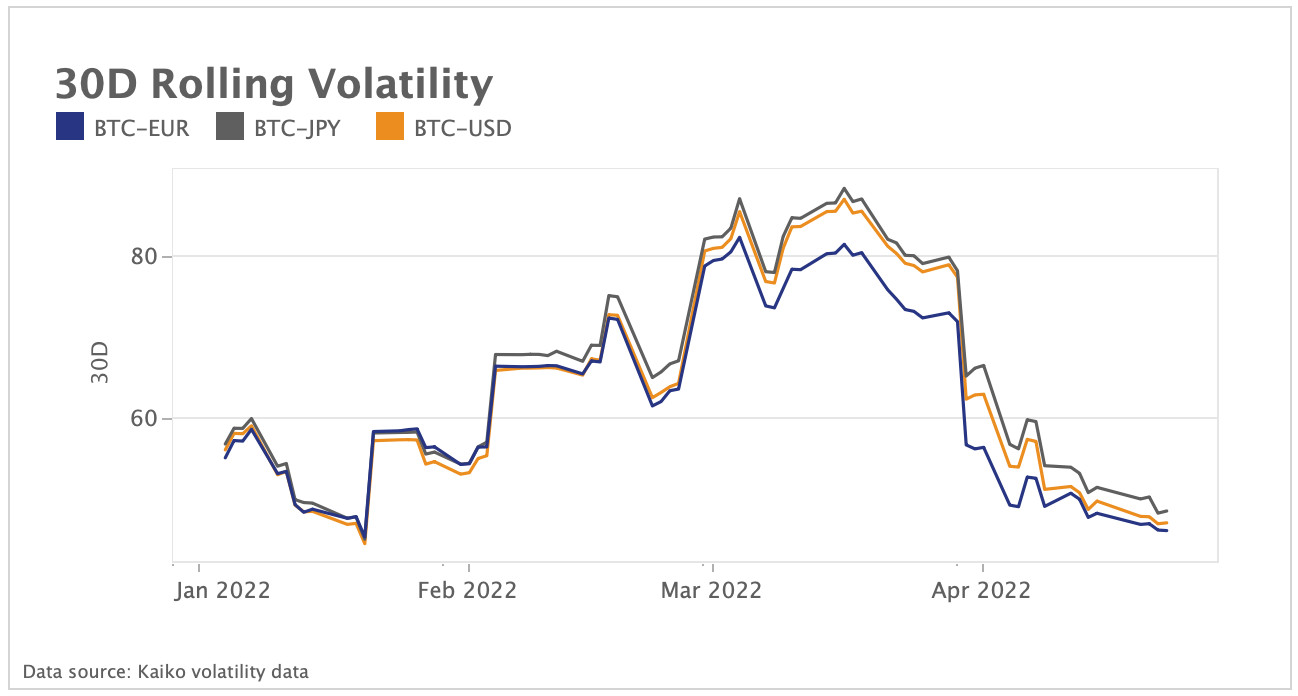
Global FX volatility rose sharply over the past few months due to rising rate differentials and the war in Ukraine. The currency market turmoil has overflowed into crypto markets, evidenced by our chart of 30-day rolling volatility of BTC prices expressed in different fiat currencies, which began diverging significantly in March and April. This has exacerbated market inefficiencies and created arbitrage opportunities across crypto markets. However, because most fiat pairs other than the U.S. Dollar are listed on unregulated or local exchanges, arbitraging these differentials remains challenging. One of the most prominent examples of the difficulties to arbitrage Bitcoin price differences on local markets is the so-called “Kimchi Premium”- a crypto phenomenon which has existed since 2016 and is largely due to South Korea’s strict capital controls.