
Close Menu
Crypto Valley Journal
    Facebook X (Twitter) Instagram
    Crypto Valley Journal
    • Hot Topics
      • News
      • Minds
    • Focus
      • Background
      • Blockchain
      • Legal & Compliance
      • Non-Fungible Token (NFTs)
    • Investing
      • Markets
      • Financial Products
      • Decentralized Finance (DeFi)
      • Exchange overview
    • Education
      • Basics
      • Glossary
      • Politicians on crypto
    • Statistics
      • Bitcoin-ETF-Flows
      • Ethereum-ETF-Flows
      • Crypto market data
      • On-chain data
    • Academy
      • Overview
      • Part 1: Blockchain
      • Part 2: Money
      • Part 3: Bitcoin
      • Part 4: Cryptocurrencies
      • Part 5: Decentralized Finance
      • Part 6: Investing
    • English
      • Deutsch
    Crypto Valley Journal
    You are at:Home»Focus»Background»Bitcoin miners face financial struggles and centralization threats
    Bitcoin miners face financial struggles and centralization threats

    Bitcoin miners face financial struggles and centralization threats

    By Victor Koetter on 19. August 2024 Background

    Bitcoin miners are facing financial challenges, with decreased block rewards since this year's halving and an all-time low hash price putting pressure on the ecosystem. This decline raises concerns about the sustainability of mining operations and the potential security risks as miners stop contributing and the system becomes more centralized.

    Several factors have contributed to this challenging environment, such as an unstable month triggered earlier this month or reduced block rewards after the halving earlier this year. The halving is programmed into bitcoin's source code. It states that after 210,000 blocks have been mined, or about four years, the block rewards for miners will be cut in half. This year, the mining reward was reduced from 6.25 BTC to 3.125 BTC per block. The only other source of income for bitcoin miners, transaction fees, are becoming more and more substantial.

    Subscribe to our newsletter

    The best articles of the week, directly delivered into your mailbox.

    All time low revenue for bitcoin miners

    Miner profitability can also be expressed in terms of hash price. The hash price represents the reward per hash rate and is calculated using the current bitcoin exchange rate, the block reward plus fees, and the network's hash rate. The hash price is currently at an all-time low. While transaction fees spiked after the April 2024 halving, the impact was short-lived and fees have been trending lower since. The spike can be attributed to the launch of the Runes protocol, which coincided with the halving and was expected to increase activity on the bitcoin blockchain.
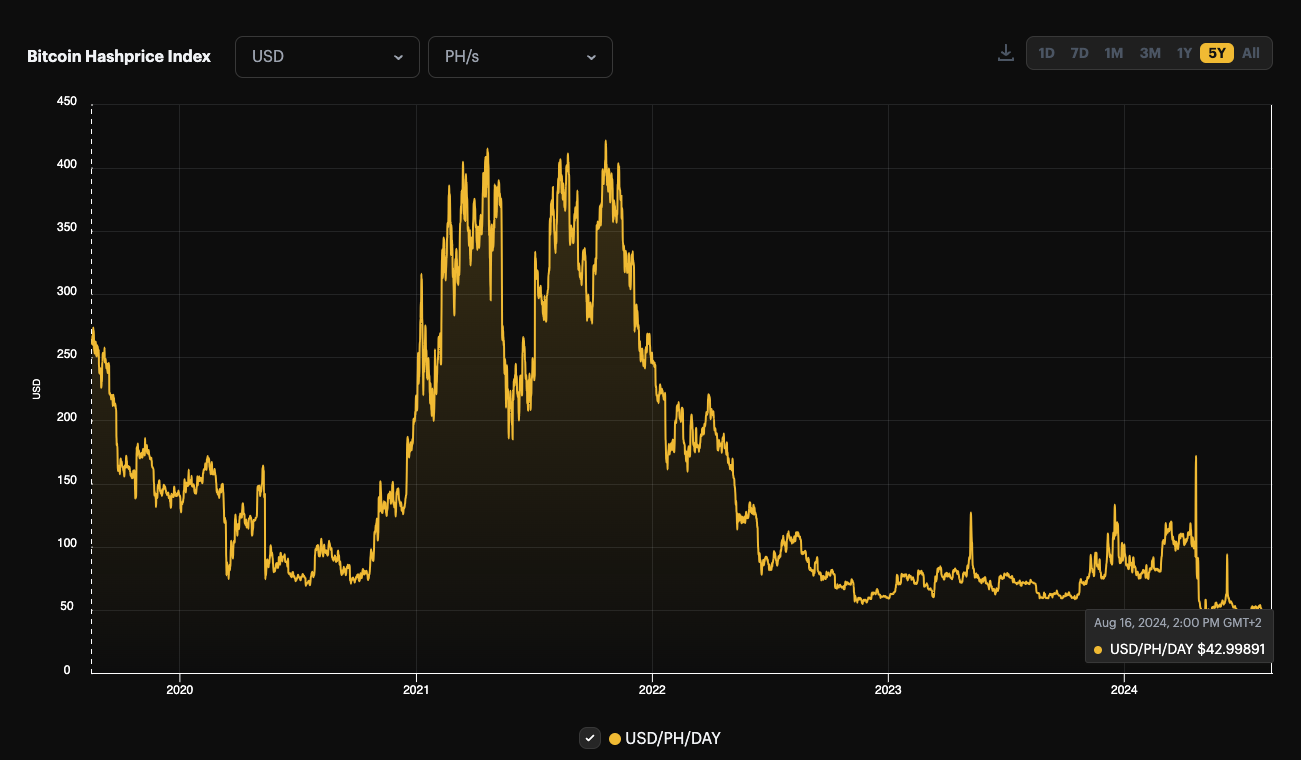
    Bitcoin Hashprice
    Bitcoin hash price over the past 5 years / Source: Hashrate index

    Since only those miners who successfully calculate bitcoin transactions are rewarded, competition among miners is high. To increase their chances of securing the block reward, miners invest in more specialized hardware to gain an edge over the competition. However, this is capital intensive and drives out smaller competitors and makes it harder to enter the space. This development leads to a centralization of computing power and thus a less decentralized network, weakening one of the main arguments for bitcoin as an independent currency.


    Ray Dalio’s Bridgewater Associates Minds

    Star investor Ray Dalio considers Bitcoin inferior to gold

    Analysis by Bitget Research on Bitcoin quantum computing risks, ECDSA exposure, NIST post-quantum standards, and BIP-360 migration paths. Background

    Bitcoin quantum computing: What recent developments mean for network security

    JPMorgan warns: Recurring DeFi exploits and stagnant ETH-denominated TVL curb institutional engagement in the DeFi sector. DeFi

    JPMorgan: DeFi hacks and TVL losses weigh on institutional investors

    Basics

    Unit bias in crypto: Why cheap coins mislead investors

    Ray Dalio’s Bridgewater Associates Minds

    Star investor Ray Dalio considers Bitcoin inferior to gold

    Analysis by Bitget Research on Bitcoin quantum computing risks, ECDSA exposure, NIST post-quantum standards, and BIP-360 migration paths. Background

    Bitcoin quantum computing: What recent developments mean for network security

    Industry response and consolidation

    In response to declining revenues, major players in the bitcoin mining industry are reevaluating their strategies. This can be seen in the behavior of miners. Many of them sold part their Bitcoin holdings prior to the halving, with the selling accelerating afterwards. Miners are also looking at other business areas such as artificial intelligence (AI). It has been reported that major miners such as Texas-based Applied Digital are moving into AI using their existing infrastructure. While the mining hardware itself cannot be used directly for AI computing, miners have a professional setup required for large-scale computing, such as cooling systems, security, and access to cheap energy that can be used.

    Meanwhile, there is strong internal rivalry and competition to increase control of the hash rate. Riot Platforms, the third largest publicly traded bitcoin mining company, has increased its stake in rival Bitfarm by an additional 1 million shares, bringing its total ownership to nearly 19%. This follows an earlier proposal by Riot to acquire Bitfarm for $950 million, which was rejected. This reflects a trend of consolidation and competitive realignment in the cryptocurrency mining industry.

    Mining pool centralization is also a growing concern, with just four pools controlling over 75% of the Bitcoin network’s hash rate. While joining a mining pool doesn’t inherently weaken the network, the pool operators can access sensitive data like IP addresses. This presents security risks, particularly in surveillance-heavy countries like China, where Antpool, the second-largest pool, is based. China’s dominance in the sector is driven by low electricity costs and its control over a significant portion of chip manufacturing. Notably, Bitmain, a major producer of Application-Specific Integrated Circuits (ASICs), controls 80-90% of the global chip supply.
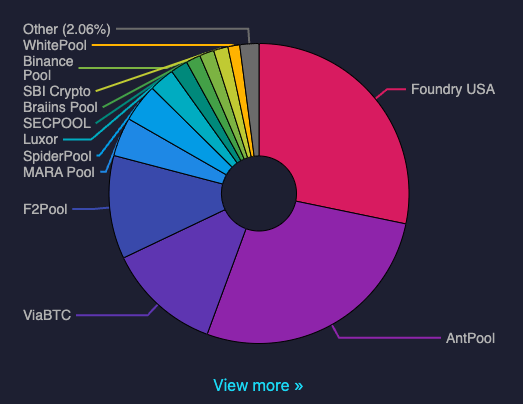
    Mining pools
    Bitcoin mining hash rate by mining pool / Source: Mempool

    Long-term viability

    The block reward reduction raises the question how a sustainable and long term operation of the network can be achieved. Growing adoption and utility of the bitcoin network brings adequate transactions to sustain a fee market which can replace the block rewards. Rewards will hit zero around 2140, by then the bitcoin network will have to be significant enough to have miner revenue and network security rely solely on fees.

    Also the network is facing increasing centralization risk. Single entities are controlling chip production, mining pools are consolidating and publicly traded mining companies are in takeover mode without new competitors in sight. These developments could impact Bitcoin’s security and decentralization. Further mining companies are turning to alternative areas such as AI, indicating waning belief and revenue. These financial difficulties, and decentralization threats currently facing the bitcoin ecosystem are significant challenges that require answers for a sustainable long-term adoption.


    Share. Facebook Twitter LinkedIn Email Telegram WhatsApp

    About the author

    Victor Koetter

      Victor has been actively involved in the crypto scene since 2019 and sees great potential in the possible applications of the technology and the resulting innovations. At the Crypto Valley Journal, he is responsible for the coverage of the topics NFTs & Metaverse. In 2021, he also co-founded the Swiss NFT Association. The association forms a knowledge hub around the topic of NFTs and organizes regular informative events.

      Related Articles

      Admiral Paparo confirmed to the US Senate: INDOPACOM operates an active Bitcoin node and is conducting operational tests to protect military networks.

      US military operates Bitcoin node in the Indo-Pacific

      Bitcoin fails again at the 80'000 USD mark, profit-taking weighs on ETH, SOL and XRP despite Strategy purchase and ceasefire.

      Bitcoin price climbs to 80’000 USD – profit-taking hits ETH, SOL and XRP

      Satzlänge: 32.7% der Sätze enthält mehr als 20 Wörter, was mehr als das empfohlene Maximum von 25% ist. Du solltest versuchen, die Sätze zu kürzen. Bindewörter: Keiner der Sätze beinhaltet Bindewörter. Verwende welche. Gute Ergebnisse (5) Passiv: Du verwendest nicht zu viel Passiv. Das ist großartig! Abgeschlossene Sätze: Es gibt keine sich wiederholenden Satzanfänge. Das ist großartig! Verwendung von Zwischenüberschriften: Gut gemacht! Absatzlänge: Es gibt keine Absätze, die zu lang sind. Gut gemacht! Wortkomplexität: Du nutzt nicht zu viele komplexe Worte, was deinen Text leicht zu lesen macht. Gute Arbeit!

      New documentary seeks to unveil the mystery behind Satoshi Nakamoto

      Canada announces national crypto ATM ban. Roughly 4,000 machines are affected as Ottawa targets fraud and money laundering.
      29. April 2026

      Canada bans crypto ATMs

      OKX, BlackRock and Standard Chartered launch a joint framework that makes tokenized RWAs usable as margin collateral under G-SIB custody.
      29. April 2026

      OKX, BlackRock and Standard Chartered use tokenized treasuries as collateral

      Hoskinson calls support of the CLARITY Act by Garlinghouse and the XRP community insanity and accuses Ripple of harming the industry.
      28. April 2026

      XRP vs. Cardano: Hoskinson calls CLARITY Act support “insanity”

      twitter image button instagram image button linkedin image button youtube image button

      About Crypto Valley Journal
      About Crypto Valley Journal

      On the pulse of the movement

      • Academy
      • Contact
      • Advertising
      • About us
      • Partner
      • Imprint
      • Privacy
      • Disclaimer
      Search

      Type above and press Enter to search. Press Esc to cancel.