Over the last few years, the crypto market has grown considerably. Crypto assets already had a market cap of over 2.3 trillion USD in 2021. But how do traditional markets deal with this growth and how they integrate crypto assets in the future as the growing influence is undisputed.
The issue of whether and under which conditions crypto assets carry systemic risk is a lingering one. The definition of systemic risk focuses on the stability of the entire financial system – as opposed to the stability of an individual market participant, the solidity of the financial markets infrastructure, and the effectiveness of the monetary policy. It excludes money laundering/terrorism financing and consumer/investor protection aspects.
The issue was first discussed and assessed in 2018 after Bitcoin (BTC) and crypto assets reached an all-time high capitalisation. It was not an issue of concern during 2019 and 2020. However, the discussion intensified again during the second half of 2021, following another all-time high capitalisation of crypto assets in April and November 2021. We review below the arguments made in the discussion of the systemic relevance of crypto assets, and the conclusions achieved. We summarise in some detail the most recent assessment and conclusion published by the Financial Stability Board (FSB) on 16 February 2022 and offer an outlook.
Initial analyses of crypto assets
On 13 March 2018, following the all-time high capitalisation level achieved by crypto assets in January 2018, the FSB advised the G20 (interstate forum that includes 19 countries and the EU) that crypto assets do not pose a risk to the overall stability of the much larger traditional financial system. The conclusion was based on the size of the crypto market - small relative to the size of traditional financial markets – and on the very limited use of crypto assets for the real economy and related financial transactions. However, the FSB warned that the assessment would be different if the use of crypto assets increased significantly along with enhanced investor confidence and bigger interconnection with the regulated financial system.

Regarding potential vulnerabilities emerging from unbacked crypto assets (such as BTC), the FSB notes that the connections between crypto assets and systemically important financial institutions are currently limited and follows the International Monetary Fund (IMF) in assessing such connections as more important in emerging economies than in mature economies. It also notes the growing institutional adoption of crypto assets through nonbanks (such as hedge funds) and related products.
During the "crypto winter", the Bank of England (BoE) confirmed on 1 May 2019 that crypto assets do not pose a risk to the overall stability of the much larger traditional financial system. The conclusion rested on the market capitalization of the crypto market - too small compared to the multi-trillion-dollar global financial market.
The European Central Bank (ECB) reached another conclusion on 14 May 2019, warning that the dynamics displayed by crypto markets meant that more significant threats to the EU financial stability could not be ruled out, and careful monitoring was needed. On 28 February 2019, however, the United States Federal Reserve (US Fed) included the collapse of the bitcoin market amongst the stressed events conducted to measure risk to the US financial market. On 1 July 2019, the G20 confirmed that crypto assets do not pose a threat to global financial stability but acknowledged the need to monitor their developments closely.
Concers about financial stability caused by the growth of crypto assets
On 13 October 2021, after crypto assets grew from a capitalisation of USD 191 billion on 1 January 2020 to USD 2.3 trillion in October 2021, the BoE concluded that while the financial stability risks remain limited, the current developments of crypto markets raise financial stability concerns because of the increasing interconnectedness with the traditional banking and financial system, the emergence of leveraged players in the unregulated sector, and the rise of Decentralised Finance (DeFi) and stablecoins. In October 2021, the International Monetary Fund (IMF) highlighted that in several emerging economies the macro-relevance of crypto assets is higher than in mature economies because they feature a more extensive adoption and penetration of crypto compared to the levels characterising mature economies.
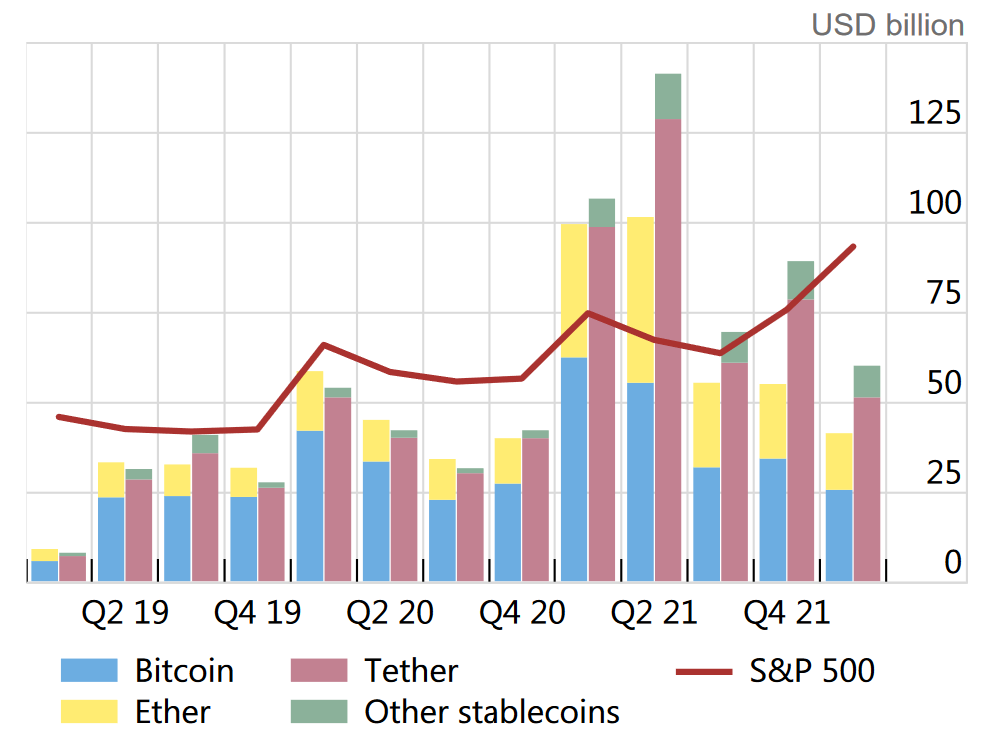
On 16 February 2022, the FSB recognised that the market for crypto assets has been evolving fast and is getting nearer to representing a threat to global financial stability. It concluded that it has become more challenging than before to assess the point where financial stability risks could rapidly escalate.
The market capitalisation of crypto assets remains small compared to all assets making up the financial system, and the degree of interconnectedness is still limited. However, nonbanks and banks have been increasingly undertaking crypto asset activities and gaining exposure to the crypto asset class through dedicated and sometimes leveraged financial products; investors and consumers continue to display low levels of understanding of crypto assets and there is uncertainty around the degree of operational resilience of some crypto asset-focused actors.
Identified deficits by FSB
Concerning exposures associated with stablecoins, the FSB flags that the nature and composition of the reserve assets of the companies issuing and managing stablecoins may represent market exposures; governance, risk management, and operational weaknesses may impact investor confidence level. The FSB also flags that critical payment systems on which the real economy depends could be impaired if stablecoins were used more extensively for payments. This particularly applies to global stablecoins. In addition there were problems with:
- Products (ETPs) and funds offering leveraged trading strategies
- Provision of crypto custodial, trading and other services by financial institutions and banks
- Wealth and confidence effects that sudden market shocks could trigger
- Degree with which these crypto assets are used in payments and settlement (which remains limited)
In relation to DeFi, the FSB highlights that risks to financial stability may emerge in connection with the growing size of DeFi and the insufficient regulation and oversight. The FSB concludes that financial stability risks originating from crypto markets have become more real than before. With increasing adoption of crypto assets by the traditional financial sectors and actors enhances the interconnectedness between traditional and crypto markets, which facilitates the transmission to traditional financial markets of shocks originating in the crypto markets.

Authorities still have gaps in identifying and quantifying the financial stability risks posed by crypto markets. Therefore the FSB will continue to monitor crypto asset market risks and explore potential regulatory and supervisory actions to address financial stability threats, including improving data collection and enhancing cross-border and cross-sectoral cooperation/information sharing.




The view from regulatory agencies has changed over time
The assessment of whether crypto assets and related markets carry a systemic risk for the financial system has been considered by regulatory bodies such as the FSB, IMF, ECB, US Fed, and BoE regularly since 2018. As always the conclusion has been that, currently, crypto assets do not pose a systemic risk. Relative size of the crypto asset markets and degree of interconnectedness with traditional financial markets are the main inputs on which the assessment is based on.
However, this conclusion has been nuanced over time. The introduction of bankable investment products and other institutional-grade investment vehicles, the initiatives by the banking sector to develop crypto asset services, the advent of DeFi solutions and stablecoin offerings, and the growing general popularity of crypto assets, have increased the interconnectedness between crypto markets and traditional financial markets.
Integration of crypto assets in the future
This development exposes traditional financial markets to shocks destabilising crypto markets in a more significant way than had been the case in the past. Regulatory authorities respond through increased data collection and monitoring and enhanced cross-border cooperation.
As crypto assets become more integrated with traditional markets and more sizeable in terms of market capitalisation, it is reasonable to expect a strengthening of the supervision of crypto asset exposures by the regulated sector, a finalisation of the Basel Committee on Banking Supervision (BCBS) prudential treatment of banks’ crypto asset exposure, and the acceleration of the work to broaden the regulatory perimeter to include crypto market actors.