
A summarizing review of what has been happening at the crypto markets of the past week. A look at trending sectors, liquidity, volatility, spreads and more. The weekly report in cooperation with market data provider Kaiko.
The last 7 days in cryptocurrency markets:
- Price Movements: Historically, crypto assets have performed worse than equities during the September market slump.
- Market Liquidity: Market share of volume for Binance's BUSD stablecoin hit all time highs.
- Derivatives: Ether options reveal investor apprehension ahead of the Merge but bullish sentiment prevails post-Merge.
- Macro Trends: Eurozone inflation hit record highs, surpassing U.S. inflation for the first time since 2015.
Another choppy week in crypto markets
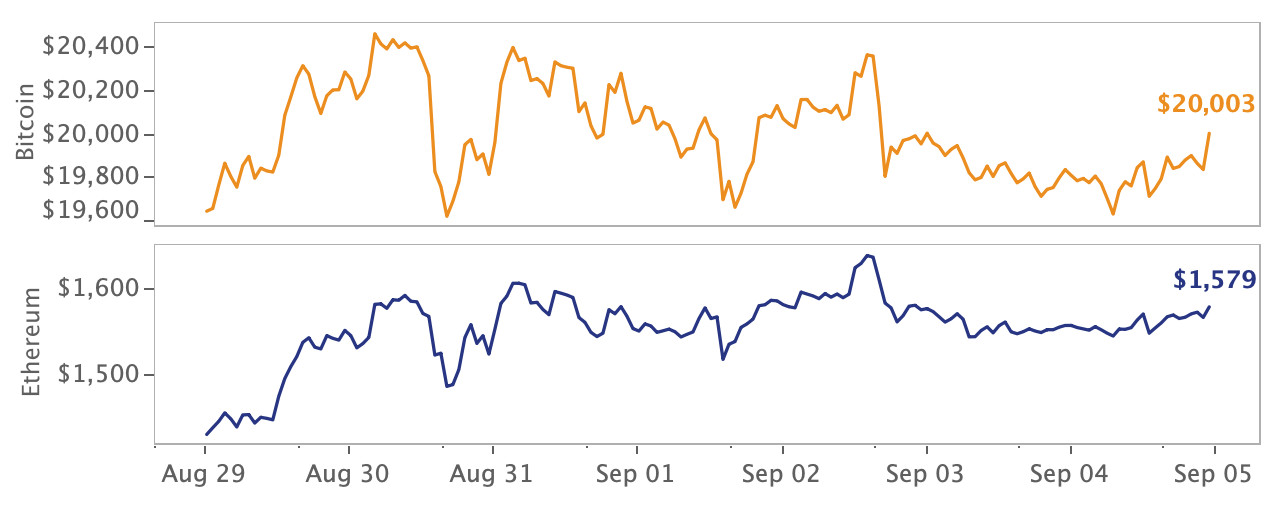
It was another choppy week in crypto markets, with Bitcoin (BTC) failing to hold above $20k and Ethereum (ETH) starting September below $1.6k, a level it has failed to consistently breach since mid-August. Macro continues to cast a shadow of uncertainty over both crypto and traditional risk assets as the energy crisis worsens. The European Central Bank will likely take a (very) hawkish approach at their upcoming meeting following the release of higher-than-expected inflation numbers for Europe. In crypto news, Bitcoin maximalist and former MicroStrategy CEO Michael Saylor is being sued by the District of Columbia for tax fraud and a post by Crypto Leaks alleged that Ava Labs, the company behind Avalanche, and its lawyers engaged in anti-competitive lawsuits against rivals. Ava Labs has denied the allegations.
Arbitrum ecosystem is bright spot in sea of red
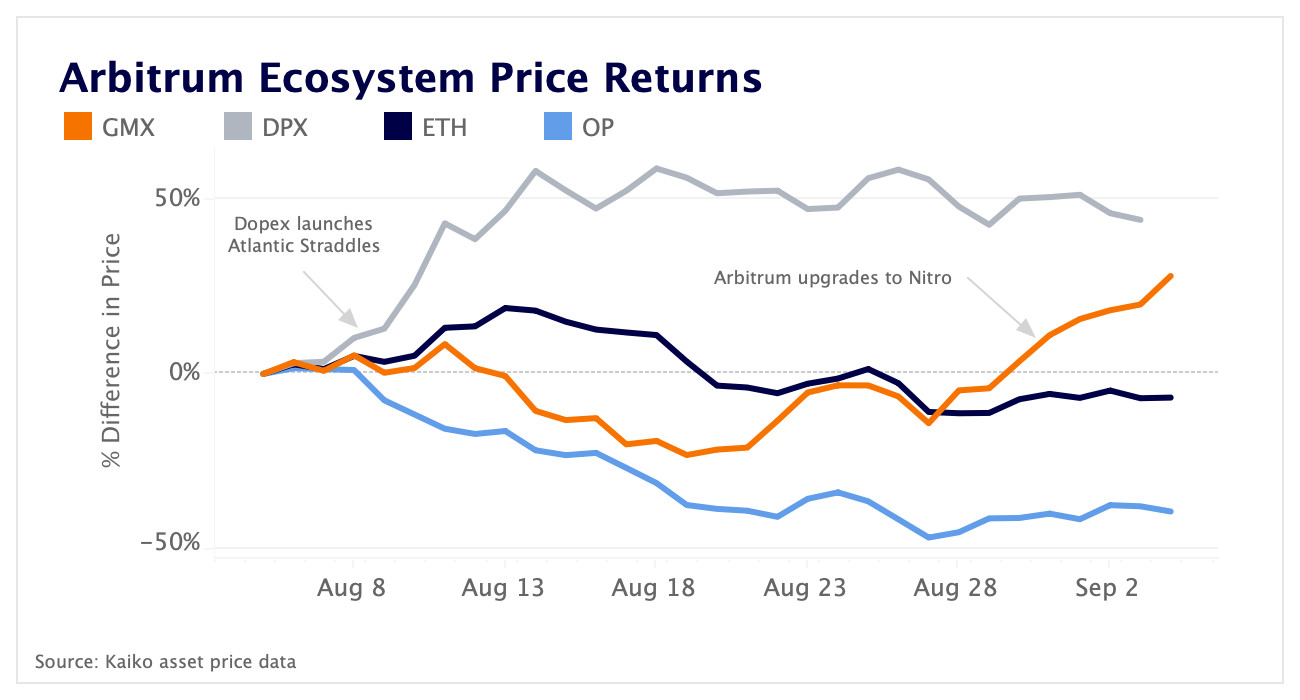
Top Arbitrum projects GMX and Dopex have significantly outperformed ETH and competitor Layer 2 network Optimism's OP token over the past month. Arbitrum does not yet have a token, and this has partly fueled an increase in TVL from $2bn in mid-July to $2.65bn now, under the assumption that the L2's current users could earn an airdropped Arbitrum token in the future.
Over this same time, open interest on GMX, a decentralized spot and perpetual futures exchange, tripled from $21mn to $64mn. Dopex, a decentralized options protocol, released Atlantic Straddles in early August, allowing users to bet on ETH volatility or write contracts and earn premium from those betting on volatility; straddle contracts sold out in 7 minutes. Arbitrum recently upgraded to Nitro on August 31, with Offchain Labs (developers of Arbitrum) touting a variety of improvements, including 7x to 10x higher throughput.
September slump affects crypto more than equities
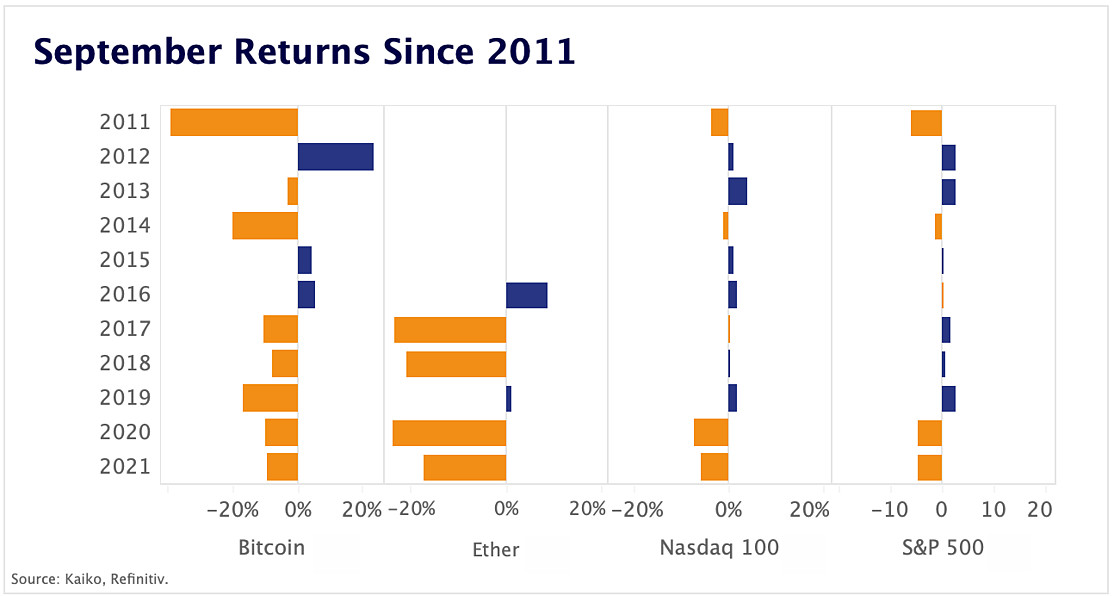
September is historically one of the weakest months of the year for equity markets. Explanations for the so-called “September effect” vary from increased spending needs after the summer holidays to tax selling and portfolio rebalancing ahead of the end of the fiscal year for mutual funds. The September slump transcends asset classes and appears to impact crypto markets even more with bitcoin and ether registering negative returns for most of their existence.
Despite asset valuations already trending significantly down this year, they remain under pressure as the Fed’s quantitative tightening hits full stride in September. However, if the Merge goes without problems this could provide some support for crypto assets, allowing them to decouple from macro headwinds.
BUSD's market share of stablecoin volume hits all time high
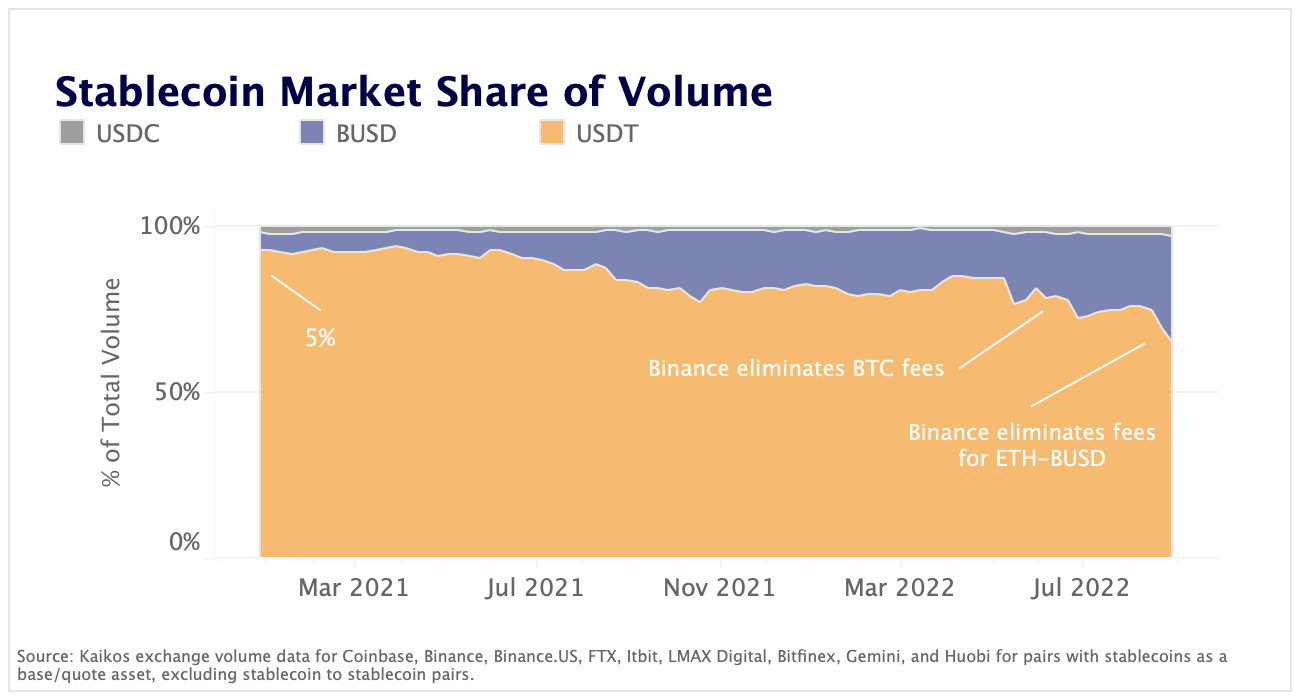
As covered previously in the Data Debrief, the effects of Binance’s elimination of trading fees for all BTC-stablecoin pairs in July was massive, leading to a significant increase in market share for the exchange. Binance followed this up on August 26 by eliminating trading fees for ETH, though notably only for the ETH-BUSD pair. BUSD’s market share grew from 5% in late 2020 to over 20% in October 2021, before stalling and losing ground in mid 2022.
The elimination of BTC trading fees temporarily grew BUSD’s market share. Eliminating trading fees for ETH-BUSD appears to be a concentrated effort to boost BUSD’s volume, especially ahead of the Merge when ETH volumes have been and will continue to be elevated. BUSD hit market share all-time highs of nearly 32% following the move. The next steps for Binance and BUSD will be interesting: will it attempt to encroach on USDC’s top spot in DeFi or will it continue to focus on USDT’s centralized exchange dominance? Given Binance’s success and growth, the answer may be both.




A look at ETH supply ahead of the Merge
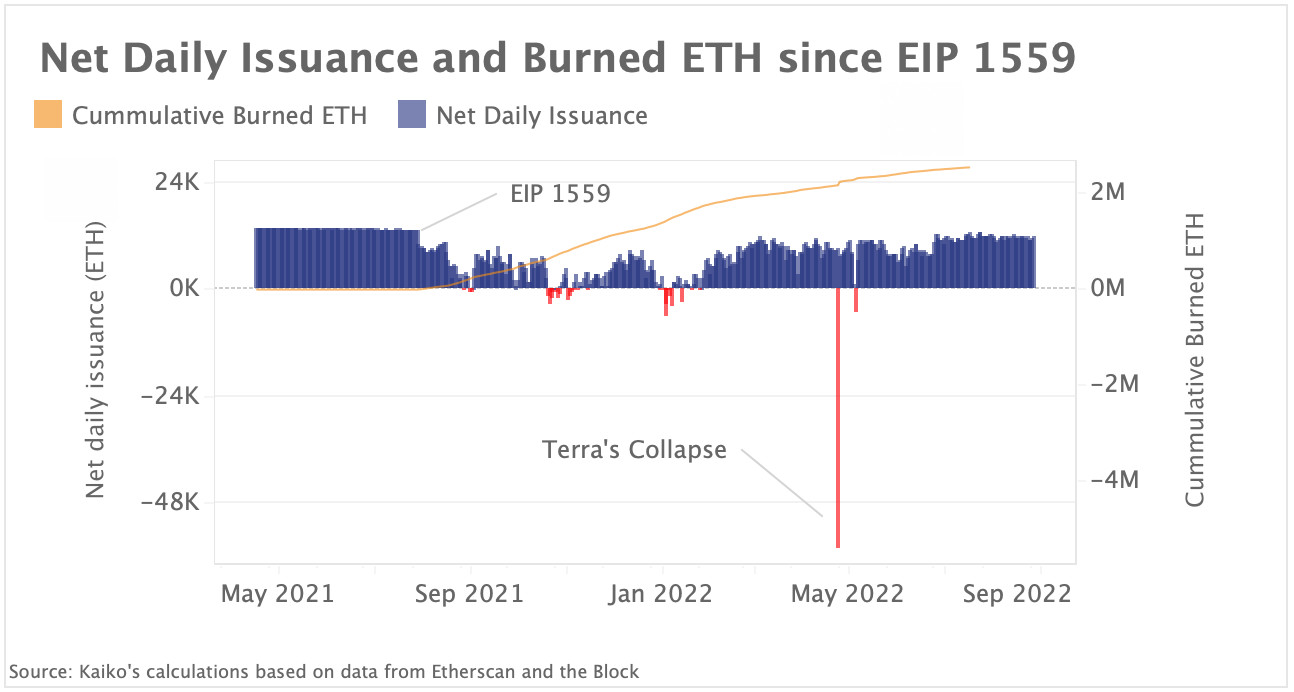
The upcoming Merge is expected to reduce Ethereum’s network energy footprint, change its security mechanism (from Proof-of-Work to Proof-of-Stake), and reduce issuance of ETH by eliminating mining rewards. ETH issuance will now depend on the amount of ETH staked on the consensus layer (the Beacon chain). At the current levels of staked ETH — around 11% of total supply — issuance is projected to decline by nearly 90%. Taking into account the fee burning mechanism introduced as part of the London hard fork (EIP-1559) a year ago, analysts expect ether to become a deflationary asset in the first few years after the Merge.
Overall, more than 2mn ETH have been burned since last year's EIP-1559 upgrade, while the net issuance has turned negative during short periods of strong market volatility or network activity. After the upgrade is completed in the second half of September, deflationary periods are set to become more frequent, potentially underpinning ETH’s market value.
ETH options turn more bullish post-Merge
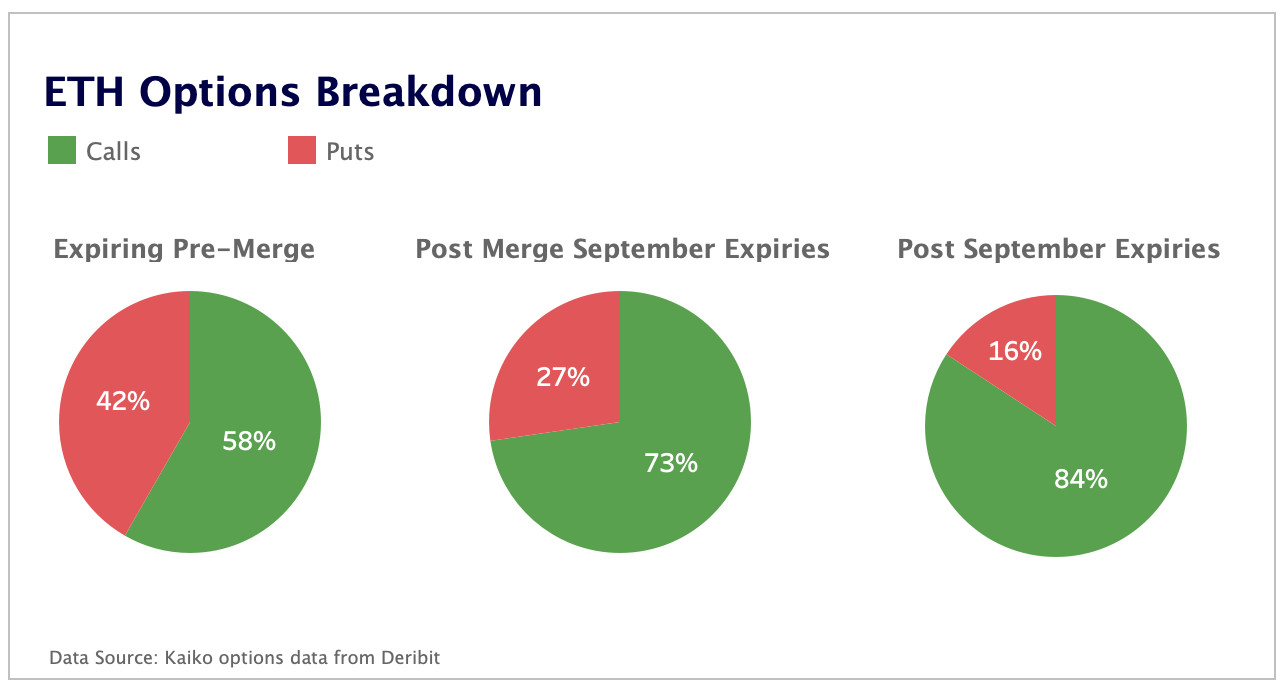
The apprehensiveness of investors ahead of the Merge is on show in options data, particularly when looking at the various expiries pre- and post-Merge. For pre-Merge expiries, investors seem to be far more anxious in anticipation of a potential delay or failure. 42% of options volumes pre-Merge are put options as ETH holders hedge their exposure heading into the Merge. This was the most bearish split of option volumes we observed across all expiries. Post-Merge however, investors become a lot more bullish and speculative on ETH, with call options commanding 73% of option volumes of September expiries after an expected Merge date of September 15. Post-September expiries are even more bullish for ETH, with call options dominating 86% of option volumes as investors seem to be optimistic about the long term future of the network using a proof of stake mechanism.
Eurozone inflation surges, fuelling ECB rate hike bets
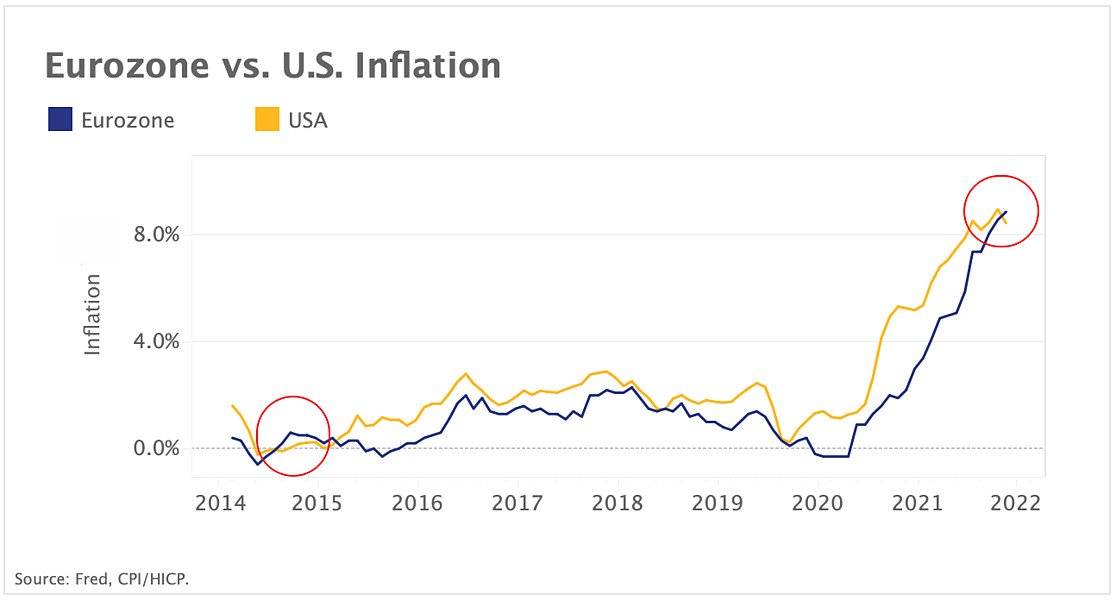
Eurozone inflation hit another record high in August, surging by 9.1% and exceeding U.S. inflation for the first time since 2015, boosted by rising energy and food costs. This has fuelled bets for a super-sized interest rate hike at the European Central Bank’s meeting this week. In July the ECB followed the U.S. Fed in raising interest rates, ending a nearly decade-long period of negative interest rates. However, Europe remains well behind the U.S. in increasing rates and the Fed-ECB rate differential coupled with stronger U.S. growth outlook have been among the main drivers of the Dollar over the past months.
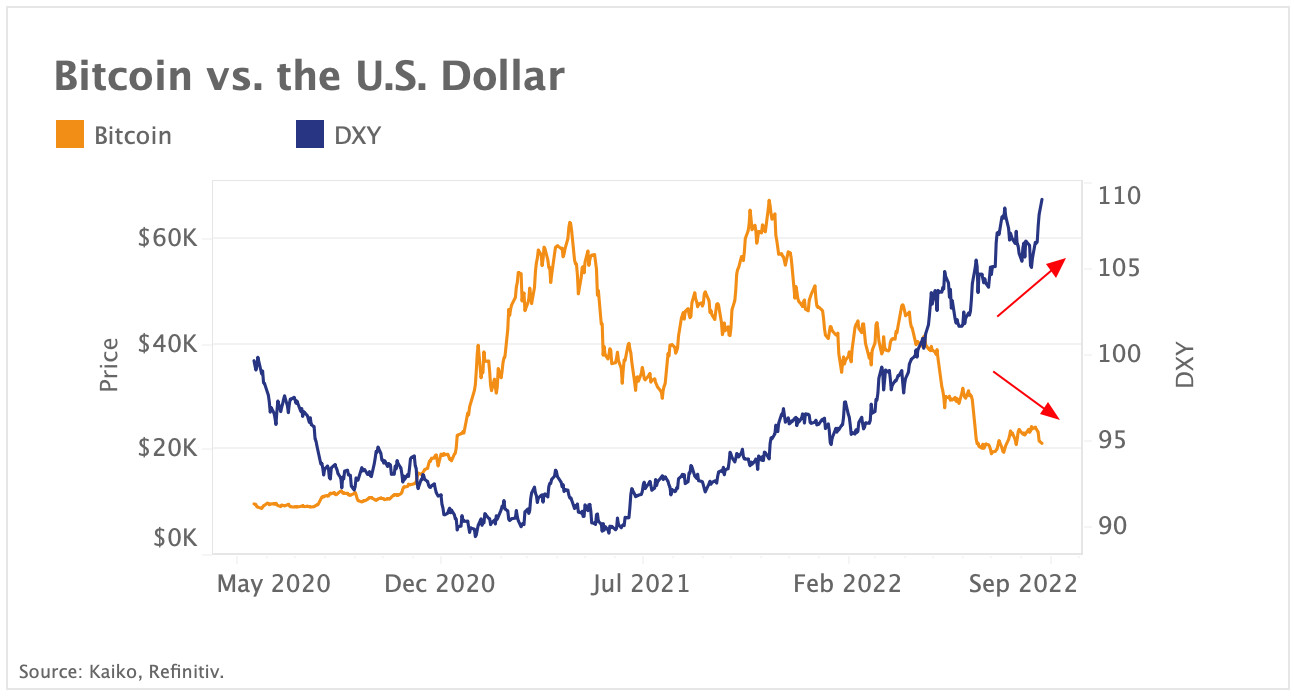
The U.S. Dollar Index (DXY) measuring the greenback’s performance against a basket of its main competitors, briefly pushed above the 110 mark early on Monday morning and is up over 12% YTD. Despite the prospect of a front-loaded ECB tightening, the Euro fell below $0.99 USD after Russia cut off key gas supplies through the Nord Stream pipeline, escalating Europe's energy crisis. Over the past 2 years bitcoin’s correlation with the DXY has been mostly negative and further strengthening of the DXY is likely to put some downward pressure on crypto markets and non-yield bearing assets.
BTC and Chinese stock correlation falls from record highs
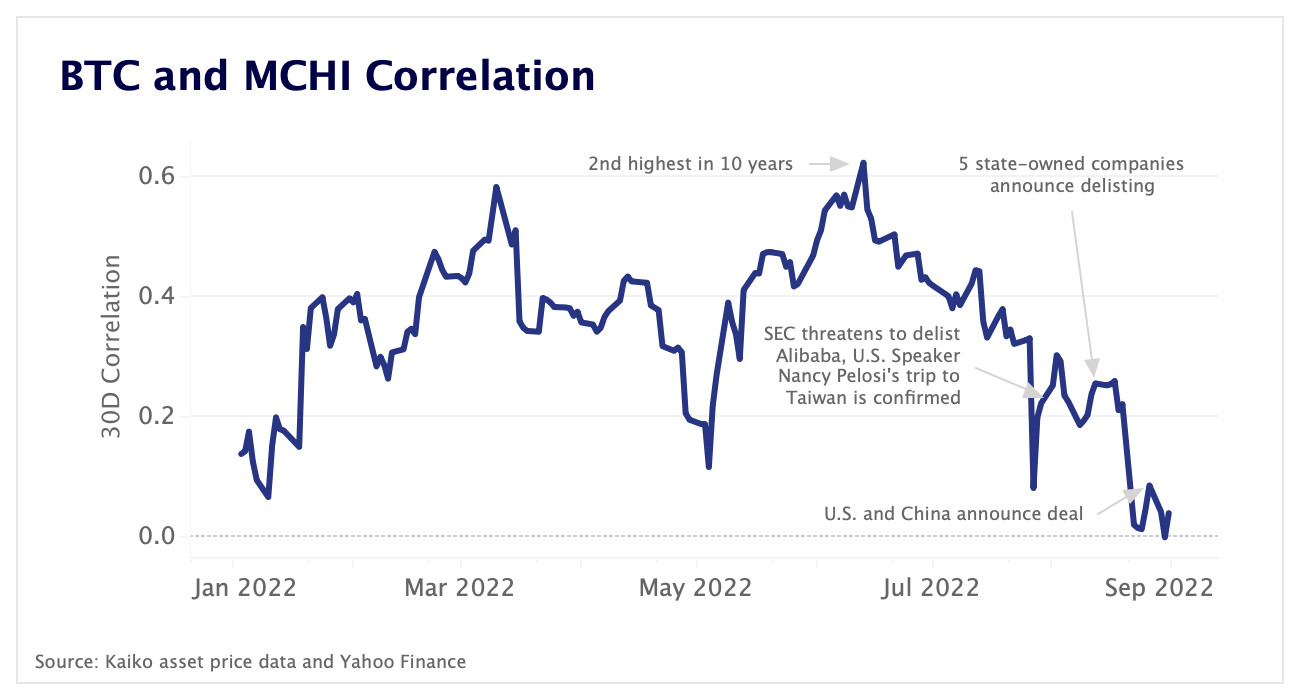
The correlation between bitcoin and the iShares China ETF (MCHI), whose top holdings are Tencent and Alibaba, has declined from its second highest level in ten years. The assets’ 30-day correlation peaked on March 10 and June 13, though they appear largely coincidental, as June’s peak came following the collapse of Terra and China increasing COVID-19 restrictions. U.S.-listed Chinese equities have been in the news frequently, as the two countries have had ongoing disagreements after the U.S. SEC finalized rules in December 2021 that allow it to delist companies that do not comply with audit requirements. Following the SEC including Alibaba on the list of companies at risk of delisting on July 29, the two sides reached an agreement on August 26, though SEC Chair Gary Gensler has cautioned that implementation is far from certain.